

It should come as no surprise that the spa business is embracing digital transformation in a time when technology is influencing every part of our life. With the introduction of cutting-edge technologies, spas are discovering new methods to improve their offerings and give their customers a seamless and customized experience. The spa experience is being digitized, which is transforming the way we unwind, revive, and take care of ourselves. This includes online reservations, virtual consultations, and smart devices.
Scheduling and booking appointments online: A convenient option
Online booking and scheduling is one of the primary areas where technology has had a huge impact. The days of calling the spa, waiting for confirmation, and navigating backed-up phone lines are long gone. You may now book your favorite treatments and appointments from the convenience of your home with just a few clicks. Spa websites and smartphone apps have streamlined the procedure and made it easier for you to select the date, time, and particular services you need. Some spas even provide real-time availability information so you can easily reserve your desired time window.
Personalization and smart devices: Improving the spa experience
Additionally, the integration of wearables and smart devices has increased the level of personalisation in the spa experience. These gadgets can monitor your stress levels, sleep habits, and vital signs, giving your spa therapist and you useful information. With this knowledge, spa professionals may create wellness plans and treatments that are customized to your unique requirements. For instance, the spa may suggest stress-relieving treatments or activities to help you relax and regain equilibrium if your device detects elevated levels of stress.
Virtual Advice: Professional Opinion from Anywhere
The computerized spa experience now includes virtual consultations as well. Clients can now communicate with spa staff via video conferences or online chats rather than physically visiting the facility for an initial inspection. This not only reduces travel time and costs, but also enables people to consult with specialists from around the globe. Virtual consultations make it possible to access professional information from the comfort of your own home, whether you're looking for beauty assistance, individualized workout plans, or dietary guidance.
Virtual and augmented reality: immersive escapes
The experience of visiting a spa has been elevated to a whole new level by the combination of augmented reality (AR) and virtual reality (VR) technologies. Imagine getting a massage or a facial while being transported to a tranquil beach or a verdant forest. Spas can build sensory-stimulating, immersive experiences with VR headsets that help customers escape reality and completely unwind. On the other side, AR can be applied to improve therapy visualization. Before making a purchase, customers, for instance, can view a 3D model of how a particular skincare product would behave on their skin.
Digital Wellness at Your Fingertips: Beyond the Spa
Additionally, digitization has made it possible for spa devotees to experience wellness outside of conventional physical settings. Online classes and workshops on subjects like meditation, yoga, and nutrition are becoming widely available at spas. These digital platforms offer convenience and accessibility, enabling people to practice self-care from any location in the world. These virtual experiences make sure that you may still put your well-being first, regardless of whether you are at home, on the road, or just unable to visit a physical spa.
Getting the Balance Right: Using Human Touch
Even though the digitization of the spa experience has many advantages, it's crucial to maintain a balance between technology and human interaction. The human interaction and individualized care offered by knowledgeable therapists are the core of a spa. Technology should complement and improve the experience rather than taking the place of people. Spas must therefore strike the ideal balance between modern technological advancements and age-old methods to give customers the best of both worlds.
The way we approach self-care and relaxation has changed as a result of the digitization of the spa experience. The spa sector has undergone a revolution, becoming more open, convenient, and individualized thanks to online reservations, smart devices, virtual consultations, and immersive technologies. Technology integration has improved client experiences while enabling spa personnel to offer customized wellness plans and treatments. The human touch should not be replaced by technology; rather, it should be used to enhance it. Spas can still provide a comprehensive and restorative experience in the digital age by finding the proper balance.
UPDATED LOFT THAI GUIDE
Additional guidance and current information
The following editorial update expands on the original Loft Thai article with practical context, current treatment guidance and further reading.
Digitise the Journey, Not the Guest
The original article described online booking, wearables, virtual consultations, VR, AR and digital classes as ways to make spas more convenient and personalised.
A service blueprint needs a different centre. It maps what the guest is trying to accomplish, what the front-line team needs to know and where information changes hands.
The aim is not to construct a larger profile of the guest. It is to make the agreed service easier to understand and deliver.
Discovery Should Resolve the First Questions
A current service page should explain the technique, duration, main stages, products or equipment, branch availability, price and general suitability boundaries.
Archived articles can educate, but they should be dated and linked to the operational menu. Social posts and search snippets should not become competing sources of truth.
For Loft Thai’s current journey, the menu and collection pages establish the present service; the blog adds context and comparison.
Booking Should Create One Reliable Record
The booking record should identify the treatment, branch, date, arrival time, duration, guest count, current price, payment status and accepted requests.
Whether the guest starts with Book, WhatsApp or LINE, the final confirmation should contain the same fields. An internal reference prevents the conversation from fragmenting.
When availability requires staff confirmation, say so explicitly. A submitted form is not the same as an accepted appointment.
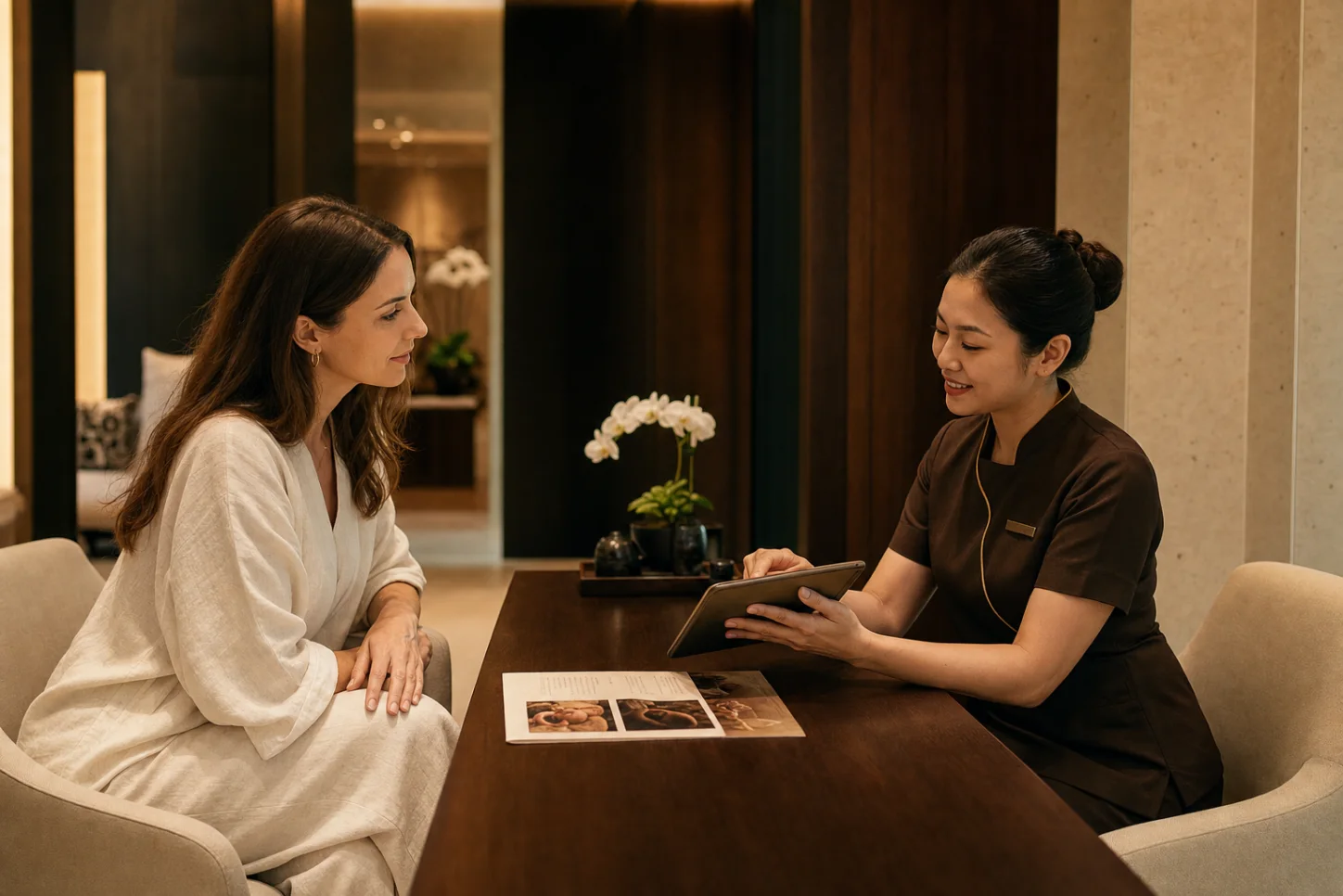
Accessible Forms Reduce Corrections
W3C guidance supports clear labels, short forms, grouped fields, instructions and useful error messages. WCAG 2.2 also addresses target size, redundant entry, accessible authentication and consistent help.
Those features reduce effort for keyboard and screen-reader users, travellers using translation tools and anyone booking on a small screen.
Avoid requesting the same contact and booking details again at payment or arrival unless verification is necessary.
Digital Pre-Consultation Must Remain Provisional
A guest may share pressure preference, areas to avoid, product sensitivities, accessibility needs or a reason for choosing the treatment before arrival.
The form cannot see movement, hesitation or changing comfort. A trained person must review relevant information and confirm the plan in the room.
Do not let an automated category quietly prescribe strong pressure, heat, exfoliation or device settings.
Design the Reception-to-Therapist Handoff
The therapist needs a concise, relevant service brief—not the guest’s entire marketing history. Reception needs to know whether an adaptation was accepted and who owns any unresolved question.
Use role-based access and plain status language. A sensitive note should not be copied into a general chat group or printed where unrelated staff can see it.
At the start of treatment, the therapist should confirm the plan directly with the guest rather than treating the record as unquestionable.
Keep In-Room Technology Subordinate to Consent
A room may include lighting, music, water, temperature, suction, a connected chair or another adjustable system. The settings should follow the selected protocol and guest feedback.
Explain the function before use, give the guest a way to pause or stop and record only what is genuinely needed for continuity.
A system that remembers a setting can be convenient. It should not override a fresh consultation or assume that yesterday’s preference remains suitable.
Separate Service Records From Card Data
The booking needs payment status and a transaction reference, not full card details stored in a spa note.
PCI Security Standards Council guidance treats e-commerce security as an end-to-end responsibility. Guests should use an appropriate payment page and should never be asked to send a full card number, security code or card image in ordinary chat.
Before payment, show the exact treatment or voucher, amount, currency, branch conditions, cancellation terms and refund position.
Give Every Field a Purpose and Retention Rule
Thailand’s Personal Data Protection Act creates obligations around the collection, use and disclosure of personal data and gives heightened attention to sensitive information such as health data.
Map which fields are required for service, safety, accounting, support or marketing. Separate those purposes rather than relying on one broad consent box.
Define who can view the record, how corrections happen, when it is deleted and what the spa can export if a vendor relationship ends.
Digitise Service Recovery With an Owner
A cancellation, delay, payment dispute, accessibility problem or treatment concern should create a clear case with an owner and next action.
Automation can acknowledge receipt and collect the booking reference. A person should take over when judgment, privacy or fairness is involved.
Close the loop by documenting the resolution and the process change, not by sending repeated satisfaction requests.
A Human Route Is Part of the Architecture
Some guests cannot or do not wish to use an app, online account, QR code or digital payment path. Others need language, mobility, sensory or communication support.
A telephone, message or reception-assisted option should produce the same quality of confirmation as the self-service route.
Redundancy is not inefficiency when it protects access and continuity during outages.

Train Staff to Recognise the System’s Limits
Reception and therapists need to know which source is current, which fields are sensitive, how to correct a record and when to escalate.
Training should cover phishing, account access, payment boundaries, device hygiene, respectful consent and the procedure for a system outage.
Staff should never have to choose between following a screen and responding appropriately to the guest in front of them.
Measure Continuity, Not Digital Activity
The number of form submissions, messages or automated recommendations does not reveal whether the service improved.
Track confirmation completeness, correction rate, duplicate entry, unresolved handoffs, accessible completion, payment issues, guest effort and recovery quality.
Pair those measures with staff observation. A lower reception time may simply mean that therapists now carry hidden administrative work.
A Twelve-Stage Spa Digitisation Blueprint
Review the complete sequence before buying another platform or device.
-
01
Set the current source
Identify the live menu, price, branch and policy records.
-
02
Map guest goals
Describe what people need to understand or complete at each stage.
-
03
Map staff actions
Show ownership, decisions and handoffs behind the interface.
-
04
Minimise fields
Remove data that does not support service, safety or a defined obligation.
-
05
Design accessible input
Use labels, instructions, visible focus, adequate targets and useful errors.
-
06
Define booking status
Separate submitted requests, accepted appointments and payment state.
-
07
Create the treatment brief
Give the therapist only relevant, current and reviewable information.
-
08
Protect payment
Keep card data out of general messages and spa notes.
-
09
Keep human help
Provide an equivalent assisted route and escalation path.
-
10
Test exceptions
Cover changes, delays, refunds, complaints, accessibility and outages.
-
11
Train and rehearse
Teach correction, privacy, security, consent and fallback procedures.
-
12
Measure continuity
Review errors, effort, handoff quality and the real workload.
Claims Removed from the Previous Version
The previous article claimed wearables could detect stress and determine treatments, virtual consultations could deliver global professional advice, and VR or AR could create deep relaxation or preview how skincare would behave.
It did not distinguish spa guidance from medical, fitness or dietary advice and did not establish that the described systems were available at Loft Thai.
The new version keeps digitisation grounded in a service blueprint that can be tested against real guest and staff outcomes.
Hospitality Is the Continuity Layer
A well-digitised spa makes accurate information easier to carry across channels without making the interaction feel mechanical.
The guest arrives with fewer unanswered questions, the therapist receives a useful brief and the team knows how to respond when reality diverges from the workflow.
Use digital systems to preserve context. Keep human attention responsible for the experience.
“The best digital handoff preserves context for the team while allowing the guest to remain a person, not a record.”
Loft Thai Editorial Team
Continue your research
REFERENCES
Sources & further reading
- W3C Web Accessibility Initiative: Accessible Forms Tutorial
- W3C: What Is New in WCAG 2.2
- Thailand ETDA: English Translation of the Personal Data Protection Act
- PCI Security Standards Council: Best Practices for Securing E-Commerce
- NIST: Cybersecurity Framework 2.0
- Loft Thai: Current Online Booking Page
- Loft Thai: Current Spa Menu 2026
PRACTICAL GUIDANCE
Frequently Asked Questions
What does digitising a spa experience mean?
It means designing connected digital support for discovery, booking, consultation, service delivery, payment and follow-up while preserving human review and assisted access.
Should a spa consultation be fully digital?
No. Pre-arrival information can prepare the visit, but a trained person should confirm relevant details and allow the guest to adapt or stop the treatment.
What belongs in a digital spa booking record?
The treatment, branch, date, arrival time, duration, guest count, price, payment status, accepted requests and only the relevant information needed for service or safety.
How can a spa protect guest payment information?
Use an appropriate payment environment, retain only necessary transaction references and never request full card details or security codes through ordinary chat.
Why keep a non-digital booking route?
Human-assisted booking supports accessibility, language needs, guest choice and continuity during outages or difficult cases.
CONTINUE READING
Related stories
Customer Engagement Elevated: Embracing Digitalization
Customer involvement has evolved into a crucial aspect in determining a company's success in today's quickly changing business environment. Organizations now have unparalleled potential to connect with and engage with their customers in valuable and…
Read the guide
Seamless Digital Spa Experiences
It is not surprising that even the traditional idea of spa experiences is undergoing a digital revolution in today's fast-paced world where technology affects nearly every area of our lives. The idea of seamless digital spa experiences was created as a result…
Read the guide
Embracing Digital Innovation in Spas
Digital innovation has impacted practically every area of our lives in the fast-paced, technologically-driven world of today. We are always connected and looking for ways to improve and optimize our daily experiences, from smartphones to smart homes. The…
Read the guide
A New Era of Thai Massage Mastery: Loft Thai Spa x OSIM
In the world of wellness, true innovation rarely happens by accident. It emerges when heritage meets vision, when mastery encounters technology, and when two leaders decide not merely to collaborate—but to redefine an entire category. This is precisely the…
Read the guide