
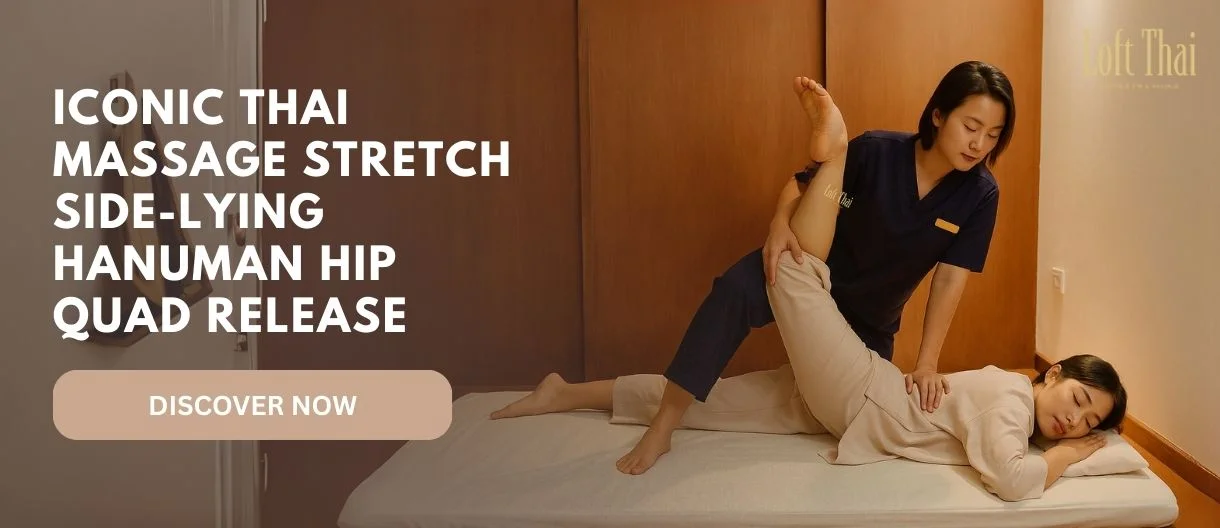
An In-Depth Exploration of a Classic Thai Massage Stretch.Thai massage, or Nuad Thai, weaves together Ayurvedic medicine, Theravada Buddhist mindfulness, and indigenous Thai acupressure traditions. Stretching—Laksana Tok Sen Phong—was historically a way for temple novices to prepare the body for long hours of sitting meditation. The Hanuman Release belongs to a family of side-lying mobilisations codified at Wat Po in the nineteenth century, yet its root imagery is older.
In the Ramakien, Hanuman is depicted leaping across oceans and shape-shifting to rescue allies; his heroic hip extension symbolises expansive compassion. Legend holds that itinerant mor nuad replicated the monkey-god’s archetypal leap by drawing a student’s leg behind the torso until the front of the thigh “laughed open like a lotus.” Practitioners today still invoke Hanuman’s name to cue the playful quality of the stretch.
Structural Anatomy—What Happens Beneath the Surface
Osseous articulation: The technique simultaneously explores two joints: the femoroacetabular joint glides into extension and slight external rotation, while the tibiofemoral joint flexes toward full approximation of the calf against the hamstrings. The pelvis tilts posteriorly, encouraging gentle decompression of the lumbosacral junction.
Myofascial continuum: The prime targets include the rectus femoris—unique among the quadriceps for its origin on the anterior inferior iliac spine—plus the iliopsoas, sartorius, and tensor fasciae latae. As the hip extends, fascial tension radiates along the superficial front line (per Thomas Myers’ Anatomy Trains) through the abdominal wall into the sternum. Meanwhile, the therapist’s stabilising hand on the sacrum lengthens the superficial back line, allowing the erector-spinae group and thoracolumbar fascia to breathe.
Neurovascular considerations: The femoral nerve, artery and vein traverse beneath the inguinal ligament; excessive compressive force could entrap these structures, so the practitioner must modulate pressure carefully. Gentle neural mobilisation often accompanies the stretch, evident in a diffuse warmth or tingling along the anterior thigh.
Energetic overlay: Classical Thai medicine maps ten major Sen lines; this manoeuvre chiefly stimulates Sen Kalathari (running along rectus femoris), Sen Sahatsarangsi (paralleling the iliopsoas) and indirectly Sen Ittha through the lower back. Conscious breathing directed into these lines is believed to disperse lom (wind) stagnation, fostering vitality.
Step-by-Step Methodology
All directions assume a right-leg stretch with the client lying on the left side. Reverse for the opposite leg.
-
Set-up and contact
-
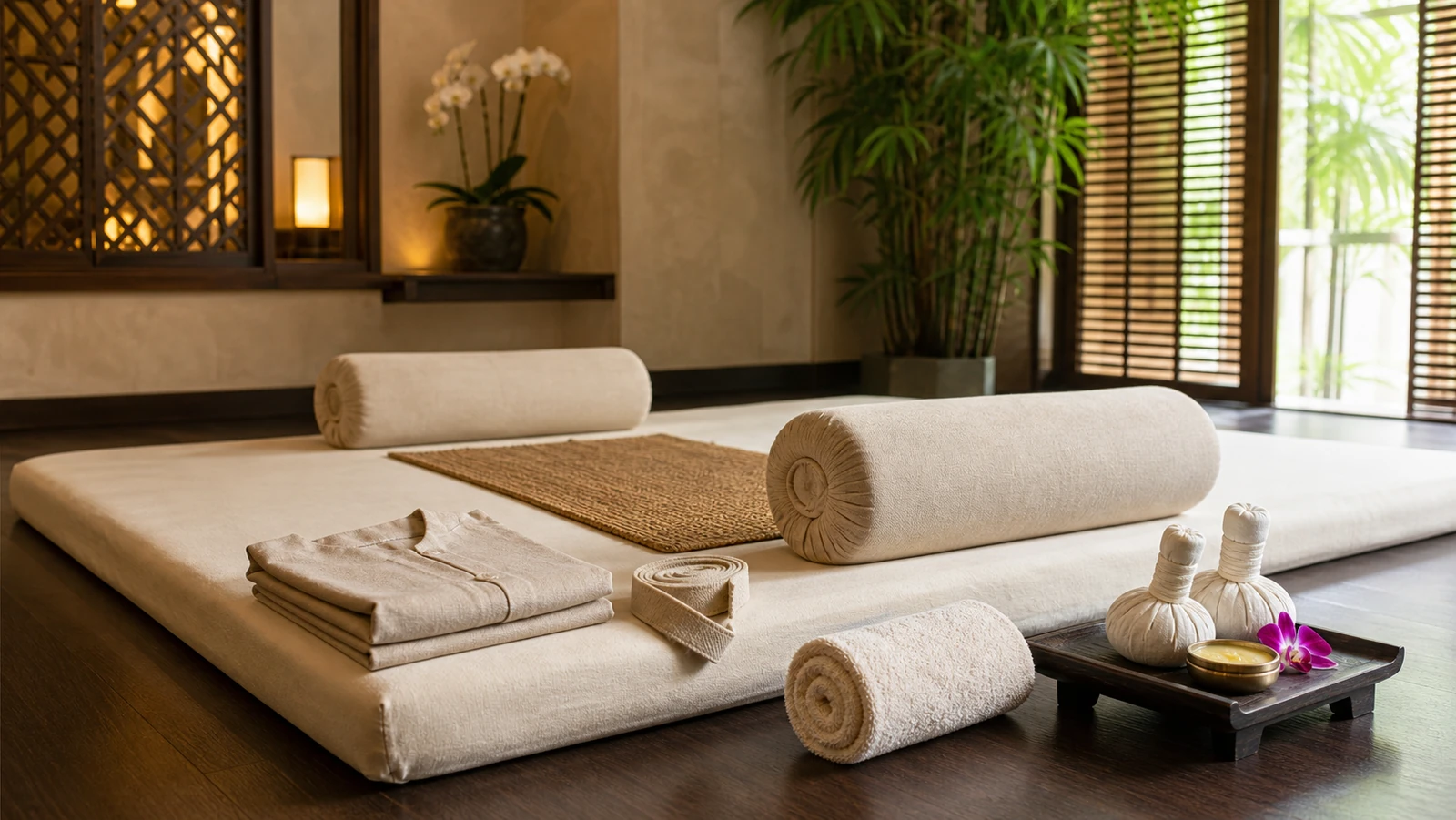
Place a folded futon or firm mattress on the floor to honour Thai tradition and maximise therapist leverage.
-
Position the client in lateral decubitus: knees stacked, spine neutral, lower arm extended overhead or bent with a pillow.
-
Kneel in a lunge stance behind the client, right knee on the mat, left foot forward for balance.
-
-
Cradle the leg
-
Slide the right forearm under the client’s distal thigh. Allow their calf to rest naturally against your forearm as though cradling a sleeping infant.
-
Lift until the client’s foot hovers roughly hip height, knee bending toward 90–110 degrees.
-
-
Anchor the sacrum
-
Place the left palm (soft, broad contact) on the posterior superior iliac spine or upper gluteal region. This prevents pelvic rotation and protects the lumbar spine.
-
-
Phase-in of extension
-
Inhale together; on the exhale shift your body weight forward, guiding the femur into extension. Your torso should remain upright—avoid pulling with the arms; instead, lean subtly so gravity and your body mass do the work.
-
Sense for the first barrier: the moment tissues declare a gentle resistance. Pause, breathe, invite the client to exhale fully.
-
-
Fine-tuning
-
Micro-rock in 5–10 mm pulses if additional yield is available. The rocking mimics the oceanic rhythm of samadhi breath and keeps the Golgi tendon organs receptive.
-
Optional: encourage the client to engage rectus femoris isometrically for five seconds (actively pressing foot toward buttock) then relax, utilising post-isometric relaxation to gain range.
-
-
Release and closure
-
Guide the leg forward slowly—never let it flop. Circle the hip a few times in flexion-abduction-adduction to flush metabolites.
-
Repeat on the opposite side to balance fascial load.
-
Each sequence usually lasts 45–60 seconds; advanced practitioners may explore longer holds up to 90 seconds, provided the client remains comfortable.
Therapist Body Mechanics—Hidden Keys to Effortless Delivery
A skilled Thai-massage practitioner appears almost motionless, yet the interior of their body is alive with directed force vectors. While executing the Hanuman Release, maintain a long neutral spine and imagine breath flowing down the Sen Sumana (central channel). The kneeling leg grounds energy; the forward leg modulates pressure. Elbows track close to the ribs, allowing the scapula to seat onto the back. When performed correctly, minimal muscular effort is felt in the arms; instead, the stretch is powered by subtle pelvic tilt. Over decades this economy of movement protects the therapist from occupational injuries.
Therapeutic Applications and Benefits

Postural re-balancing and hip health: Modern life abounds with chairs and shortened front-body lines. Prolonged hip flexion can generate anterior pelvic tilt, inhibited gluteals, and lumbar lordotic strain. By lengthening rectus femoris and iliopsoas to their end range, the Hanuman Release permits the pelvis to neutralise. Clients often stand taller and report a “lightness” across the groin within minutes.
Lumbar spine decompression: As the hip extends, fascial traction translates along the psoas into the anterior lumbar vertebral bodies, subtly unloading facet joints. Clients suffering from nonspecific low-back ache or “office syndrome” frequently describe immediate relief.
Knee mobility and patellofemoral tracking: Quadriceps length influences patellar alignment. Targeted stretch of rectus femoris improves patellar glide and may reduce anterior knee pain associated with tight quads.
Circulatory and lymphatic stimulation: Folding the knee compresses the popliteal fossa then releases it like a pump, encouraging venous return from the lower limb.
Energetic uplift and emotional release: In Thai medicine, stagnation along Sen Kalathari can manifest as lethargy or lack of passion. Students sometimes experience spontaneous emotional buoyancy or creative insight following the stretch—Hanuman’s playful spirit at work.
Preparation for deeper back-bending postures: Yogic practitioners find that executing this stretch bilaterally primes tissues for asanas like Ustrasana (Camel) or Natarajasana (Lord of the Dance).
Storytelling and Cultural Resonance
Why name the stretch after Hanuman? In murals adorning Bangkok’s Emerald Temple, Hanuman flies with one leg extended behind him, chest thrust forward, carrying a mountain of medicinal herbs to save Prince Lakshmana. Thai massage, born in temple courtyards, absorbed these visual cues. Teachers would ask novices to emulate the monkey-god’s courage by opening their own hips first; only then were they permitted to stretch others. When a therapist performs the release today, they enact a tiny echo of that mythic leap—invoking not only muscle elongation but heroic compassion (metta). Clients often appreciate when practitioners share this story; it invests the sensation with meaning beyond biomechanics.
Clinical Cautions and Contraindications
Any powerful technique demands discernment. Although injuries are rare when mindfulness prevails, awareness of red flags preserves client safety.
Knee pathologies: Meniscal tears, patellofemoral syndrome, recent ligament repairs, or osteoarthritis may flare if the knee is forced beyond comfortable flexion. If discomfort arises anterior to the patella, modify angle or abort.
Hip replacements or severe osteoarthritis: Artificial acetabular components can dislocate under extreme extension combined with external rotation. Obtain medical clearance.
Femoral neuropathy or vascular grafts: Direct traction may irritate neurovascular structures; adapt to a less intense stretch or skip entirely.
Pregnancy (second and third trimester): Supine or side-lying hip extension is generally safe, but the maternal ligamentous laxity of relaxin can exaggerate range; be conservative.
Acute low-back disc pathology: Although light traction can soothe, excessive hip extension might increase anterior shear on the lumbar spine; employ gentle oscillation instead of sustained hold.
Ehlers-Danlos and other hypermobility syndromes: These clients lack proprioceptive end-range signalling; respect a narrower safety buffer.
A golden rule in Thai massage is mai jeb mai keng—“if it hurts, it’s wrong.” Communication trumps protocol.
Progressive Variations and Adaptations
Beginners may introduce a support bolter beneath the client’s thigh, lifting passively without therapist strain. Intermediate practitioners refine leverage by placing their own knee under the client’s thigh, freeing both hands to stabilise pelvis and ankle. Advanced therapists sometimes rotate the client’s torso forward into a mild spinal twist while maintaining hip extension, globally hydrating fascial spirals. One can also thread the client’s foot into the crook of the therapist’s elbow, permitting a gentle traction of the tibial nerve. Creativity is encouraged, yet always within the container of breath synchronicity and mindful listening.
Integrating the Hanuman Release into a Session Flow
Traditional two-hour northern-style sequences organise bodywork in side-lying midway through the treatment, after the prone leg lines and before supine integration. Performing the Hanuman Release at that juncture leverages already-warmed tissues, augments pelvic mobility for subsequent abdominal work, and offers a pleasant change of orientation that refreshes client awareness. In modern spa settings, therapists often isolate the stretch within shorter 60-minute combos—paired perhaps with foot reflexology—to target “office syndrome” clientele seeking hip relief. Remember that the release is bilateral; concluding with rhythmic percussion (khob khruen) along the thigh seals the energetic circuit.
Case Illustration—From Desk Jockey to Hanuman
Consider “Nina,” a 32-year-old graphic designer who presents with anterior hip tightness and mild low-back discomfort after ten-hour computer days. Palpation reveals hypertonic rectus femoris and iliopsoas; forward head posture accompanies an exaggerated lumbar lordosis. After warming the leg lines with palm pressure, the therapist employs the Hanuman Release. Nina initially reaches her barrier at 30 degrees hip extension; after two breath cycles and gentle rocking, the range increases to 45 degrees without pain. Post-session, Nina notes smoother stride when walking downstairs and a lighter lumbar area. She returns weekly for a month; her active hip extension measured prone improves from 5 degrees (tight) to 15 degrees (normal), corroborating subjective gains.
Teaching Points for Students and Self-Practitioners
Apprentices sometimes tug the foot too close to the buttocks, shifting emphasis to knee flexion over hip extension. The essence of the Hanuman Release is in opening the hip front, not cranking the knee. Visualise Hanuman’s leap: the leg arcs behind the torso, chest proud. Another pitfall is letting the client’s pelvis roll backward, nullifying stretch. A firm yet yielding anchor hand keeps the sacrum steady. Encourage students to rehearse on peers, cultivating kinaesthetic empathy—listen with your hands.
For self-care, one may mimic the stretch using a strap in a prone quad stretch or practice Half-Frog pose (Ardha Bhekasana) in yoga. While these versions omit the energetic dialogue of therapist and receiver, they still bestow meaningful tissue lengthening when performed mindfully.
Small Technique, Grand Outcomes
The Side-Lying Hanuman Hip-Quad Release reminds us that mastery in Thai massage does not stem from an encyclopedic list of maneuvers but from embodying the spirit of each one. A practitioner attuned to their own breath, grounded through knees and hips, and guided by compassionate curiosity can, in half a minute, restore hip glide, relieve lumbar tension, and rekindle a client’s zest for movement. In our sedentary epoch, such a release is more than a manual stretch—it is a call to heroic openness, an invitation to leap like Hanuman across the gulf that separates stiffness from supple vitality.
Approach the technique with reverence, patience and playful heart, and it will serve you for a lifetime of practice. May every extension of the client’s leg echo the mythic leap, may every exhale dissolve another thread of tightness, and may both giver and receiver emerge lighter, taller, and more alive.
UPDATED LOFT THAI GUIDE
Additional guidance and current information
The following editorial update expands on the original Loft Thai article with practical context, current treatment guidance and further reading.
What the Side-Lying Mobilisation Actually Does
The upper hip moves toward extension while the knee bends. The therapist may cradle the thigh or lower leg and use the other hand to monitor the pelvis, upper gluteal region or lower back.
The movement can create a stretch across the front of the thigh and hip. It may also be felt elsewhere because individual hip structure, knee tolerance, previous injury and pelvic position change the sensation.
“Hanuman” Is an Evocative Name, Not a Standardised Diagnosis
Hanuman is a central figure in the Ramakien, Thailand’s version of the Ramayana tradition, and his dynamic movement makes him a powerful image for some Thai massage schools.
This editorial review did not establish a primary Wat Pho or nineteenth-century record that universally codifies this exact mobilisation under the name “Hanuman Hip-Quad Release.” The cultural metaphor can be acknowledged without inventing a precise lineage.
Hip Extension and Knee Flexion Change the Anterior Thigh
Rectus femoris crosses both the hip and knee: it contributes to hip flexion and knee extension. Combining hip extension with knee flexion can therefore lengthen it across both joints more than bending the knee alone.
The iliopsoas contributes strongly to hip flexion, while sartorius and other anterior and lateral structures respond differently according to hip rotation and abduction. A therapist should not claim to isolate one muscle from touch alone.
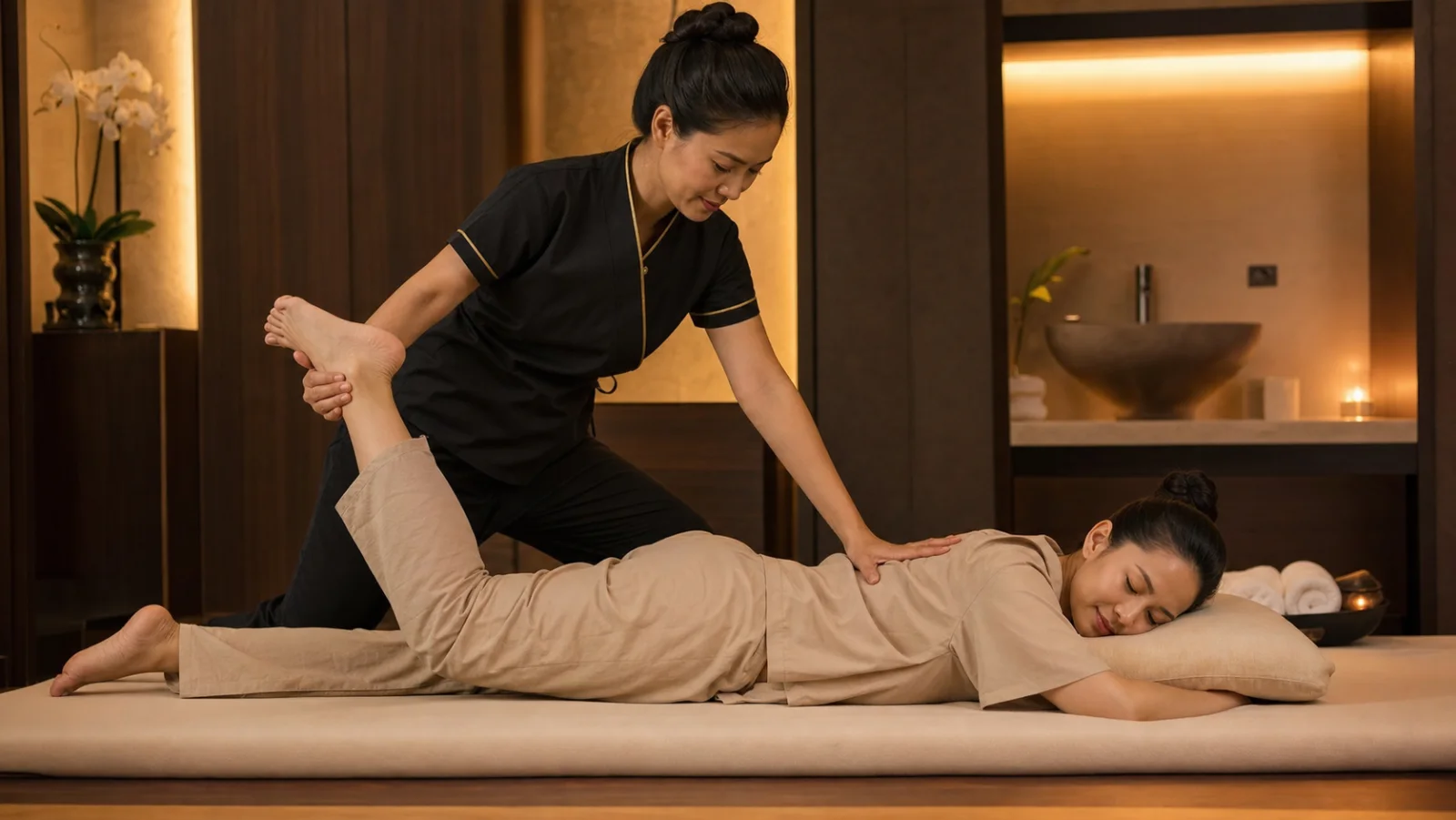
A Stable Setup Comes Before Range
The guest lies comfortably on one side with the head supported and the lower hip and knee arranged for balance. A cushion between or beneath the legs can reduce pressure on the lower hip and knee.
The therapist positions close enough to support the upper leg without pulling from the arms. The movement should begin from a small range so the guest can identify the first stretch sensation.
Pelvic Monitoring Prevents a False Sense of Hip Range
As the upper leg moves behind the torso, the pelvis may roll backward or the lower back may arch. That creates the appearance of more hip extension without necessarily increasing movement at the hip joint.
A broad monitoring hand is not used to pin the pelvis aggressively. It gives the therapist feedback so the movement can stop before compensation becomes the main event.
Knee Flexion Must Remain Individually Comfortable
The knee is not a handle for forcing the hip. Previous ligament injury, meniscus symptoms, arthritis, swelling or pain around the kneecap may limit how far it can bend.
Support can be moved closer to the thigh, the knee can remain less flexed, or the entire technique can be replaced. Heel-to-buttock contact is not a quality target.
Use Breath as Feedback, Not as a Command
A slow exhalation may help the guest notice whether they are bracing. The therapist can pause at a comfortable first resistance rather than bouncing through it.
Breath does not prove that tissue has released, and a guest should never be told to breathe through sharp pain. The useful signal is whether the movement remains calm and controllable.
Stretching Can Change Range of Motion Without “Realigning” the Body
A 2023 systematic review with meta-analysis found that several stretching techniques can produce acute increases in joint range of motion. Another review found that higher-intensity static stretching sometimes produced larger range changes, but evidence was not sufficient to make pain the required target.
Short-term range does not show that the pelvis, gait or spine has been permanently corrected. It may reflect changes in stretch tolerance, muscle-tendon behaviour and measurement context.
Tingling Is a Stop Signal, Not “Energy Moving”
The femoral nerve and major vessels pass through the front of the hip region. A diffuse muscular stretch can be normal; burning, electrical sensation, numbness, unusual weakness or persistent tingling is not a goal.
The therapist should release the position and reassess. New neurological symptoms, significant groin pain or loss of strength requires appropriate clinical evaluation.
When the Technique Should Be Modified or Omitted
Recent hip or knee surgery, acute injury, fracture risk, joint replacement restrictions, severe arthritis flare, suspected clot, unexplained swelling and neurological symptoms require medical guidance.
Pregnancy, hypermobility, osteoporosis and a history of dislocation do not produce one universal rule, but they materially change positioning and range. A spa practitioner must remain within training and referral boundaries.
Do Not Recreate the Full Leverage With an Untrained Partner
A professional therapist uses body position, tactile feedback and an immediate release path. An untrained partner may pull the ankle, overlook pelvic rotation or continue after the guest braces.
For home mobility, choose an active or self-controlled quadriceps stretch prescribed for your circumstances. The person being stretched should remain able to reduce the range without depending on someone else’s reaction.
Precision Makes the Shape Meaningful
The side-lying hip-and-quadriceps stretch is most credible when described as an adjustable assisted mobilisation, not a mythic shortcut to posture correction or complete fascial release.
Stable support, small initial range, pelvic monitoring, knee respect and immediate response to tingling matter more than the name or final photograph.
“The goal is not to make the leg travel farther; it is to keep the movement clear, supported and free of defensive tension.”
Loft Thai Editorial Team
Continue your research
REFERENCES
Sources & further reading
PRACTICAL GUIDANCE
Frequently Asked Questions
Is the Hanuman stretch an official universal Thai massage name?
Some schools use the name, but this review did not establish it as a universal historical label for one standardised mobilisation.
Where should I feel the side-lying stretch?
A comfortable stretch may be felt across the front of the upper thigh or hip. Sharp knee or groin pain, burning, numbness or tingling is a reason to stop.
Should the therapist press the heel to the buttock?
No fixed endpoint is required. Knee flexion and hip extension should be limited by comfort, health history and controlled movement.
Does this stretch correct pelvic alignment?
Evidence supports possible short-term range-of-motion change from stretching, not permanent realignment of the pelvis, spine or gait from one manoeuvre.
Can I request the stretch during Thai massage?
You can ask, but the therapist should decide whether it suits your current hip, knee and health history. A safer alternative may be used.
CONTINUE READING
Related stories
Hot Stone Massage: A Journey of Warmth, Healing, and Tranquility
Hot stone massage is one of the most beloved spa treatments worldwide, offering a profound sense of relaxation while simultaneously easing tension, improving circulation, and enhancing overall well-being.
Read the guide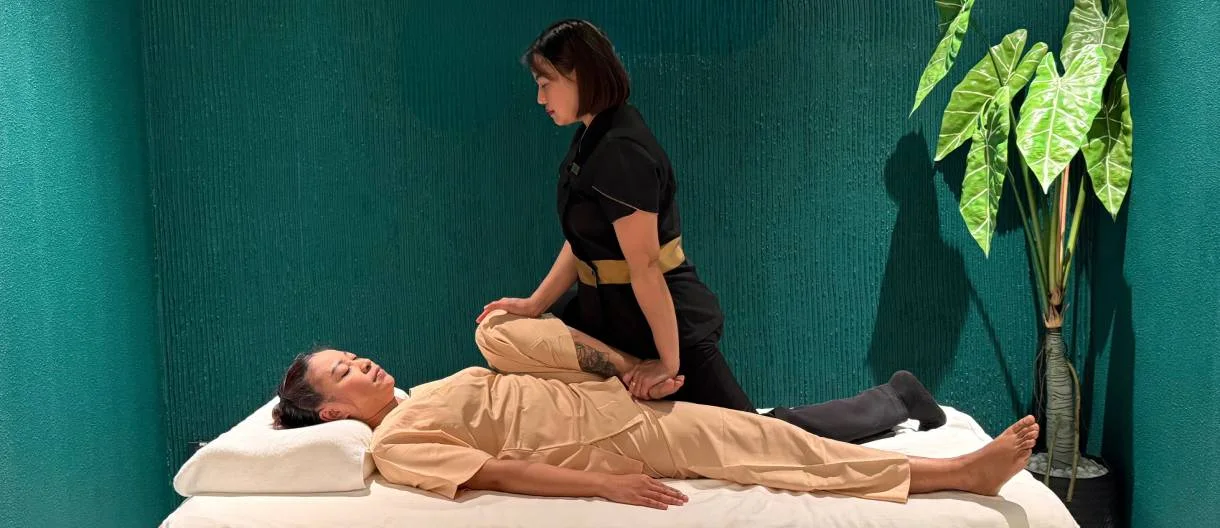
Unlocking the Secrets of Thai Massage in Bangkok
At Loft Thai Spa, massage is more than a wellness service — it is an art form rooted in ancient tradition, guided by anatomical science, and delivered with championship-level precision. In our latest showcase video, we invite you to discover the heart of what…
Read the guide
The History and Heritage of Thai Massage
Exploring its Roots in Ayurvedic Medicine, Buddhist Traditions, and the Healing Legacy of Jivaka Kumar Bhaccha
Read the guide
Best Thai Massage Thailand: The Loft Thai Story
Inside a Loft Thai treatment room, the first language is rhythm. A therapist settles her stance, listens to the guest’s breathing and lets pressure build without hurry. Hands pause before they move again; every stretch is supported, every change of position…
Read the guide