Exploring its Roots in Ayurvedic Medicine, Buddhist Traditions, and the Healing Legacy of Jivaka Kumar Bhaccha
A Living Art of Healing
In the tranquil rooms of a luxury spa, where soft music drifts through the air and aromatic oils infuse serenity, every massage given is more than a service—it is a ritual, a continuation of an ancient lineage of healing. Among the most revered of these traditions is Nuad Thai, or traditional Thai massage, a practice so deeply woven into the cultural and spiritual fabric of Thailand that in 2019 UNESCO recognized it as part of the Intangible Cultural Heritage of Humanity.
Yet, Thai massage is not merely about physical relaxation. It is a sophisticated healing art, with roots extending back more than 2,500 years, merging Ayurvedic medicine from India, Buddhist philosophy, and the legendary guidance of Jivaka Kumar Bhaccha, the “Father Doctor” of Thai healing. To truly appreciate Thai massage in a luxury spa setting, we must journey into its history—through temples, medical manuscripts, and cultural rituals—to uncover how this ancient practice came to embody the essence of holistic well-being.
The Roots in Ancient India – Ayurveda as the Foundation
What is Ayurveda?
Ayurveda, meaning “the science of life,” is one of the world’s oldest healing systems, developed in India more than 3,000 years ago. Central to Ayurvedic philosophy is the balance of doshas—Vata (air and space), Pitta (fire and water), and Kapha (earth and water). This balance governs health, energy, and spiritual harmony.
The influence of Ayurveda spread far beyond India, traveling with monks, traders, and scholars. When Buddhism reached Southeast Asia around the 3rd century BCE, it carried with it not only spiritual teachings but also practical wisdom in medicine, nutrition, and healing touch.
Ayurvedic Practices in Thai Massage
Several key elements of Thai massage can be traced directly to Ayurvedic roots:
- Sen energy lines: Similar to the nadis in Ayurveda, Thai massage uses pressure along invisible energy pathways believed to carry “lom” (life force or wind).
- Herbal compresses: Traditional Thai therapies use steamed herbal pouches to relieve muscle tension—an Ayurvedic technique adapted to local Thai herbs such as lemongrass, turmeric, and kaffir lime.
- Oils and rituals: The concept of using natural oils and holistic treatments echoes Ayurvedic traditions of balancing the body through external therapies.
Thus, Ayurveda gave Thai massage its medical backbone, shaping it into a structured approach to wellness rather than a simple relaxation technique.
The Buddhist Connection – Compassion in Practice

The Arrival of Buddhism in Thailand
Buddhism arrived in Thailand during the 3rd century BCE, brought by missionaries sent by Emperor Ashoka of India. Along with the teachings of mindfulness and compassion came practices of healing and caring for the body as a vessel for spiritual growth.
Temples (wats) in Thailand became not only places of worship but also centers of education, medicine, and healing. Monks were trained in massage and herbal medicine, preserving these skills as acts of merit and compassion.
Metta: The Spirit of Loving-Kindness
At the heart of Thai massage lies Metta Bhavana, the Buddhist practice of cultivating loving-kindness. A therapist performing Thai massage does so not only with technical skill but also with the intention of spreading compassion.
Unlike many massage traditions, Thai massage often begins with a moment of silence—sometimes a prayer or mantra—dedicated to Metta, setting an intention to relieve suffering and bring peace to the recipient. This spiritual dimension transforms Thai massage into more than a physical act; it becomes an embodiment of Buddhist ethics.
Temples as Healing Sanctuaries
The most famous example of this union between Buddhism and healing is Wat Pho in Bangkok, often referred to as the birthplace of Thai massage. Within its cloisters, stone inscriptions and diagrams detail the Sen lines, positions, and therapeutic techniques. Even today, visitors come to Wat Pho not only to admire the Reclining Buddha but to receive massages from practitioners trained in this centuries-old lineage.
The Healer Jivaka Kumar Bhaccha – Father of Thai Medicine
Who Was Jivaka?
At the heart of Thai massage heritage is the figure of Jivaka Kumar Bhaccha, known in Thailand as “Dr. Shivago Komarpaj.” He lived in India during the time of the Buddha, over 2,500 years ago, and is remembered as the Buddha’s personal physician.
Jivaka was renowned for his exceptional skills in herbal medicine, surgery, and therapeutic massage. Legends describe him healing kings, monks, and laypeople alike. His name has been passed down through oral traditions, temple manuscripts, and healing prayers recited even today at the start of many Thai massage sessions.
The Legacy of Jivaka in Thai Massage
Practitioners of traditional Thai massage often begin their work with an invocation called the “Wai Khru”, paying respect to Jivaka as the spiritual forefather of their healing art. The words honor him as “the Father Doctor, who brings health and who cures suffering.”
This ritual establishes a direct lineage between today’s therapist and the ancient healer, grounding the session in gratitude, respect, and continuity of knowledge.
Evolution in Thailand – From Folk Healing to National Heritage
Thai Traditional Medicine
For centuries, Thai massage existed as part of traditional Thai medicine, an integrated system that included:
- Herbal remedies
- Diet and nutrition
- Massage and bodywork
- Spiritual practices and rituals
Villages often had local healers trained in these methods, and monasteries acted as centers for knowledge preservation. Treatments were not only for relaxation but also for childbirth, physical injuries, fatigue, and chronic illness.
Suppression and Revival
During the 19th century, Western medicine was introduced to Thailand. Under King Rama V, much of traditional medicine was suppressed in favor of modern scientific approaches. Many manuscripts were lost, though some were preserved by being inscribed onto stone walls at Wat Pho.
In the 20th century, however, traditional Thai massage experienced a revival, supported by both the government and international interest. Schools were established to codify techniques, and Thai massage gained recognition not only as cultural heritage but also as an essential branch of holistic healthcare.
UNESCO Recognition
In 2019, UNESCO inscribed traditional Thai massage on its list of Intangible Cultural Heritage of Humanity, acknowledging its value as a living tradition that fosters community, healing, and cultural identity. This recognition elevated Thai massage beyond wellness tourism, framing it as an art form deeply rooted in the history and soul of Thailand.
Techniques, Symbolism, and Ritual
The Unique Characteristics of Thai Massage
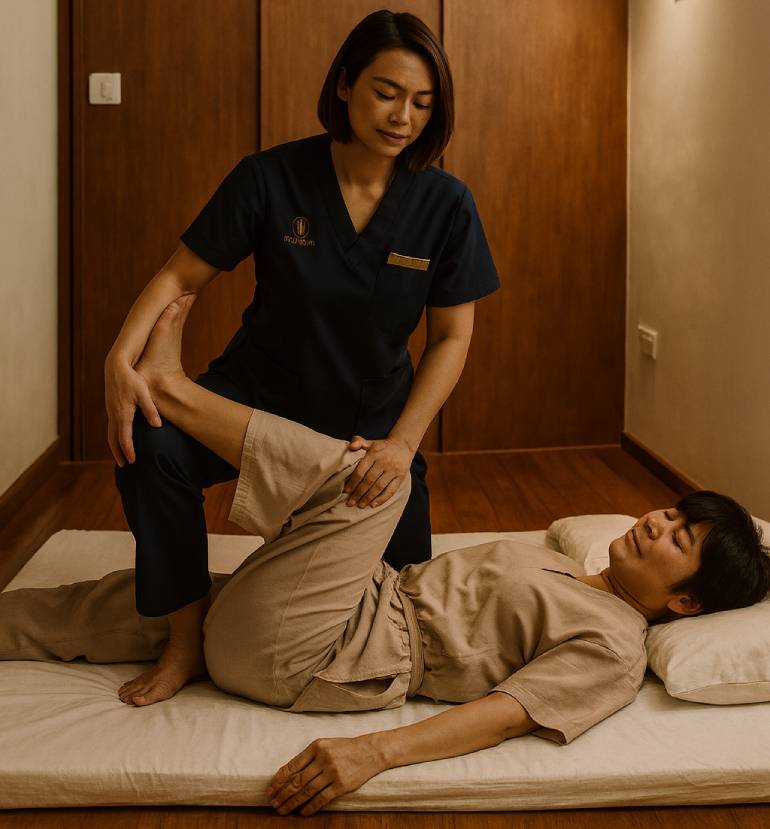
Unlike Western oil-based massage, Thai massage is often described as “yoga for two people.” The recipient remains clothed, lying on a mat, while the therapist uses hands, elbows, knees, and feet to apply pressure, stretch, and mobilize the body.
Key features include:
- Sen line therapy: Releasing blocked energy channels.
- Passive yoga postures: Enhancing flexibility and circulation.
- Rhythmic pressure: Creating a meditative flow.
- Breath awareness: Encouraging harmony between therapist and client.
The Ritual of Wai Khru
Before beginning, many therapists silently chant the Wai Khru prayer to honor Jivaka Kumar Bhaccha. This invocation connects the treatment to an ancient lineage and creates a sacred atmosphere.
Symbolism in Practice
Even the physical gestures in Thai massage hold symbolic meaning:
- The act of pressing the Sen lines mirrors the Buddhist teaching of clearing obstacles on the path to enlightenment.
- The use of two people in synchrony represents interdependence and compassion.
- The practice of mindfulness during massage echoes Buddhist meditation, bringing therapist and client into the present moment.
Thai Massage in a Luxury Spa Setting
From Monasteries to Luxury Spas
In today’s luxury spas, Thai massage has evolved from a folk tradition into an experience that combines ancient wisdom with modern elegance. High-end spas integrate traditional rituals with premium amenities—silk robes, aromatic oils, herbal teas, and serene atmospheres designed to engage all senses.
Storytelling in Wellness
Luxury spa clients are not only seeking relaxation; they seek connection, meaning, and cultural depth. By sharing the story of Thai massage—its roots in Ayurveda, its Buddhist compassion, and its link to Jivaka—the spa creates an experience that is both indulgent and educational. Guests leave not only with looser muscles but with a deeper appreciation of Thailand’s cultural heritage.
Modern Adaptations
Today, variations of Thai massage in luxury spas may include:
- Oil-infused Thai massage blending traditional techniques with aromatherapy.
- Signature treatments combining Thai stretches with Western deep-tissue massage.
- Couple’s Thai massage designed as a shared ritual of relaxation and bonding.
- Thai herbal rituals using steam, compresses, and teas for full-body rejuvenation.
Why Thai Massage Endures
The enduring popularity of Thai massage lies in its multifaceted nature. It is at once:
- A medical system rooted in Ayurveda.
- A spiritual practice grounded in Buddhist compassion.
- A cultural heritage tied to temples and rituals.
- A modern luxury experience, adaptable to global spa culture.
In a world where wellness trends rise and fall, Thai massage continues to resonate because it offers something timeless: the union of body, mind, and spirit.
A Timeless Legacy of Healing
When a guest lies down in a luxury spa in Bangkok, Paris, or New York to receive a Thai massage, they are not simply indulging in a treatment. They are entering into a story that spans continents and centuries—a story born in Ayurveda’s ancient healing, nurtured by Buddhism’s compassion, and sustained through the legacy of Jivaka Kumar Bhaccha.
From the sacred temples of Thailand to the refined halls of modern spas, Thai massage continues its mission: to heal, to connect, and to remind us that true well-being is not just the absence of pain but the presence of harmony.
And so, every stretch, every press, and every silent prayer in Thai massage carries forward this unbroken chain of healing heritage, offering guests not only the best of physical rejuvenation but also a touch of timeless spirituality.
UPDATED LOFT THAI GUIDE
Additional guidance and current information
The following editorial update expands on the original Loft Thai article with practical context, current treatment guidance and further reading.
A Layered History, Not One Invention Date
The phrase “2,500 years old” connects Nuad Thai to the era of the Buddha and the physician Jivaka. It is meaningful within practitioner tradition, but it should not be read as a continuous technical manual preserved unchanged for twenty-five centuries.
Manual care develops through practice, teaching, travel, local materials and social institutions. The massage seen in Bangkok today reflects multiple periods and communities.
A careful history distinguishes what practitioners revere, what written records document and what modern institutions standardise.
Jivaka: Historical Physician and Revered Lineage Figure
Jivaka Komarabhacca appears in Buddhist tradition as a physician associated with the Buddha and monastic community. Thai traditional medicine communities honour him as a teacher or ancestral figure.
Some modern accounts call him the inventor of Thai massage and attribute today’s full system directly to him. The surviving evidence does not establish that one person authored the contemporary sequences, Sen maps and professional categories now taught in Thailand.
His role is best described as a revered medical lineage figure whose symbolic importance remains alive in teacher-honouring practices.
Regional Exchange and Local Thai Knowledge
Thai traditional medicine developed within a region connected by trade, religion, migration and scholarship. WHO historical material notes influences from Indian and Chinese systems alongside distinct Thai practice.
Buddhist concepts, herbal knowledge, movement, touch and local experience did not combine in a single moment. Communities adapted them to climate, work, family care and available materials.
Calling Nuad Thai only imported Ayurveda erases this Thai development; calling it isolated from regional exchange oversimplifies history in the opposite direction.

Household and Village Care
UNESCO describes roots in self-care within Thai peasant society, where villages had massage healers who responded to aches associated with physical work.
This community setting matters because knowledge moved through observation, family practice and apprenticeship, not only through elite institutions.
Nuad Thai later became an income-generating occupation, but its heritage includes ordinary care relationships as well as temples, schools and spas.
Inscriptions, Textbooks and the Public Record
Stone inscriptions and diagrams associated with Wat Pho are among the best-known records of Thai medical knowledge. Royal-era medical books and other temple inscriptions also preserve terminology, line concepts, symptoms and treatment references.
A Thai Traditional and Alternative Medicine journal study examined Wat Pho material, other temple inscriptions, royal medical books and an ancient Nuad Thai document to structure that knowledge for a modern digital classification.
These records show organised written traditions. They do not prove that every current spa sequence existed in exactly the same form when the inscriptions were made.
Sen as a Traditional Organising System
Traditional Thai medicine describes wind or energy moving through Sen lines and identifies ten principal lines within a much larger symbolic network.
Sen helps organise teaching, point selection and relationships between body regions. Its cultural and clinical role can be studied without claiming that the lines are identical to nerves, arteries or fascia.
Modern training can pair the traditional map with anatomy, contraindications and safe body mechanics.
Court, Folk and Teaching Styles
Nuad Thai has never been one mechanically identical sequence. Distinctions are often made between court-associated and folk or general styles, with differences in etiquette, positions, tools and movement.
Schools and individual lineages also select different names, order and emphasis. Modern spa Thai massage may add hospitality features, private rooms and a standard duration.
Variation does not automatically make a practice inauthentic. The important question is whether its lineage, technique and service scope are described honestly.
The Twentieth-Century Revitalisation
UNESCO’s account identifies 1985 as the launch of a project to revitalise and maximise knowledge of Nuad Thai. Practitioner networks and annual gatherings also supported transmission.
Revitalisation involves selection and formalisation: curricula are organised, terminology is compared and assessment becomes more standard. This can protect knowledge while also changing how it is taught.
The modern school, certificate and spa industry are therefore part of the tradition’s history, not merely a commercial afterthought.
Health Promotion and Therapy Became Distinct Professional Contexts
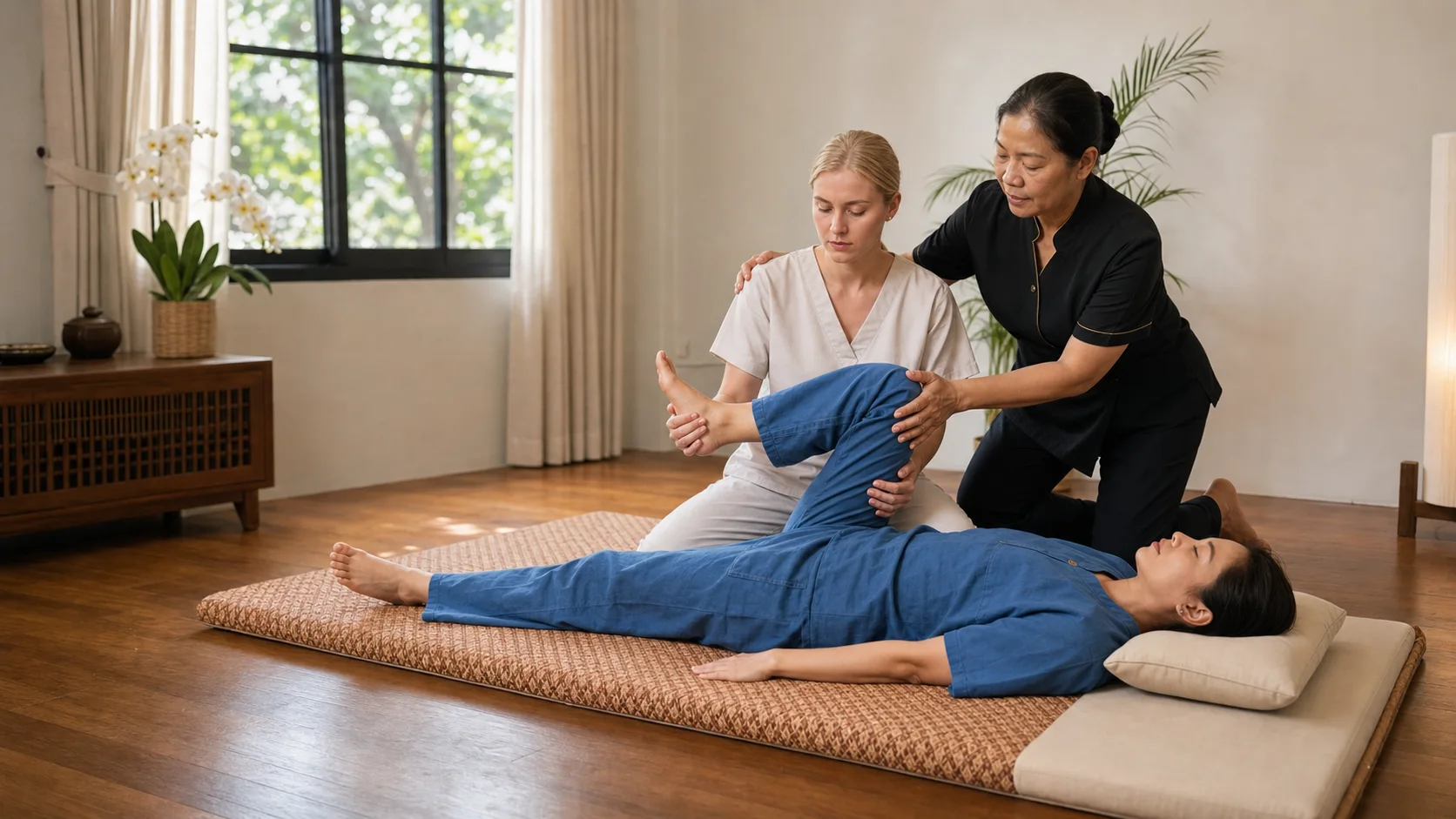
WHO benchmarks distinguish Nuad Thai for health from Nuad Thai therapy. Health-promotion massage is commonly full-body and intended for relaxation and general care, while therapy is symptom-oriented within Thai traditional medicine.
That distinction helps explain why a spa treatment and hospital or clinic service may use related techniques but operate under different scopes, training and governance.
Visitors should not assume that every massage venue diagnoses or treats medical conditions.
What UNESCO Recognised in 2019
Nuad Thai was inscribed on UNESCO’s Representative List of the Intangible Cultural Heritage of Humanity in 2019.
The inscription recognises knowledge, practice, cultural meaning, communities and safeguarding. It is not a prize for a brand, a medical efficacy certificate or a guarantee that any individual venue is authentic.
Heritage remains alive through practitioners, teachers, students, clients, community organisations and responsible documentation.
- Living knowledge rather than a museum object
- Transmission through people and communities
- Traditional healthcare context
- Cultural identity and occupation
- Safeguarding and continued practice
From Thai Communities to a Global Wellness Language
Tourism, migration and international training brought Thai massage to spas and studios around the world. New terms such as Thai yoga massage made aspects of the practice legible to foreign audiences.
Global interest can support livelihoods and visibility, but it can also flatten history into exotic décor or overstate spiritual and medical claims.
Responsible presentation credits the Thai tradition, names adaptations and avoids using UNESCO as a marketing certification.
How History Changes the Guest Experience
A guest does not need to master the full history before booking. It is enough to understand that the treatment carries cultural knowledge and that a professional session still requires individual screening and consent.
Ask whether the massage is clothed, which movements are included, how pressure is adjusted and what training the therapist has completed.
Appreciation becomes concrete through respectful communication, fair treatment of practitioners and realistic expectations.
A Tradition Preserved Through Practice
Thai massage history is strongest when it is allowed to be complex. Revered Buddhist lineage, local Thai care, written records, modern revival and global practice all belong in the story.
Nuad Thai endures not because every detail remained unchanged, but because people continued to teach, adapt, document and practise it.
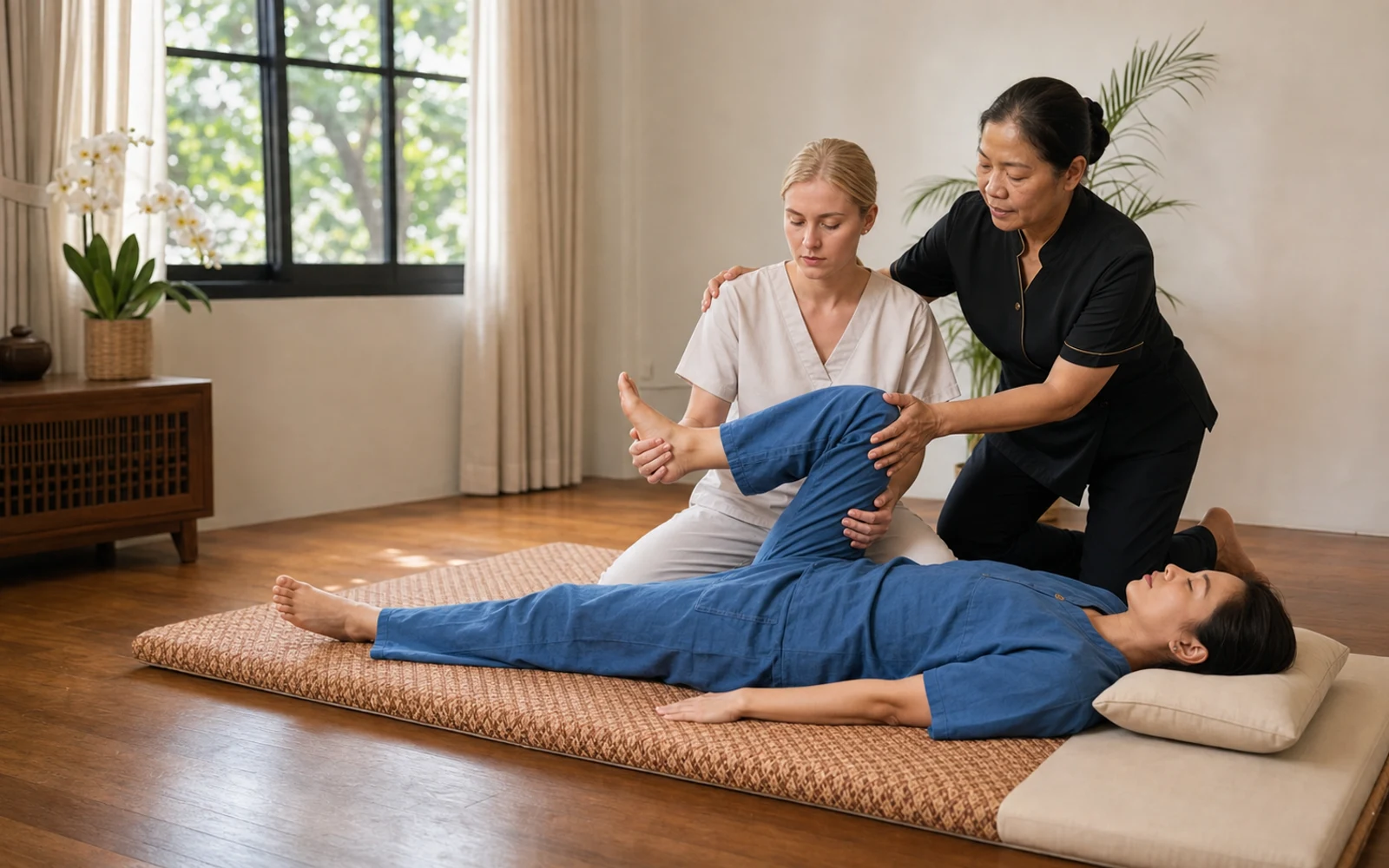
“Nuad Thai is not a technique frozen in antiquity; it is knowledge preserved, adapted and practised by communities.”
Loft Thai Editorial Team
Continue your research
REFERENCES
Sources & further reading
- UNESCO: Nuad Thai, traditional Thai massage
- WHO: Benchmarks for training in Nuad Thai therapy
- WHO: Legal status and historical context of traditional medicine
- Journal of Thai Traditional and Alternative Medicine: Literary transformation of Nuad Thai records
- Thailand Foundation: Nuad Thai and intangible cultural heritage
PRACTICAL GUIDANCE
Frequently Asked Questions
Is Thai massage really 2,500 years old?
The traditional lineage reaches back to the era of Jivaka and the Buddha, but modern Nuad Thai is the product of many periods of Thai community practice, documentation, revival and training.
Did Jivaka invent Thai massage?
He is revered as a medical lineage figure, but surviving evidence does not establish that he personally authored the complete modern system.
Why is Wat Pho important to Thai massage history?
Its stone inscriptions and diagrams are prominent written records of Thai medical knowledge and have played a major role in public teaching and preservation.
When did UNESCO recognise Nuad Thai?
UNESCO inscribed Nuad Thai on the Representative List of the Intangible Cultural Heritage of Humanity in 2019.
Does UNESCO recognition certify a Thai massage spa?
No. The inscription recognises the living cultural element and its communities; it does not certify individual venues, therapists or medical claims.
CONTINUE READING
Related stories
The Science of Pressure Points and Energy Lines (Sen)
How Thai massage stimulates circulation, relieves blockages, and balances body energy—an educational deep dive for health-conscious, well-traveled spa guests.
Read the guide
The Art of Authentic Thai Massage: A Holistic Journey of Healing
In the heart of Bangkok, where tradition meets modern sophistication, the art of Thai massage continues to thrive — not merely as a spa treatment, but as a cultural treasure and holistic wellness philosophy that has endured for over 2,500 years. Today, Thai…
Read the guide
How to Become the Best Therapist in Thailand
Thailand is known around the world as the Land of Smiles—but for those who work in wellness, it’s also the Land of Healing. From ancient temples to modern spa sanctuaries, massage therapy in Thailand is not just a job; it is an art, a philosophy, and a…
Read the guide
Best Thai Massage Thailand: The Loft Thai Story
Inside a Loft Thai treatment room, the first language is rhythm. A therapist settles her stance, listens to the guest’s breathing and lets pressure build without hurry. Hands pause before they move again; every stretch is supported, every change of position…
Read the guide