
In 2026, the idea of a world-class spa has evolved far beyond plush interiors and premium products. As global travelers become more experienced and wellness-literate, expectations have shifted toward authenticity, intelligence, and emotional depth. Luxury is no longer loud. It is thoughtful, intentional, and rooted in meaning.
To understand what truly defines a world class spa in 2026, one must look behind the scenes—beyond the reception desk and into the philosophy that shapes every gesture, every silence, every touch. Few places illustrate this evolution as clearly as Loft Thai Spa, whose approach offers a revealing blueprint of luxury spa standards in 2026.
This is not a story about trends. It is a story about systems, culture, and human excellence.
From “Luxury” to Legitimacy: How Spa Standards Have Changed
In the early 2010s, luxury spas were often judged by visible markers: marble floors, designer uniforms, imported oils, and extravagant menus. While aesthetics still matter in 2026, they are no longer sufficient. Today’s most respected spas are evaluated on deeper criteria:
- the rigor of therapist training
- the consistency of service across locations
- the intelligence behind treatments
- the ability to create a coherent emotional journey
A world class spa in 2026 must operate more like a cultural institution than a beauty salon. It must have values, pedagogy, and a point of view.
Loft Thai Spa understood this shift early.
The Hidden Foundation: A Training School Before a Spa
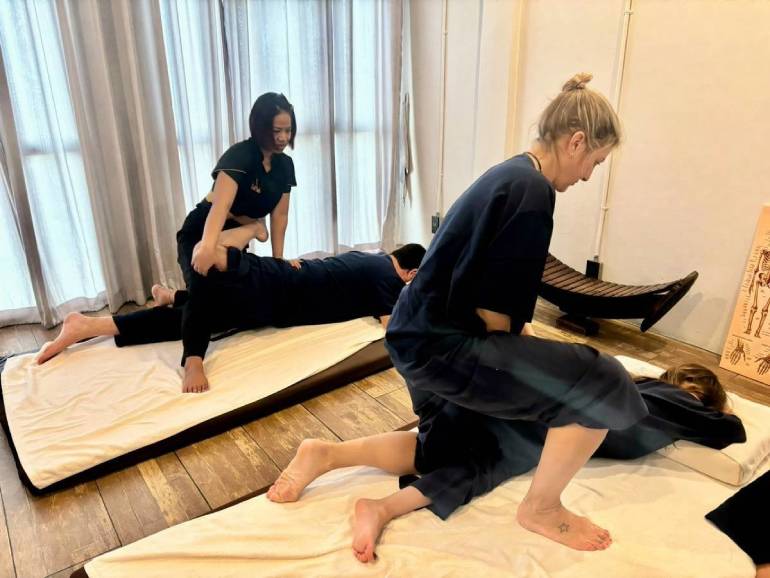
One of the least visible yet most decisive factors in luxury spa standards 2026 is education. Many spas recruit therapists from the market and adapt them internally. Loft Thai Spa reversed this logic by building its own professional training ecosystem.
Behind the spa lies a fully structured Thai massage and wellness training school. This is not an annex; it is the backbone of the brand.
Therapists are not simply hired—they are formed. Selection begins with anatomy awareness, physical aptitude, and attitude. Training continues with posture discipline, pressure calibration, rhythm mastery, and above all, sensitivity. Touch is treated as a language, not a technique.
This educational rigor allows Loft Thai Spa to maintain something rare in the industry: consistency without standardization. Guests may experience different therapists, but never a different level of care.
In 2026, this is a defining trait of a world-class spa: control over knowledge transmission.
Therapist Selection: Skill Is Not Enough
Luxury spa standards in 2026 demand a reassessment of what makes a great therapist. Technical excellence is assumed. What differentiates elite practitioners is emotional intelligence.
- listening ability
- emotional neutrality
- respect for silence
- cultural awareness
A therapist is not a performer. They are a guide.
This is particularly important as spa guests in 2026 arrive overstimulated—digitally saturated, cognitively overloaded, emotionally tired. The therapist must create a safe psychological space where the nervous system can slow down.
That ability cannot be improvised. It must be trained, mentored, and continuously refined.
Continuous Education as a Luxury Standard
In many spas, training ends once a therapist is hired. In a world class spa 2026, education never stops.
Loft Thai Spa operates on a model of continuous upskilling. Therapists regularly revisit fundamentals while also learning advanced techniques: deep tissue adaptations, anti-aging facial massage, lymphatic intelligence, head and neck therapy, and modern facial protocols.
Why does this matter for guests?
Because bodies change. Stress patterns evolve. Clients become more knowledgeable. A spa that does not evolve becomes obsolete—no matter how beautiful it looks.
In 2026, continuous education is not an operational cost; it is a luxury signal.
Best Massage in 2026: Precision Over Force
The definition of the “best massage” has also changed. In the past, intensity was often mistaken for effectiveness. In 2026, refinement is the true benchmark.
- precision rather than pressure
- flow rather than sequence
- responsiveness rather than routine
Traditional Thai massage techniques are respected, but never frozen in time. They are adapted to contemporary bodies—office shoulders, travel fatigue, stress-compressed diaphragms.
The result is a massage experience that feels intelligent. Guests often describe it not as “strong” or “gentle,” but as exactly what was needed.
That sense of accuracy is what defines the best massage in a world-class spa today.
Best Facial Treatments: Where Science Meets Hands
Facials in 2026 are no longer divided between “medical” and “relaxing.” The most advanced spas understand that visible results and deep relaxation are not opposites—they reinforce each other.
- skin analysis and product intelligence
- manual expertise and facial massage mastery
- nervous system regulation
Machines may assist, but hands remain central. Facial massage is treated as a sculptural art—working with fascia, muscle tone, lymphatic flow, and microcirculation.
The goal is not just glow, but long-term skin behavior. Clients leave not only looking better, but understanding their skin better.
In a world class spa 2026, the best facial is one that educates the skin rather than overwhelms it.
Cultural Experience as a Core Luxury
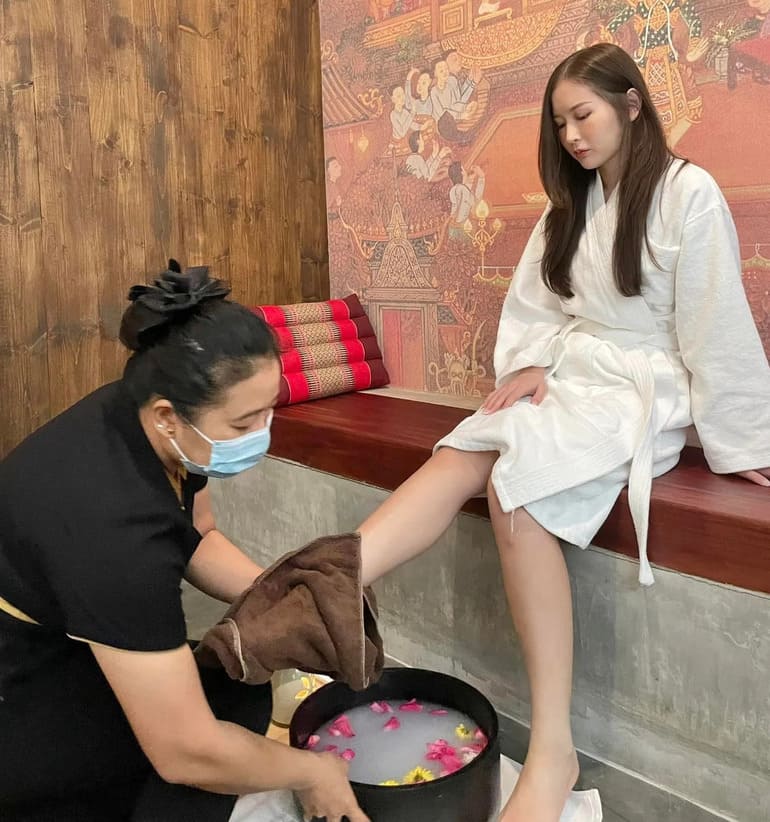
Perhaps the most underestimated element of luxury spa standards in 2026 is culture.
Global travelers no longer want generic “Asian-inspired” environments. They want rooted experiences—places that feel honest, local, and meaningful.
- the rhythm of movements inspired by traditional practices
- the respect for silence, central to Thai philosophy
- the use of tea as a grounding ritual rather than a beverage
- the presence of art as contemplation, not decoration
This cultural coherence creates something rare: a sense of place. Guests know where they are—not just geographically, but emotionally.
Tea as a Transitional Ritual
In many spas, tea is an afterthought. At Loft Thai Spa, it is part of the treatment architecture.
Tea is offered not as refreshment, but as a transition. It helps the body move from treatment mode back into the world—slowly, gently.
The selection of teas, often sourced from Northern Thailand, reflects the spa’s philosophy: grounding, warmth, balance. No sugar rush. No distraction.
In a world class spa in 2026, even the smallest ritual has a purpose.
Art, Silence, and Spatial Flow
Luxury in 2026 is increasingly defined by what is removed, not added.
Loft Thai Spa places great emphasis on silence—not enforced, but protected. Acoustic design, therapist movement, and spatial layout all work together to minimize disruption.
Art is present, but never intrusive. It invites pause, not attention.
The flow of space—from entrance to treatment room to tea area—is designed to feel intuitive. Guests never feel rushed, confused, or observed.
This invisible choreography is one of the hardest things to execute—and one of the clearest markers of a world-class spa.
Emotional Architecture: The True Luxury of 2026
When asked what guests remember most, it is rarely a specific product or technique. It is a feeling.
In 2026, emotional architecture has become the highest form of luxury. In Phrom Phong, this coherence is delivered through trained presence, purposeful silence, and expert touch — never through excess. The ability to design how someone feels before, during, and after a visit is what separates excellent spas from extraordinary ones.
Loft Thai Spa’s philosophy is built around this principle. Every decision—training, selection, culture, silence—is made in service of emotional coherence.
Guests arrive fragmented. They leave integrated.
Why This Defines a World-Class Spa in 2026
To summarize without reducing:
- legitimacy through education
- excellence through human intelligence
- authenticity through culture
- calm through design
- meaning through restraint
A world class spa in 2026 is not defined by trend adoption, but by philosophical clarity. It knows what it stands for, how it trains its people, how it respects culture, and how it protects the guest’s inner space.
Loft Thai Spa embodies this shift not by claiming perfection, but by building systems that allow excellence to repeat itself—quietly, consistently, humanely.
In a world that grows louder every year, this may be the ultimate luxury.
UPDATED LOFT THAI GUIDE
Additional guidance and current information
The following editorial update expands on the original Loft Thai article with practical context, current treatment guidance and further reading.
First, “World-Class” Is Not a Ranking
No universal league table decides whether a day spa is world-class. Awards, online reviews and editorial lists may provide clues, but each uses different criteria and none replaces direct service evidence.
ISO 17679:2016 is a published international standard for wellness-spa service requirements and supporting processes. ISO confirms that the standard remained current after review in 2022. Referring to that framework does not mean Loft Thai is ISO-certified; it simply shows that spa quality can be evaluated through systems rather than adjectives.
A guest can therefore ask practical questions: Is the menu clear? Are staff trained for the treatment? Is health information handled discreetly? Can the therapist modify the session? Is the room clean and private? These answers matter more than a superlative.
Quality Begins Before You Arrive
A professional spa gives enough information to make an informed choice. Treatment name, duration, price, key components, branch, room type, preparation and cancellation terms should be easy to confirm before payment.
Booking communication should distinguish a request from a guarantee. A preferred therapist, couples room or treatment time may depend on availability. Clear confirmation prevents the reception desk from becoming the place where expectations first collide.
Accessibility needs, pregnancy, recent procedures, allergies and mobility requirements should have a private route for discussion. A guest should not need to disclose sensitive details in a public chat or crowded reception area.
- Written branch, date, time and total duration
- Price and whether it is per guest or per couple
- Treatment inclusions and meaningful product information
- Rescheduling, cancellation and late-arrival terms
- A discreet way to share health and accessibility needs
Consultation Is a Service, Not a Formality
A good consultation establishes the guest’s goal, preferred pressure, areas to avoid, sensitivities, relevant injuries and recent medical or cosmetic procedures. It also explains what the treatment will involve.
The therapist should confirm consent again when a new body area, product or assisted position is introduced. The guest can change pressure, decline a technique or stop the session without having to justify the decision.
Consultation is not diagnosis. A wellness spa should refer unexplained swelling, acute injury, infection, severe pain or other concerning symptoms rather than promising to correct them through massage or facial care.
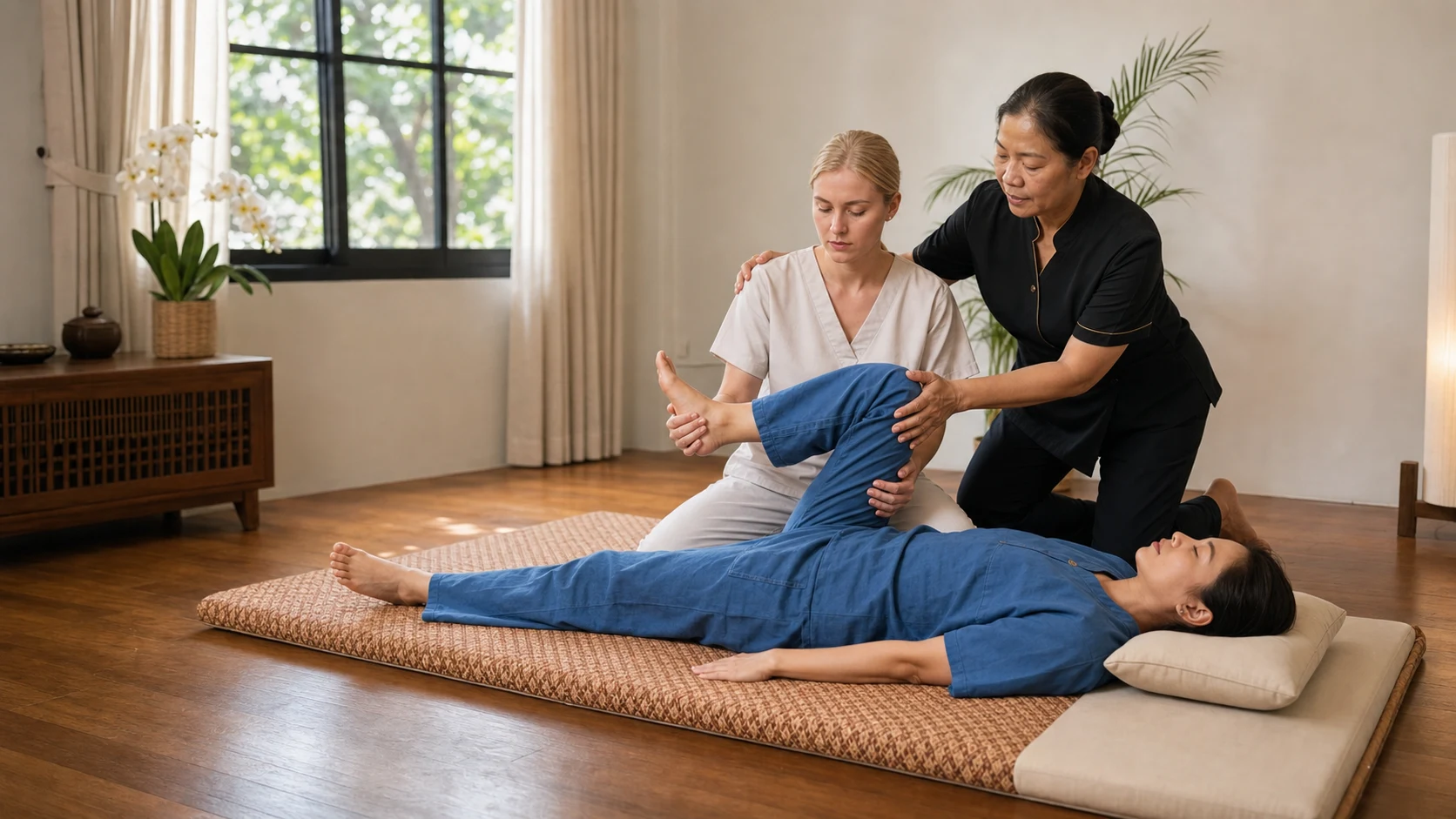
Therapist Training Must Be Visible in the Details
A certificate on a wall cannot show how a therapist works today. Quality appears in body mechanics, pacing, draping, hand hygiene, pressure control, communication and the ability to choose a safer alternative.
Continuous practice matters because a treatment menu may combine Thai massage, oil work, hot stones, herbal compresses, body exfoliation and facial protocols. Each requires separate preparation, product knowledge and contraindication awareness.
Consistency does not mean every session is identical. It means the essential standards repeat—consultation, hygiene, privacy, technique boundaries and a coherent finish—while pressure and sequence remain responsive to the guest.
-
01
Recruit
Confirm foundational education, conduct and role-specific competence.
-
02
Train
Teach the spa’s consultation, hygiene, draping and treatment protocols.
-
03
Observe
Use supervised practice and direct feedback, not self-declared mastery.
-
04
Refresh
Revisit fundamentals when menus, products or guest needs change.
The Room: Hygiene, Privacy and Quiet Function
A beautiful room still needs fresh linens, cleaned contact surfaces, hygienic product handling, safe temperature, adequate ventilation and equipment placed so the therapist can work without clutter.
Privacy is operational. Doors, curtains, changing instructions, draping and staff entry protocols should protect the guest. Couples rooms need enough space for two therapists to move safely without turning the experience into a public performance.
Silence is not the only sign of calm. A world-class room controls avoidable interruption while allowing the guest to communicate. Music, fragrance, light and temperature should be adjustable when they create discomfort.
Thai Identity Without “Asian-Inspired” Theatre
UNESCO recognises Nuad Thai as intangible cultural heritage and describes it as a living practice with transmitted knowledge and varied body tools. A Bangkok spa can honour that heritage through practitioner education, accurate explanation and respectful technique.
Cultural identity does not require exaggerated energy claims, costume or invented rituals. Local art, Thai hospitality, tea, textiles and traditional methods become meaningful when their origins and purpose are treated with care.
Guests should be able to distinguish a traditional Thai massage, a contemporary Thai-inspired signature and an oil-based spa treatment. Clear naming protects both the tradition and the person booking it.
What Reviews and Awards Can—and Cannot—Tell You
Recent reviews can reveal patterns in reception, punctuality, cleanliness, pressure communication and problem resolution. One glowing or angry review is less informative than repeated, specific observations across time.
An award is useful only when the organiser, year, category and selection method can be verified. Old honours should not be presented as current, and a media feature is not the same as an independently judged service award.
NCCIH recommends asking about a massage practitioner’s training and experience. That advice remains practical in a luxury context: reputation should lead to better questions, not replace them.
The 2026 Guest Checklist
Before booking, compare the treatment description with what you actually want. A long signature journey may suit a celebration; a precise 60- or 90-minute massage may be better after travel. Do not pay for components neither guest wants.
On arrival, notice whether the consultation is private and specific. During the session, judge how easily the therapist responds when you change pressure or decline a step. At the end, expect enough time to dress, orient and ask a practical question.
The best spa in Bangkok for one guest may not be the best for another. “World-class” becomes meaningful when the spa makes its standards legible and the guest’s choices remain active throughout.
- One clear H1-like promise on the menu, not ten miracle outcomes
- Exact treatment time and inclusions
- Private consultation and changing
- Adaptable pressure, position and products
- Traceable credentials, awards and brand claims
- A calm finish without rushed upselling
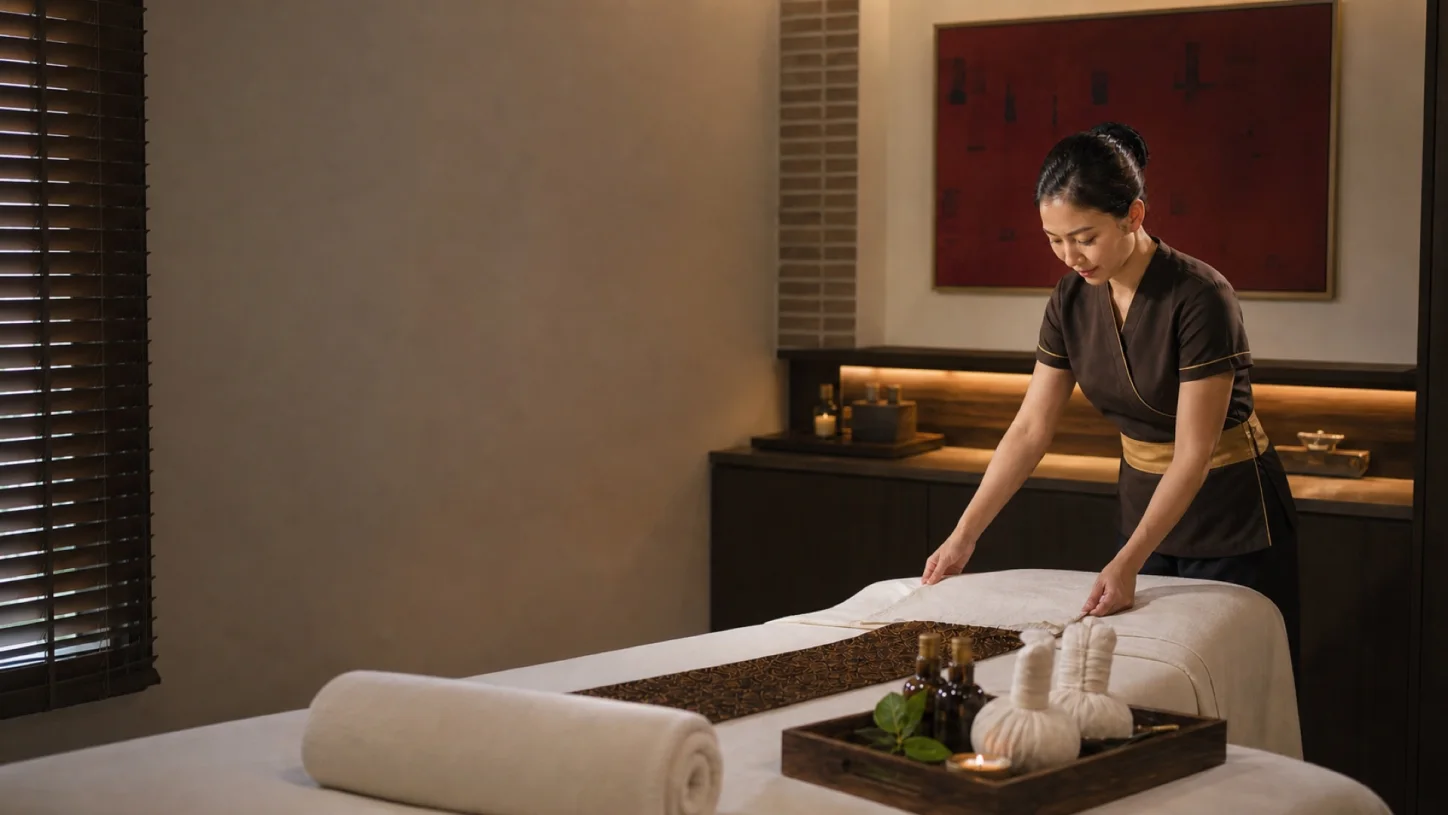
“The strongest luxury signals are often invisible: a clear consultation, a prepared room and a therapist empowered to adapt.”
Loft Thai Editorial Team
Continue your research
REFERENCES
Sources & further reading
PRACTICAL GUIDANCE
Frequently Asked Questions
Is there an official world-class spa certification?
There is no universal “world-class” rank. ISO 17679 sets wellness-spa service requirements, but a spa should not imply certification unless that status is independently verifiable.
Do high prices prove higher spa quality?
No. Price may reflect location, room, duration, products and staffing, but quality still depends on transparent service, training, hygiene, privacy and responsiveness.
What should I ask before booking a Bangkok spa?
Confirm the branch, duration, price, inclusions, room type, therapist competence for the treatment, cancellation terms and how sensitivities or injuries will be handled.
Is a strong massage a better massage?
Not automatically. Appropriate placement, pacing and communication matter more than maximal pressure.
Can a wellness spa diagnose my pain or skin condition?
No. A spa can adapt a wellness service and recommend clinical assessment when needed, but it should not diagnose or replace medical care.
CONTINUE READING
Related stories

Bangkok Spa Etiquette: Tipping, What to Wear, What to Say to Get the Pressure You Want in 2026
Booking a spa in Bangkok should feel exciting—not confusing. But if it’s your first time Thai massage or oil massage, it’s normal to wonder about the unspoken rules. Do you tip? How much? What do you wear? Do you keep underwear on? And how do you ask for the…
Read the guide
Top 10 Luxury Spas in Bangkok for High-End Wellness Experiences in 2026
Bangkok is one of the rare cities where “high-end wellness” isn’t only about marble lobbies and expensive menus—it’s about therapist skill, heritage techniques, privacy, and consistency. If you’re investing in a luxury spa day (for recovery, stress relief, jet…
Read the guide
Best Spa in Bangkok (2026 Guide): How to Choose a Luxury Spa That’s Actually Worth It
Bangkok has thousands of massage shops, day spas, hotel spas, and “luxury” venues that look premium in photos but feel rushed in real life. If you’ve ever walked out of a treatment thinking, “That was nice… but was it actually worth it?”—you’re not alone.
Read the guide
Loft Thai Spa Ranked #1 Best Spa in Bangkok 2025 by PhuketOn
We are deeply honored and sincerely grateful to share a milestone moment for our entire team. Loft Thai Spa has been ranked the #1 Best Spa in Bangkok in 2025 by PhuketOn, as part of its curated selection of the 12 Best Spas in Bangkok.
Read the guide