


Deep muscle tension is often misunderstood. Many people imagine that a tight shoulder, a stiff lower back, or a heavy neck can only be solved by stronger pressure, deeper elbows, or longer massage sessions. While deep pressure can be useful when applied correctly, the body does not always release tension simply because more force is added. In some cases, the nervous system resists strong pressure, the muscles contract even more, and the sensation of tightness returns shortly after the massage.
This is where Tok Sen massage offers a fascinating and very different approach.
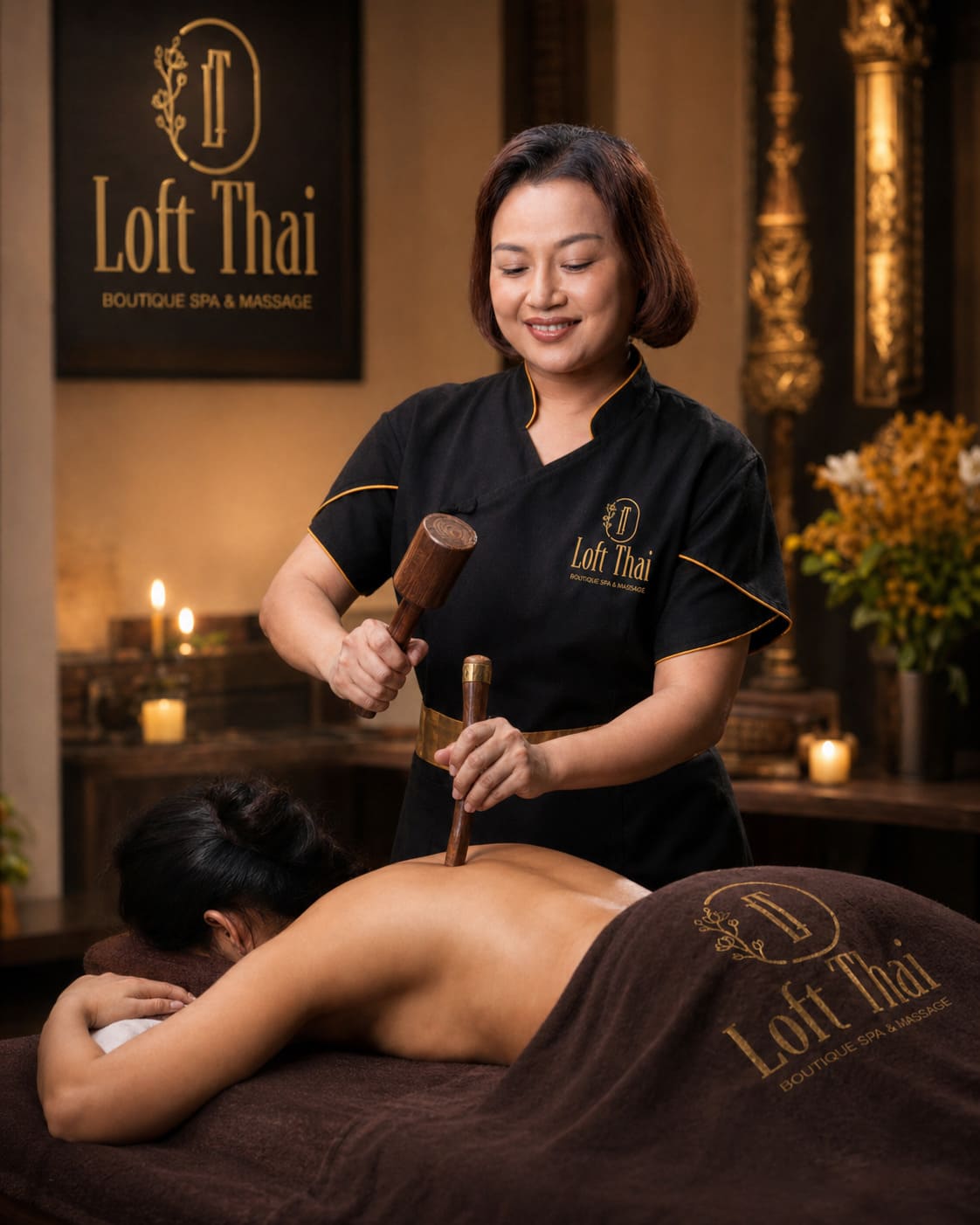
Tok Sen is a traditional Northern Thai massage technique that uses rhythmic tapping with a wooden hammer and wedge. At first glance, it may look simple: a practitioner gently taps along the body, following muscles, tendons, joints, and traditional Thai energy lines. But behind this repetitive sound and vibration is a deeper anatomical logic. Tok Sen does not rely only on compression. It uses vibration, rhythm, and resonance to communicate with the body in a way that hands alone may not always achieve.
For people experiencing deep tension, chronic stiffness, muscle fatigue, or the feeling that certain areas are “blocked,” Tok Sen can be an interesting therapy because it works through several layers at once: the muscles, the fascia, the nervous system, circulation, and the traditional Sen energy lines of Thai healing.

When we say a muscle is “tight,” we often think of it as a rope that has become too short. In reality, deep tension is usually more complex. A tight muscle may be overworked, under-recovered, dehydrated, stressed, poorly oxygenated, or neurologically guarded. It may also be surrounded by fascia that has become less elastic or less mobile.
Muscles do not work alone. They are wrapped and connected by fascia, a web-like connective tissue that surrounds muscles, bones, nerves, blood vessels, and organs. Fascia helps the body move smoothly, but when it becomes restricted, the body can feel stiff, heavy, or compressed. This is why some people feel tension not only in one isolated point, but across an entire chain: neck to shoulder, shoulder to arm, lower back to hip, or hip to leg.
Deep tension can also be influenced by the nervous system. When the body feels stress, pain, or overload, it may increase muscle tone as a protective response. This is common in people who sit for long hours, train intensely, sleep poorly, or carry emotional stress. The body may keep certain muscles slightly contracted for hours, days, or even months.
This is one reason why strong massage pressure does not always solve the problem. If the nervous system still feels threatened, the muscle may not truly relax. A skilled therapist must therefore work not only on the muscle tissue, but also with the body’s natural protective responses.
Tok Sen is valuable because its rhythm and vibration can help invite release without forcing it.
Vibration is not just a sensation. It is a form of mechanical stimulation. When vibration enters the body, it can travel through soft tissues in a way that static pressure cannot. Hands, thumbs, palms, and elbows apply pressure directly to a specific area. Tok Sen, by contrast, creates a wave-like effect. The tapping produces small vibrations that move through muscles and fascia, helping the body respond gradually.
From an anatomical perspective, vibration may influence mechanoreceptors, which are sensory receptors found in the skin, muscles, tendons, joints, and fascia. These receptors detect pressure, stretch, movement, and vibration. When stimulated, they send information to the nervous system. This may help the body adjust muscle tone, improve body awareness, and reduce the feeling of stiffness.
This is one of the reasons vibration-based techniques are used in many forms of therapy and recovery. The goal is not to “break” tension by force, but to stimulate the body’s own ability to regulate itself. Tok Sen applies this principle through a traditional Thai method that combines rhythm, anatomical direction, and therapeutic intention.
The repetitive tapping sound also creates a calming rhythm. Many people enter a deeply relaxed state during Tok Sen, not only because of the physical sensation, but because rhythm itself has an effect on the nervous system. A steady rhythm can help slow mental activity, reduce the feeling of stress, and encourage the body to shift from a guarded state into a more relaxed state.
Muscle tightness often develops when muscle fibers remain contracted or when local circulation is reduced. The area may feel hard, sensitive, tired, or painful when pressed. In conventional massage, the therapist may use kneading, compression, stretching, or trigger point techniques to encourage release.
Tok Sen approaches the muscle differently. The wooden tool creates a tapping impulse that penetrates through the superficial layers and reaches deeper muscle structures without requiring excessive pressure. This can be especially useful in areas where strong compression may feel uncomfortable, such as the neck, shoulders, calves, hips, or along the spine.
The vibration may help “wake up” the tissue. When the muscle receives repeated mechanical stimulation, it may begin to soften. Blood flow may increase locally, warmth may develop, and the nervous system may reduce unnecessary muscle guarding. For clients, this can feel like the muscle is slowly opening from the inside.
Another important point is that Tok Sen is not only applied randomly on tight spots. A skilled therapist follows the direction of the muscle fibers, the natural lines of movement, and the traditional Sen lines. This makes the technique more precise. For example, when working on the shoulders, the therapist may tap along the upper trapezius, around the shoulder blade, and down the arm to address the full chain of tension rather than only one painful point.
This is important because deep tension is rarely isolated. A stiff neck may be connected to tight shoulders. Tight shoulders may be connected to the chest, upper back, or even the arms. Lower back discomfort may be related to the hips, glutes, hamstrings, or calves. Tok Sen allows the therapist to work along these pathways with rhythm and continuity.
Fascia is one of the most important structures to understand when discussing deep tension. It is often described as a continuous connective tissue network that wraps and links the body together. When fascia moves well, the body feels flexible and fluid. When fascia becomes restricted, movement may feel limited, heavy, or uncomfortable.
Fascia can be affected by posture, injury, repetitive movement, dehydration, stress, and lack of movement. Sitting at a desk for long hours, for example, may contribute to stiffness in the hips, lower back, chest, neck, and shoulders. Over time, the fascial layers may lose some of their glide, making the body feel compressed.
Tok Sen may help fascial tension because vibration can travel through connective tissue. Instead of pressing only into one point, the tapping creates a spreading mechanical wave. This may encourage the fascial layers to become more responsive and mobile. The effect is often subtle but deep. Some clients describe the sensation as if tension is being loosened along a line rather than only at one spot.
In Thai massage philosophy, this idea connects naturally with the concept of Sen lines. Sen lines are traditional energy pathways used in Thai healing. While they are not identical to muscles, nerves, or fascia in Western anatomy, they often correspond to functional lines of tension and movement in the body. Tok Sen is traditionally used along these lines to clear stagnation, restore flow, and bring balance.
From a modern anatomical viewpoint, we can understand this as working along chains of soft tissue, where muscles, fascia, nerves, and circulation are all connected. From a traditional Thai viewpoint, we can understand it as restoring movement through the Sen energy pathways. Both perspectives help explain why Tok Sen can feel so different from ordinary massage.
One of the most overlooked aspects of massage is the nervous system. Muscles do not decide to relax by themselves. They receive signals from the nervous system. If the brain and body feel safe, muscles are more likely to soften. If the body feels threatened, stressed, or overstimulated, muscles may remain tense.
This is why aggressive pressure is not always effective. Some clients believe that a massage must be painful to work. But when pain becomes too intense, the nervous system may react by creating more tension. The body protects itself. The muscle may contract. Breathing may become shallow. The client may feel sore afterward without achieving long-lasting relief.
Tok Sen can be powerful because it does not need to attack the muscle. The tapping rhythm creates stimulation without necessarily creating pain. The body receives repeated signals through vibration, and gradually the nervous system may allow the tissue to relax. This is especially useful for people who have deep tension but do not tolerate very strong pressure well.
The sound of Tok Sen also plays a role. The wooden tapping produces a repetitive, grounding rhythm. In a spa environment, when combined with calm breathing, skilled touch, and a relaxing atmosphere, this rhythm can help the client disconnect from stress. The body moves away from alertness and toward restoration.
In this sense, Tok Sen is not only a muscular technique. It is also a nervous system technique.
Hands are essential in massage. A therapist’s hands can feel temperature, texture, muscle tone, and subtle changes in tissue. Skilled hands are irreplaceable. However, hands mainly apply pressure, stretch, glide, and compression. Tok Sen adds another dimension: vibration.
The difference is similar to the difference between pressing on a surface and sending a wave through it. A thumb can press a trigger point. A palm can compress a muscle. An elbow can apply deep pressure. But vibration can disperse through tissue, reaching areas that may not respond fully to direct pressure.
This does not mean Tok Sen is better than hands. It means Tok Sen is different. The best results often come when Tok Sen is integrated with traditional Thai massage, stretching, palm pressure, and therapeutic bodywork. The hands prepare the tissue, read the body, and guide the session. Tok Sen then adds rhythmic stimulation to deepen the effect.
At Loft Thai Spa, Tok Sen is approached as part of a refined Thai healing experience, not as a simple tapping demonstration. The technique must be controlled, precise, and adapted to the client’s body. The intensity, rhythm, angle, and location of tapping all matter. A well-trained therapist understands when to work gently, when to go deeper, and when to avoid certain areas.
In Traditional Thai Massage, the body is understood through the concept of Sen lines. These are pathways through which energy is believed to flow. When energy is blocked or stagnant, the body may feel pain, stiffness, fatigue, or imbalance. Thai massage techniques aim to restore flow through pressure, stretching, rocking, and rhythmic movement.
Tok Sen is especially connected to this philosophy because the vibration is believed to help clear blockages along the Sen lines. The tapping is not only mechanical; it is rhythmic and directional. The therapist follows the body’s pathways with intention, helping restore movement where the body feels stuck.
For clients, this can create a unique sensation. Some may feel warmth, tingling, lightness, or a wave-like release. Others may simply feel deeply relaxed and less stiff. The experience is often both physical and energetic, which is why Tok Sen remains one of the most distinctive techniques in Northern Thai healing.
Modern anatomy and traditional Thai medicine use different languages, but they can complement each other. Anatomy explains the role of muscles, fascia, circulation, and nerves. Thai tradition explains the importance of flow, balance, and energetic pathways. Tok Sen sits beautifully between these two worlds.
Tok Sen may be especially appreciated by people who carry tension in the shoulders, neck, back, hips, legs, and feet. These areas often accumulate tension from modern lifestyle habits.
The neck and shoulders are common areas of stiffness because of computer work, phone use, stress, and poor posture. The upper trapezius, levator scapulae, and muscles around the shoulder blade can become overactive. Tok Sen may help soften these areas through rhythmic stimulation, especially when combined with careful stretching and traditional Thai pressure.
The back is another area where Tok Sen can feel deeply relieving. Along the spine, the therapist must be careful and avoid direct unsafe pressure on the bones. However, when applied correctly along the paraspinal muscles and back lines, the vibration may help reduce the feeling of heaviness and improve relaxation.
The hips and glutes often hold deep tension, especially in people who sit for long hours or exercise intensely. These muscles are strong and layered, and they may not always release easily with surface massage. Tok Sen can provide a different kind of stimulation that helps the area respond.
The legs and calves can also benefit from vibration, particularly when they feel heavy or fatigued. Many people who stand for work, walk a lot, or train regularly experience calf tightness. Tok Sen along the legs may help create a sense of circulation, lightness, and release.
Tok Sen should always be performed by a trained therapist. Although the tools may look simple, the technique requires knowledge of anatomy, pressure control, body positioning, and contraindications. Tapping too strongly, too quickly, or in the wrong area may create discomfort or irritation.
Tok Sen is generally not applied directly over fragile bones, inflamed areas, open wounds, acute injuries, varicose veins, or areas with serious medical conditions. It may not be suitable for everyone, including people with certain bone conditions, pregnancy considerations, severe inflammation, recent surgery, or specific neurological or vascular issues. Clients should always inform the therapist about their health history before the session.
A professional Tok Sen session should never feel like uncontrolled hitting. The tapping should be rhythmic, intentional, and adapted to the client. Some areas require very light vibration. Other areas can receive deeper stimulation. The therapist must constantly observe the client’s comfort and tissue response.
This is one of the reasons why receiving Tok Sen in a professional spa environment matters. The quality of the technique depends not only on the tool, but on the therapist’s training, sensitivity, and understanding of the body.
At Loft Thai Spa, Tok Sen massage is presented as part of the deeper heritage of Thai healing. It is not treated as a trend or a simple exotic technique. It is a traditional method that requires respect, precision, and proper application.
The experience combines the ancestral wisdom of Northern Thai bodywork with the high standards of a professional spa environment. The therapist uses Tok Sen to help address areas of deep tension, while also integrating the broader principles of Thai massage: body alignment, pressure points, stretching, rhythm, and relaxation.
For clients who feel that ordinary massage does not fully reach their tension, Tok Sen can offer a different pathway. Instead of relying only on stronger pressure, it works through vibration and rhythm. It may help the body soften, release, and reconnect with a more natural sense of flow.
This makes Tok Sen especially interesting for people who experience recurring stiffness, deep muscular fatigue, or the sensation that certain areas of the body remain blocked even after massage. The goal is not only to feel temporary relief, but to create a deeper conversation with the body.
Tok Sen teaches us something important about healing: sometimes the body does not need more force. Sometimes it needs a different signal.
Deep tension is not always solved by pushing harder. It may require rhythm, patience, vibration, breath, and skilled touch. Tok Sen offers this alternative. Through the sound of the wooden tool, the wave of vibration, and the therapist’s understanding of Thai bodywork, the body is invited to release in a more natural way.
The beauty of Tok Sen lies in this balance. It is both simple and sophisticated. Traditional and anatomical. Physical and energetic. Gentle yet deep.
For anyone looking to understand Thai massage beyond the usual techniques, Tok Sen is one of the most fascinating examples of how ancient wisdom can still speak directly to the needs of the modern body.
At Loft Thai Spa, Tok Sen massage is an invitation to experience deep tension release differently — not through force, but through vibration, rhythm, and the refined art of Thai healing.