


Imagine a spa treatment so unique that it works inside your cheeks as well as outside. You lie back in a dimly lit room with calming aromas, and after a series of soothing strokes on your face, the therapist slips on thin gloves and gently massages the muscles inside your mouth. It may sound unconventional, but this is the transformative world of buccal massage, a luxury facial technique that beauty insiders and wellness gurus are raving about.
In this comprehensive guide, we delve into what buccal massage is, how it works on a deeper level of facial anatomy, the various techniques involved, and the rich cultural influences that have shaped facial massage practices. We’ll explore the tools and products used in a high-end spa setting, share expert opinions from estheticians, massage therapists and dermatologists, and describe how the experience feels – both physically and emotionally. You’ll also learn about the surge in popularity of buccal massage (from celebrity endorsements to social media buzz), what science and research say about its effects, the multitude of wellness benefits (from anti-aging to TMJ relief), and practical considerations like pain or sensitivity, recommended frequency, and whether it’s safe to try at home. By the end of this article, you’ll have an insider’s view of buccal massage – an inside-out approach to beauty that just might change how you think about facials.
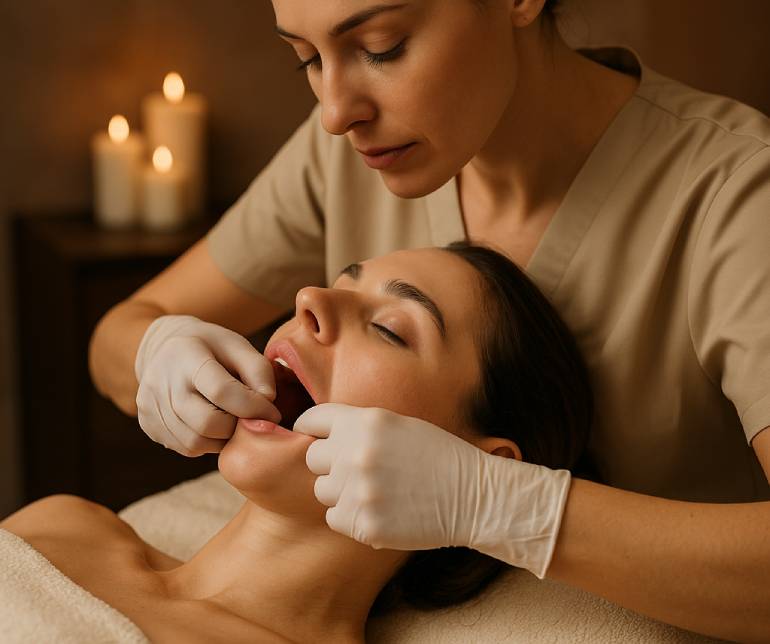
Buccal massage (pronounced “buckle”) is a specialized form of facial massage that involves treating the inside of the cheeks and jaw as well as the outside. The word buccal literally means “pertaining to the cheek.” In a buccal massage session, a trained therapist works not only on the external facial muscles, but also inserts their fingers (with gloves on) into your mouth to knead and release tension from within. This dual approach – massaging facial tissue from both inside and outside – sets buccal massage apart from a standard facial massage.
Celebrity facialist Samantha Susca describes buccal massage as “an intricate type of facial treatment that offers another way to sculpt, contour and define the facial features without the use of any technology”. In other words, it’s a natural face-lifting massage. By accessing muscles and fascia (connective tissue) intra-orally, the therapist can reach areas that traditional external massage alone might miss, allowing a deeper release of tension and a greater sculpting effect. Think of it like a deep-tissue sports massage for your face – working the “inner” layers of muscle and tissue, not just a surface rub. As one facialist put it, “Buccal massage focuses on the muscles of the cheeks and jawline, performed on the inside of the mouth as well as superficially on the face, while facial massage can target a wider range of areas”. It’s essentially an intraoral facial that gives your face a workout from the inside out.
Buccal massage was originally developed as an anti-aging and muscle-toning technique decades ago. Some trace its origins to Paris, crediting French skin therapist Joëlle Ciocco who began using an intraoral approach almost 40 years ago. Ciocco’s idea was to stretch and stimulate the facial muscles from inside and outside the mouth as a holistic alternative to more invasive procedures. Around the same time, in Eastern Europe, practitioners like Yakov Gershkovich (known for his “sculptural face lifting” method) also championed a similar inside-out massage. Buccal massage remained a somewhat niche, insider treatment for years, offered by select facialists. But recently it has burst into the mainstream – thanks in part to high-profile fans and media coverage. Glossy magazines have reported that everyone from Meghan Markle to Netflix star Anna Shay are queuing up for buccal massage. Markle’s own facialist, Nichola Joss, famously incorporates an inner-mouth massage in her signature treatments (which Markle swears by for maintaining her sculpted cheekbones). One New York esthetician noted that requests for the “Meghan Markle mouth massage” skyrocketed once people learned the Duchess was a devotee. What was once an esoteric spa offering has now become a global trend in wellness and skincare, hailed as a non-surgical facelift and a stress-relieving therapy all in one.
At its core, buccal massage is about working the key structures of the lower face – cheeks, jaw, lips – to tone and relax them. The treatment is sometimes called an “inner facial” or “inside-out massage” and typically complements an external facial massage. Many professional buccal massages are done as part of a longer facial ritual that might also include cleansing, exfoliation, masks, or even techniques like facial cupping or gua sha. But the defining feature is always the intraoral manipulation. During the buccal portion, you can expect the therapist (wearing sterile gloves) to slide one or two fingers inside your cheek and use the other hand externally to sandwich the tissue and muscles, kneading and massaging thoroughly. It’s a strange sensation at first – as Allure magazine quipped, “you will have your lips stretched to Joker-like dimensions” during a buccal massage – but many find it not only tolerable but surprisingly relaxing after the initial novelty.
How is it different from a normal facial massage? A standard facial massage works on the outside of the face with various strokes and pressures to boost circulation, relax muscles, and help products penetrate. Buccal massage goes a step further by also treating the inside of the facial muscles. Facialist Danna Omari calls it “gym class for your face,” noting that the dual inside-and-out motions are like a double workout for your facial muscles. By reaching the inner side of muscle and connective tissue, a buccal practitioner can release deep adhesions and knots – particularly in areas like the jaw (which we often clench) and the corners of the mouth – that an external massage might not fully address. This inside-out approach can also help target specific concerns such as smile lines (nasolabial folds) or jowls from two angles. Ultimately, buccal massage aims to achieve results you can see (a more lifted, contoured face with a healthy glow) and feel (less tension and profound relaxation), all through natural manual techniques.
It’s important to note that buccal massage is a highly specialized technique. Not every esthetician or massage therapist offers it, and proper training in intraoral work and facial anatomy is essential for it to be done safely. Because the practitioner is working near sensitive areas (like your gums, jaw joints, and facial nerves), they must know what they’re doing. In untrained hands, an overly aggressive attempt at buccal massage could potentially bruise the inner mouth or irritate lymph nodes. But in the hands of a skilled therapist, buccal massage is both safe and deeply therapeutic. As we’ll see, the best practitioners often have studied anatomy and even have backgrounds in areas like medical massage or physiotherapy. In fact, some of the technique’s roots lie in therapies for jaw pain (TMJ disorder), where intraoral massage has long been used in medical contexts to relieve tension. Now, the spa world has refined and elevated it into a sought-after beauty treatment as well.
To appreciate how buccal massage works, it helps to understand a bit of facial anatomy – especially the muscles, connective tissues, and other structures that this technique targets. Our faces are a complex tapestry of over 40 muscles, layered with fat pads, all wrapped in a web of connective tissue called fascia, and served by a network of nerves and lymphatic vessels. Buccal massage engages with all of these elements in some way:
Muscles: The primary focus of buccal massage is the facial musculature – particularly the chewing and expression muscles around the cheeks, jaw, and mouth. One key player is the masseter muscle, a strong jaw muscle at the back of the cheek that we use to chew and often clench when stressed. The masseter can become overdeveloped or tense (think of people who grind their teeth), leading to a square jawline, discomfort, or headaches. Buccal massage often involves kneading the masseter from both inside (pressing outward from inner cheek) and outside (pressing inward from jawline) to release this tension. Clients frequently don’t realize how tight their masseters are until a therapist works on them – one practitioner noted that many of us hold tension in our jaw “the same way we do in our shoulders,” and that one side (often the dominant side) can be tighter.
Another important muscle is the buccinator, for which buccal massage is named. The buccinator is a thin, flat muscle in the middle of your cheek – it helps you suck in your cheeks or blow (it’s sometimes called the “trumpeter’s muscle”). It lies deeper in the cheek, under the more surface muscles used for smiling. Buccal massage can directly palpate and massage the buccinator by working inside the mouth along the inner cheek wall. Releasing tension here can help the cheeks appear less hollow or clenched, and improve pliability of the mid-face.
Around the mouth, there’s the orbicularis oris (a circular muscle around your lips, used for kissing or puckering) and various smaller muscles that control expressions – like the risorius (which pulls the mouth corners sideways into a grin) and the zygomaticus (which lifts the corners for a smile). All these muscles converge at a point near the mouth corners called the modiolus, which is essentially a hub where about nine muscles interweave. The modiolus is an “emotionally charged” spot – when we’re tense or unhappy, these muscles tighten, contributing to deeper nasolabial folds or a downturned mouth. Buccal massage often includes gentle work on the modiolus area internally and externally. For example, a therapist might pinch the tissue at the corner of the mouth (one finger inside, one outside) and make small circular motions to relax it. This can soften laugh lines and ease that unconscious tightness we hold in our expressions.
Buccal massage may also reach the pterygoid muscles (internal muscles further back near the jaw joint) indirectly, which is helpful for those with TMJ pain. And some practitioners even work up to the temporalis (the broad fan-shaped muscle at your temples, used for chewing) by massaging inside the upper cheek and along the gumline toward the back – or simply by externally massaging the temples after the intraoral part. In essence, buccal massage can address all the major muscles of mastication (chewing) as well as many facial expression muscles. By relaxing and stretching these muscles, the treatment not only relieves tension (preventing problems like jaw pain and tension headaches) but also allows the muscles to return to a more natural, lifted resting position, which can make the face look firmer and more symmetrical.
Fascia and Connective Tissue: Beneath our skin, all those muscles and fat pads are held together by the fascia – a continuous web of connective tissue. Fascia can get tight or stuck due to stress, posture, or injury, forming restrictions (think of it like cling wrap that can bunch up). In the face, fascial tightness can contribute to sagging or reduced elasticity because it impedes the glide between skin and muscle. One of the aims of buccal massage is to perform a kind of myofascial release for the face. By gently pulling, lifting, and stretching the inner and outer facial tissues, the therapist can help release fascial adhesions. “Over time, stress and aging cause fascial restrictions, impacting the skin’s elasticity and overall appearance. Buccal massage focuses on releasing tension within the fascia, promoting improved circulation and restoring a youthful glow,” notes one spa that specializes in the technique. Essentially, freeing up the fascia can allow the facial structures to sit more smoothly – imagine smoothing out a crumpled sheet – which may translate to firmer-looking skin and better muscle function.
A practical example: the buccal fat pad (the pocket of fat in the mid-cheek) sits between layers of muscle and fascia. Buccal massage can manipulate this area (without removing fat, as surgery would) to ensure it’s not stuck or bulging due to tight surrounding fascia. That’s why some people notice a reduction in “chipmunk cheeks” or jowls – it’s not that fat is gone, but it’s been redistributed or depuffed via massage. Connective tissue also includes collagen and elastin fibers in the skin, which benefit from the increased blood flow during massage. Some experts suggest that stimulating facial tissues regularly may boost collagen production over time, although this is a subtle and gradual effect.
Lymphatic System: The face has numerous lymph nodes and vessels, particularly along the jawline, under the chin, and near the ears. Lymphatic drainage is a key aspect of many facial massages, and buccal massage is no exception. Lymph is the fluid that carries waste and toxins away from tissues; when it doesn’t circulate well, you get puffiness and dullness. By massaging both inside and outside, especially along the inner cheek and gum areas, buccal massage can stimulate lymph flow from deep facial pockets out toward the drainage points. One facialist explains that by releasing muscle tension and doing intraoral motions, “space is created for toxins and stagnant fluids to flush outward and for oxygen and nutrients to flow upward to the skin”, like clearing a traffic jam in your tissues. This is why, after a buccal massage, clients often see a reduction in swelling (say goodbye to morning puffiness or that heavy look after a salty meal) and notice a brighter complexion as circulation and lymph flow improve.
Therapists skilled in lymphatic techniques will typically massage in specific directions – always moving fluids toward the nearest lymph node basin. For example, strokes on the cheeks will glide outward toward the ears (to the parotid lymph nodes) or downward along the jaw to the nodes in the neck. Intraoral moves can even aid lymph drainage: one expert shared that when your thumb reaches a certain point inside near the cheekbone, “that point is also helpful for moving lymph”. After the internal work, many practitioners finish with an external lymphatic drainage sequence (light, sweeping strokes along the face and neck) to flush out all that released fluid and toxins. The result is a face that not only feels lighter but often looks more sculpted and defined because excess fluid is gone.
Nerves: While the goal of buccal massage isn’t directly to work on nerves, the facial nerves do run through the areas being massaged. The main motor nerve of the face, the Facial Nerve (VII), branches through the parotid gland in the cheek and controls all the expression muscles. By easing muscular and fascial tension around those nerve pathways, buccal massage can potentially relieve any minor impingements and improve neuromuscular function (resulting in more relaxed, natural expressions). The Trigeminal Nerve (V), which provides sensation to the face and controls the chewing muscles, is also affected indirectly – massaging the chewing muscles (which the trigeminal nerve innervates) can send feedback to the nervous system to dial down an overactive clench reflex. Clients with TMJ disorder or clenching habits often report that intraoral massage leads to less nerve-triggered pain and even fewer tension headaches, which are often tied to the trigeminal system.
Beyond specific nerves, the overall effect of a thorough facial massage is often deep nervous system relaxation. The face and jaw are loaded with sensory receptors. When those areas are massaged, it can activate the parasympathetic “rest and digest” response, slowing your heart rate and lowering stress hormones. This is why a good buccal massage can leave you feeling not just face-relaxed, but mind-relaxed. People sometimes even enter a meditative, floaty state during treatment once they acclimate to the unusual sensation.
In summary, buccal massage is rooted in solid anatomy and physiology: by working on muscles (to relieve tension and exercise them), on fascia (to improve mobility and elasticity), on lymph flow (to detoxify and depuff), and on pressure points (to trigger relaxation), it aims to holistically improve the function and appearance of the face. In the next section, we’ll break down how therapists actually perform these techniques, both externally and intraorally, to achieve those results.
Buccal massage isn’t a single technique but rather a collection of techniques that together create an inside-out facial workout. Different practitioners may have their own style or protocol, but most buccal massages involve a blend of external sculpting movements, intraoral manipulations, and lymphatic drainage. Let’s look at the key methods and phases:

Before any fingers go in your mouth, the therapist will typically begin with traditional external facial massage to warm up the tissues. This often includes firm, lifting strokes using oil or cream on the face, targeting the muscles of the jaw, cheeks, and even neck. The idea is to relax the superficial muscle layer and get blood flowing, so that the deeper work is more effective. As one facialist notes, “I modify my technique to focus on relaxing and warming up muscles in the neck and lower face so they’re more pliable when it comes time to don my gloves and work inside the mouth”. During this phase (sometimes called the “sculptural phase” of the treatment)
Some external techniques used here include effleurage (long gliding strokes), petrissage (kneading and rolling the flesh, almost as if sculpting clay), and even gentle percussion taps (a staple in Japanese Kobido massage, known to stimulate and firm). The therapist might also do lifting “pinch and roll” moves – for example, pinching along the jawline to stimulate the muscle attachments and sharpen the contour. All of this external work doesn’t just feel good; it’s actively prepping the face for the buccal magic to come. One expert likened it to stretching before a workout, saying that by the time she actually put her fingers inside the client’s mouth, the facial muscles were already relaxed and “tingling” as if after a warm-up jog. In some cases, the external sculpting can be quite vigorous. Clients have described the rapid lifting and jiggling motions as intense but oddly enjoyable – “a certain scoop or tug might feel intense, but the lifting, squeezing and jiggling felt incredible, and I could actually feel my facial muscles relaxing,” wrote one reviewer of a sculpting facial. By the end of this outer massage stage, you may notice the face looking flushed (thanks to increased circulation) and a bit lifted already.
A quick note: Not all “sculpting facials” include the buccal (intraoral) portion. Some spas offer purely external facial massage services that aim to contour the face. But the buccal technique takes sculpting to the next level by addressing deeper structures internally. If you’re booking, ensure the service explicitly mentions intraoral or buccal massage if you want the full inside-out experience.
After the initial sculpting and once you’re sufficiently relaxed, the therapist will put on fresh disposable gloves and begin the intraoral massage – the hallmark of a buccal treatment. Typically, you’ll be asked to slightly open your mouth (not uncomfortably wide, just enough to allow access). The therapist will usually start at one corner of the mouth and work one side of the face at a time. This focused approach ensures they can thoroughly massage every structure on that side before moving to the other.
A common entry point is under the lips: “I enter the client’s mouth at the chin beneath the bottom lip, at the mentalis muscle,” Susca (a buccal specialist) explains. The mentalis is the muscle at the center of your chin (that puckers the chin area). Starting here is smart because it’s less sensitive than deeper cheek areas and eases the client into the feeling of having fingers inside the mouth. The therapist might use the thumb inside and index finger outside, pinching along the chin and lower lip area to relax it. Then, gradually, they will move deeper into the mouth, reaching the inner cheek and jaw areas.
Inside your mouth, the therapist’s fingers (often the thumb or sometimes the index finger) will press and glide against various muscles. Meanwhile, their other hand on the outside provides counter-pressure. Think of it like your cheek or lip being gently sandwiched and massaged between two fingertips – one outside, one inside. They will usually massage in slow, deliberate motions: circular rubs, gentle squeezing, or stroke-like movements along the muscle fibers. When targeting the jaw muscles, for example, a technique is to anchor the thumb inside near the upper gums and then use the outside fingers to stroke along the jawline, effectively kneading the masseter from both sides. One esthetician described her method: anchoring her index fingers between the upper lip and gum (to tighten and lift the nasolabial fold area), then anchoring her thumbs at the hinge of the jaw inside the mouth and from there sculpting along the jawline and up under the cheekbones, kneading the masseter as she goes. This inside pressure, combined with the outside support, allows a much deeper release of the muscle than external massage alone. Clients often feel trigger points – spots that are tender in a “good hurt” way – especially when the therapist works the masseter and the junction where your jaw meets your cheek (near the back, by the molars). If it’s very tender, the therapist will usually adjust pressure, since the goal is release, not pain.
The practitioner will also massage the inner cheek area thoroughly. This can involve sliding the thumb along the inside of the cheek from the lips toward the ear (following the line of the buccinator muscle). When the thumb hits the firmer area near the back (you might feel a ridge of bone of the upper jaw), that spot can be a bit tender – but it’s a key area for relieving tension and even aiding sinus drainage. Gentle, slow circular motions here help loosen tight cheek muscles and can even release the sinus pressure that often accumulates in the mid-face. Some advanced buccal massage practitioners incorporate internal lymphatic drainage moves as well – for instance, pressing gently on the roof of the mouth or floor of the mouth to stimulate lymph channels, or using a sweeping motion in the inner cheek to push fluid toward the mouth’s opening (where it can then be drained outwards). “There are even advanced lymphatic drainage techniques performed inside the mouth, and they’re very powerful,” notes facialist Raquel Medina-Cleghorn. Not every spa does this, but it shows how versatile intraoral work can be.
During the intraoral phase, the therapist will pay special attention to areas of chronic tension. The jaw joint (TMJ area) is one – by massaging around the joint internally, including the surrounding gums and even up towards where the jaw hinges, they can help release tight connective tissue and muscles that contribute to jaw pain. Some intraoral protocols for TMJ dysfunction even involve massaging the gums and roof of the mouth to release tension in tiny muscle attachments there. Another focus area is the mouth corners and lips – massaging just inside the lips at the corners (the modiolus region we mentioned) can be done by placing the thumb inside and index finger outside at the corner, then making small circular or up-and-down motions. This helps soften those laugh lines and can slightly “lift” the mouth corners by relaxing the muscles that pull them down.
The therapist will systematically cover the entire inside of the cheek on both sides. Typically, they do one side for several minutes, then switch gloves or finger and do the other side. Some use both hands inside the mouth simultaneously (one on each side) for certain moves, especially if they want to stretch the upper lip area or work on both cheeks at once, but many prefer one side at a time to focus pressure.
Clients often wonder: what does this actually feel like? We’ll discuss sensations in detail in a later section, but suffice it to say here that intraoral massage feels unusual yet satisfying. You may feel a strong pressure or dull ache on tight spots (similar to having a knot worked out in a back massage), but it usually comes with a sense of relief. Many people even find themselves relaxing into it after the first few moments, as the inside of the cheek warms up and the tension starts melting. If you’re very sensitive, you can always ask the therapist to go lighter. Communication is key – they will often ask if the pressure is OK. Remember, the goal is not to make you flinch, but to coax your facial muscles into releasing their grip.
Once the internal massage is complete (which can last anywhere from 10 minutes up to 30 minutes of a session, depending on the total treatment length), the therapist will gently remove their gloves. Often, they’ll do another quick cleanse of your skin (since they were touching inside your mouth, they want to keep everything hygienic). Then comes the finishing touch: external lymphatic drainage and relaxation strokes.
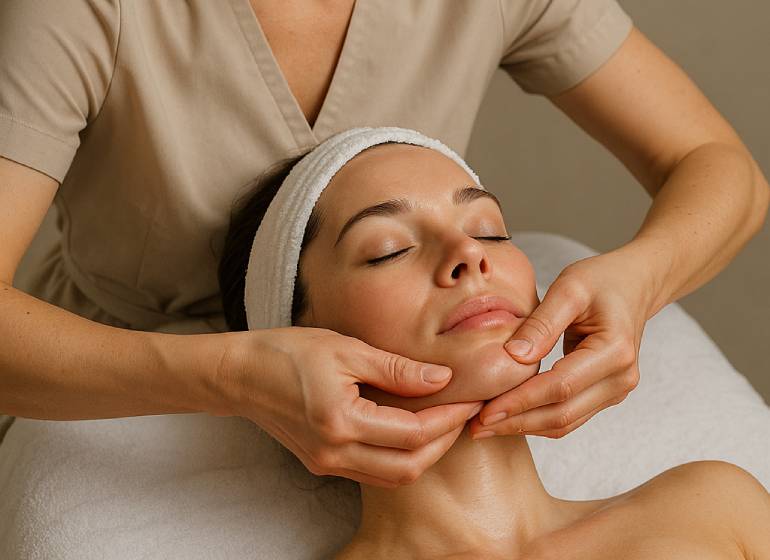
The final phase of a buccal massage treatment often involves calming, light massage to reduce any lingering redness and encourage lymph flow. After the deep tissue work, your face might be flushed or slightly puffy in spots (from increased circulation). To soothe and sculpt it, the therapist applies very gentle, rhythmic strokes that usually go from the center of the face outward and downward – following the lymphatic pathways. For example, using feather-light pressure, they may stroke from the nose across the cheek to the ear, or from the jaw up toward the ear, then down the neck to the collarbone (where major lymph ducts drain). This helps “flush the toxins and fluids” that were released during the massage out through the lymph nodes. One client reported that after her session, the facialist explained her cheek redness would calm down in the next day or two as lymph continued to drain, and indeed she saw noticeably less redness by day 3 – a testament to how effective the post-massage drainage can be in reducing inflammation.
At this stage, the therapist might also apply a cooling tool or mask. In a luxury spa, you might get chilled jade or rose quartz rollers glided over your face, or cold globes, to further reduce swelling and close down the pores. Another popular add-on is an alginate or sheet mask after the massage – since your skin is now primed to absorb ingredients, a nourishing mask can be extra beneficial. Some treatments include technology like LED light therapy post-massage to boost collagen or calm redness, though that’s optional and depends on the spa.
Importantly, by the end of the buccal and lymphatic sequence, your face should feel deeply relaxed. Many therapists will finish with a few relaxing strokes on the neck and shoulders, maybe a temple rub, to ground you before you sit up. It’s common to feel a bit “spaced out” or light-headed (in a good way) immediately afterward because of how tension has released. They might offer you water (it’s good to hydrate, as with any massage, to help flush out toxins).
To recap the technical flow: most buccal massages proceed as: cleanse → external massage (sculpting phase) → intraoral massage (buccal phase) → external lymphatic drainage/cooling → finish. The details can vary: some practitioners incorporate things like facial cupping at the start (as Danna Omari did in one case, using gentle suction cups for lymph drainage before going buccal), or an exfoliating peel mid-way (to smooth the skin before doing massage, as mentioned in a Meghan Markle-inspired facial where an AHA peel was applied and removed right before the buccal portion). These are embellishments that can enhance results, but the core of buccal massage is always those hands-on techniques inside and out.
One interesting note: because buccal massage requires such specialized skill, often only certain therapists at a spa perform it. It’s not unusual that out of a whole team, one or two have the buccal training. As an anecdote, at a New York spa, only one esthetician did buccal and she had learned it by tracking down Yakov Gershkovich for training. This means if you want it, you might have to book specifically with the trained therapist or at certain times. It’s a good idea to inquire when making an appointment to ensure you get the real deal.
Having covered the how-to, let’s step back and look at the bigger picture: buccal massage in context. It may seem like a very modern, trendy concept, but the idea of massaging the face – even potentially including the inner mouth – has global and historical precedents. In the next section, we’ll explore how different cultures (including Thai, Chinese, and Japanese traditions) have approached facial massage and how those practices intersect with today’s buccal techniques.
While buccal massage as a named technique is relatively new in the spa world, the concept of facial massage for health and beauty is ancient. Many cultures have long recognized that massaging the face can promote wellness, balance, and a youthful appearance. Here, we highlight how Thai, Chinese, and Japanese traditions – each famed for their holistic health practices – relate to facial and even intraoral massage. Understanding these roots adds a rich context to why buccal massage is effective and how it has evolved as a luxury treatment today.
Thailand is world-renowned for its massage heritage. Traditional Thai massage (Nuad Thai) is an ancient healing system combining acupressure, Ayurvedic principles, and assisted yoga postures. It primarily focuses on the body’s energy lines (sen lines), but Thai massage also encompasses the head and face. In a traditional Thai massage routine, after working the body, a practitioner often finishes with a head, neck, and face massage to leave the client totally relaxed and balanced. Thai facial massage techniques tend to be gentle yet rhythmic, emphasizing circulation and pressure points.
In Thai wellness culture, a facial massage is not merely cosmetic – it’s deeply therapeutic. It’s believed to release stored stress and restore “sbai” (well-being) to the whole body. A Thai facial massage may involve light thumb pressure on points around the eyes, nose, and mouth (similar to reflexology or acupressure) to clear sinus congestion and energy blockages. Therapists also use circular strokes on the cheeks and kneading on the jawline, often in tandem with aromatic balms or herbal compresses. At some Thai spas, you might experience a steamed herbal poultice gently pressed on facial points – the warmth and herbs reduce inflammation and invite relaxation.
Thai beauty rituals have for centuries included facial massage for maintaining a youthful look. It’s said that in old Siam, ladies of the royal court would receive regular face massages with botanical oils to enhance their complexions. The focus was on a holistic glow rather than altering appearance. An example from a modern Thai spa: “Inspired by generations of Thai beauty rituals, Thai facial massage promises a holistic approach to achieving a healthy, radiant complexion. It stimulates blood flow for a brighter glow and gently drains lymph to reduce puffiness, all while promoting a deep sense of relaxation”. Indeed, increased circulation brings nutrients to the skin and a rosy brightness, while lymphatic moves diminish under-eye bags and swelling. Equally important, Thai facial massage relieves the muscle tightness that contributes to lines. As one practitioner notes, “daily stress can manifest as tightness in your facial muscles, contributing to wrinkles and lines. Thai facial massage helps release this tension, smoothing the skin and promoting a more relaxed expression”.
While traditional Thai massage doesn’t explicitly include intraoral work, Thai healing philosophy views the body as interconnected. Jaw tension might be addressed indirectly via reflex points on the feet or face. Moreover, Thai massage therapists are generally not shy about using firm techniques; a Thai therapist might, for instance, use a knuckle to press on the muscle attachments at the jaw hinge from outside or even have the client do certain jaw stretches. It’s not hard to imagine Thai massage evolving to incorporate buccal techniques, especially as global spa trends cross-pollinate – Thailand’s wellness industry often blends ancient wisdom with new innovations. In Bangkok’s high-end spas today, you might find a fusion treatment where a Thai herbal facial is followed by a buccal massage segment, marrying local tradition with the latest facial sculpting craze.
In essence, the Thai approach contributes an emphasis on holistic well-being and deep relaxation. From Thailand we get the reminder that a facial massage should not only make us look better but feel better, calming the mind and spirit. Buccal massage certainly aligns with that, often delivering an almost meditative release (as we’ll describe later when talking about emotional effects).
Traditional Chinese medicine (TCM) has a rich history of treating the face for both health and beauty. In Chinese culture, the face is a microcosm of the body – you may have heard of Chinese face mapping, where different facial areas correspond to organ health. Massage and stimulation of the face, therefore, can influence overall wellness by unblocking stagnant qi (energy) and improving circulation of blood and fluids. Two notable Chinese practices to mention are acupressure massage (Tui Na) and gua sha.
Acupressure (Tui Na) for the face: Tui Na is a form of Chinese therapeutic massage that often accompanies acupuncture. On the face, a practitioner might massage along the meridians (energy channels) that traverse the face. For example, the Stomach meridian flows through the cheek area, and massaging along it (from beside the nose across the cheek) is thought to help with digestion and vitality, in addition to firming the face. Key acupressure points on the face include ones near the nose (for sinus relief), the temple (for headaches), and the jaw. If you visit a Chinese reflexology or acupuncture specialist for jaw tension, they might press a point on the jaw muscle called Stomach 6 (just above the angle of the jaw) – this is done externally but can significantly release clenching. Similarly, points on the cheekbone and near the mouth corners might be pressed to stimulate facial nerves and muscles. This is conceptually similar to buccal massage’s aim of releasing tension, just from an external, energy-focused perspective.
Chinese facial massage techniques also incorporate light pinching, tapping, and “knuckle kneading” along facial contours to increase circulation. They place great importance on not dragging or stretching the skin, but rather working underlying tissue – which, interestingly, aligns with buccal massage’s principle of focusing on muscle and fascia rather than pulling the skin.
Gua Sha and Cupping: Gua sha has recently gained worldwide popularity as a facial technique (you’ve probably seen those flat jade or rose quartz stones on social media). Gua sha involves scraping the skin gently with a smooth tool to increase blood flow and move lymph. It originates as a medical technique to treat ailments by scraping the body (often more forcefully on the back to raise “sha” or redness), but the facial adaptation is much gentler and used for beauty. A TCM practitioner might use gua sha on the face to reduce puffiness, relax muscle tension, and give a lifting effect. Notably, gua sha on the jaw and neck can help with TMJ issues. According to one review, “gua sha may help people with TMJ disorder, as the therapy can release pressure and increase circulation in the region, relieving TMJ symptoms.” In fact, alternative therapists sometimes recommend gua sha along the jawline and cheek as a home care method for jaw tightness. Facial Gua Sha Massage with Loft Thai Spa in Bangkok offers a luxurious and therapeutic version of this ancient practice, combining traditional technique with spa-level care for visible sculpting and de-puffing results.
Chinese cupping is another technique – small suction cups can be used on the face to gently pull the skin. This is usually done in motion (sliding the cup) to boost lymphatic flow and blood circulation without leaving bruises. The Cut’s article on buccal massage actually mentions a “cupping phase” done prior to the intraoral part to loosen up fluids. This is essentially a nod to the Chinese approach within a modern facial: the suction “loosens the accumulation of fluid” so you’re not puffy.
Internal techniques in Chinese medicine: While classical TCM texts don’t describe sticking fingers in the mouth for a massage, TCM does have oral health practices (like scraping the tongue, or acupuncture points on the gums for certain conditions). Some TCM-trained bodyworkers might massage the jaw muscles by placing a finger inside the cheek to reach a trigger point, particularly for treating jaw disorders. So there is a bit of convergence here – for instance, a practitioner treating TMJ pain might combine acupuncture on the face with a brief intraoral massage of the pterygoid muscle. Also, Chinese martial arts medicine (Dit Da) sometimes used massage inside the mouth to reset jaw injuries. These are relatively niche, though.
In terms of philosophy, Chinese facial therapies bring the concept of balance and flow. The goal is not just cosmetic but to harmonize the energy in the face and body. For example, clearing stagnation in facial lymph and blood is believed to brighten not only the complexion but also the eyes (the “spirit” of the person). The Chinese approach is also big on preventative care – much like buccal massage’s aim to be a “preventative and corrective workout” for the face, Chinese facial massage encourages regular practice to keep tissues healthy long before deep wrinkles set in.
Today, many estheticians incorporate Chinese tools and techniques (gua sha, jade rollers) at the end of a buccal massage session to amplify the results. After the rigorous internal work, a cool jade roller across your cheeks and neck feels divine and aligns your qi. In summary, the Chinese tradition contributes acupressure knowledge, lymphatic mastery, and the idea of facial massage as medicine, all of which dovetail beautifully with the buccal massage ethos.
Japan has one of the most revered facial massage heritages, best exemplified by Kobido – often called the ancient Japanese face-lifting massage. Dating back to the 15th century, Kobido (which means “ancient way of beauty”) was originally created for Japanese nobility, including empresses, as a means to maintain a youthful, vibrant complexion. It is a highly sophisticated modality, involving fast, rhythmic hand movements that tap, pinch, and stroke the face in complex patterns. Kobido practitioners undergo years of training to master its techniques and the flow of energy (Ki) through the face.
The principles of Kobido align remarkably well with what modern spa-goers seek: a natural facelift. Kobido’s methodical movements are said to promote collagen production and enhance muscle tone. It focuses extensively on improving circulation and lymphatic drainage – by strategically manipulating facial tissues, Kobido increases blood flow and helps eliminate toxins and excess fluid. This yields a radiant complexion and reduced puffiness, much like buccal massage aims to do. A key difference is Kobido is entirely external; it doesn’t involve any intraoral work. However, Kobido covers not just the face but also the neck and often the scalp, treating over 50 facial muscles with varied techniques.
One hallmark of Japanese facial massage (including Kobido and other styles like Anma or the popular Tanaka massage) is attention to the lymph nodes. Japanese beauty experts are known to be meticulous about finishing each stroke by draining it to the ear or neck to “clear” the waste. If you’ve seen videos of Yukuko Tanaka’s famous Zogan massage, you’ll recall she always swept her fingers down the sides of the neck after massaging the face, to flush the lymph. This systematic lymph drainage in Japanese technique is something buccal massage therapists also emphasize – as noted earlier, many finish with external lymphatic massage after the intraoral work, effectively combining the sculpting with drainage to ensure a well-rounded result.
Another aspect is speed and rhythm. Kobido can go from slow, intentional moves to very fast percussion-like taps in a heartbeat. This variable rhythm stimulates the skin and muscles in different ways – slow moves relax and drain, fast moves invigorate and tone. Some modern buccal practitioners incorporate a bit of that in the external phase, using slower strokes to warm up, then rapid lifts to “workout” the muscles, then slow again to calm. The sensorial experience of Kobido – a dance of fingers on the face – is often described as extremely relaxing yet energizing for the skin. Likewise, buccal massage has a rhythm: perhaps slower internally, but externally it can be dynamic. In effect, Japanese methods contributed the notion that a facial massage can be as precise and effective as a technical skill, not just random rubbing.
A contemporary tie-in: Many high-end spas in Japan and around the world now offer hybrid treatments, for example a “Kobido-inspired buccal facial.” They might do traditional Kobido strokes externally and then add the buccal intraoral component for deeper release. Japanese aestheticians like to stay on the cutting edge of beauty, so it’s not surprising to see them embracing buccal massage. Some even incorporate modern gadgets with it (like microcurrent devices used after manual massage to further stimulate facial muscles). But at its heart, the Japanese contribution is the reverence for facial massage as an art form – a careful craft of improving one’s natural beauty through touch. They also highlight relaxation and stress relief as equal goals: “Beyond its physical benefits, Kobido offers profound relaxation... releasing tension in facial muscles and unconsciously held stress patterns”. Buccal massage too is about releasing deeply held stress (we often don’t realize how much emotional stress we park in our jaw and face).
In summary, the East Asian traditions (China and Japan) laid the groundwork for seeing facial massage as a pathway to both beauty and wellness, using sophisticated techniques to lift the face naturally. Meanwhile, Western aesthetics eventually picked up on these ideas but added their own twist – for instance, European facialists like those in France developed lymphatic massage further (think of Dr. Jacquet’s pinching massage in the early 20th century for sebum regulation). The buccal technique itself was pioneered by Western experts like Ciocco in France and others in Europe/Russia, yet it harmoniously complements the Eastern practices. It’s truly a East-meets-West synergy: the holistic, energetic focus from the East combined with the muscle-specific, inside-out focus from the West.
As a nod to cultural context, if you step into a Loft Thai Spa (for example) for a buccal massage, you might notice touches of Thai or Asian influence – maybe the use of Thai herbal balms during the massage, or beginning the treatment with a Thai breathing ritual, then incorporating advanced buccal sculpting, and finishing with a Japanese ko-bi-do inspired percussion. This blending is what makes modern luxury spas so special: they curate the best techniques from around the world to create an immersive experience that is both results-driven and deeply rooted in wellness traditions.
One of the beauties of buccal massage is that it primarily relies on the therapist’s hands – no high-tech machines or gimmicks, just skilled manual touch. However, there are a few essential tools and products that help facilitate the treatment, especially in a spa setting where comfort and hygiene are paramount.
Gloves: The number-one “tool” for buccal massage is a pair of thin, disposable gloves (usually nitrile or latex-free vinyl for those with allergies). Since part of the massage is performed inside your mouth, the therapist must wear gloves for sanitation. Good practitioners will change gloves or at least thoroughly clean them when moving from one side of the mouth to the other, and certainly between clients. The gloves are typically lightly powdered or lubricated so they don’t snag on delicate skin inside the mouth. Some therapists even apply a dab of non-flavored lip balm or edible oil to the glove to ensure smooth movement inside the cheek. As a client, you can rest assured that when those “medical-looking” gloves go on, you’re still in a spa atmosphere – they’ll likely be warm (maybe heated briefly or naturally warmed by the therapist’s hands) so it doesn’t feel too clinical.
Facial Oil or Balm: For the external portion of the massage, the therapist will apply some kind of massage medium to your skin to provide slip. This could be a luxurious facial oil – often spas choose oils that nourish the skin, such as rosehip, argan, jojoba, or grapeseed oil infused with essential oils. Oils allow the therapist’s fingers to glide without pulling the skin, which is crucial for comfort and to avoid any irritation. In some cases, they might use a rich cream or a specialized massage balm. For example, one Allure writer noted her facialist covered her skin in Manuka honey before doing the massage. Honey is actually an interesting choice – it’s sticky, which could help the therapist grip the skin for lifting movements, and it’s also very nourishing and anti-bacterial. Each spa has its signature products: some might use an aromatherapeutic oil with calming scents (lavender, chamomile) to enhance relaxation, while others might use a collagen-rich cream to plump the skin during the process. The important thing is that the product keeps the skin supple during the external massage and often it’s left on to absorb, unless it’s something that needs rinsing (like that honey, which was likely cleansed off before the intraoral part).
Mirror (for at-home guidance): In a professional treatment, you won’t be handling a mirror (you’ll be too blissed out to care), but interestingly some therapists give clients a mirror at the end or during a consultation to point out areas of tension or to teach them a small move to do at home. Nichola Joss, for instance, is known to instruct clients on a mini at-home routine; she might hand them a mirror to demonstrate how to massage their own cheek from inside with their thumb. So while not a “tool” used during the massage, a mirror can be part of the educational aspect in a spa setting, especially if the therapist wants to empower you to maintain results.
Spa Accessories (Headbands, etc.): You’ll likely be given a headband or wrap to keep your hair off your face. Also, many spas use a steamer or warm towels before the massage to open your pores and soften the muscle tissue. Warmth makes the face more receptive to massage (like warming clay to mold it). A soft stream of warm mist or a hot towel compress on your face and jaw for a minute can make a big difference in how fluid your muscles feel. This isn’t a tool the therapist wields, but it’s part of the setting.
Advanced Tools (optional): By default, buccal massage uses no gadgets. However, some luxury spa treatments that incorporate buccal massage may also include devices around the manual work. For example, after the massage, an esthetician might do a session of microcurrent (a tool that sends gentle electrical currents to facial muscles, essentially “workout via electricity”) to further tone the freshly relaxed muscles. Or they might place you under an LED light therapy panel for 10 minutes to calm redness and stimulate collagen post-massage. Another tool that pairs well is ultrasound or radiofrequency for skin tightening, but these are more common in med-spa settings and would usually come before or separate from the buccal portion. It’s worth noting that some top facialists eschew gadgets entirely during a buccal session – Joomee Song, for example, emphasizes that she works only with her hands and no rollers or gua sha stones during her sculpting facials, because “the hand is the only way to feel and fully understand the condition of the muscles”. That said, after she’s done, someone else could certainly give you a cool jade roller.
Herbal and Aromatic Touches: In a Loft Thai Spa setting, don’t be surprised if they incorporate a bit of Thai wellness tradition in the tools/products. For instance, an herbal compress ball (luk pra kob) might be gently pressed along your neck or jaw at the end – this is a warm pouch of Thai herbs like prai, lemongrass, turmeric, which soothes muscles and leaves an intoxicating scent. Alternatively, they might cleanse your palate (since your mouth had activity) by offering a sip of warm herbal tea post-treatment, which is a lovely Thai hospitality gesture.
Skincare Products for Finishing: After the massage, high-end spas will usually apply some finishing products: maybe a serum (hyaluronic acid for hydration or vitamin C for glow) and a moisturizer, plus sunscreen if it’s daytime. Your skin can drink up actives now due to improved circulation. Some facialists deliberately massage with a serum-infused cream so that it penetrates during the treatment. Skincredible, a spa describing their buccal facial, notes that the massage “allows for deep stimulation of muscles and better absorption of skincare” (source not directly cited above, but a common claim). So product-wise, you’re likely to get high-quality skincare incorporated seamlessly, though the star of the show is the massage technique itself.
In summary, the toolkit for buccal massage is simple: clean hands (in gloves), a lubricating skin product, and deep knowledge of anatomy. Simplicity, however, doesn’t mean basic – the experience is often very luxurious because of the ambiance and the personal attention. Many clients actually appreciate that it’s a treatment “free of machines,” describing it as almost old-world and artisanal in approach, yet with modern understanding. It’s just you, the therapist, and the power of touch – amplified by a bit of spa alchemy like fragrant oils and soothing sounds.

One could describe buccal massage in technical terms all day, but nothing quite captures it like the actual experience. So, what does it feel like to get a buccal massage? Let’s walk through the sensations and emotional journey during the treatment, and what many people report feeling afterward.
During the Treatment – Initial Sensations: At first, an external facial massage feels familiar – pleasant strokes, some kneading on tight spots, your face warming up. You might feel the therapist’s fingers sculpting under your cheekbones and along your jaw, which can be a mix of slight discomfort (if you had tension there) and relief. As they loosen your neck and face, you’ll likely start to drift into relaxation. There is often a moment of anticipation when you know the intraoral part is coming. The therapist may say, “Okay, I’m going to work inside your mouth now,” and they’ll gently insert a gloved thumb or fingers. This moment can feel strange: having someone else’s fingers in your mouth is not an everyday occurrence (unless you count dental visits, which aren’t exactly spa-like). One writer humorously noted, “you will have gloved hands in oral regions you didn’t know existed” – an apt description of the novelty.
When the fingers first go in, you’ll feel your cheeks being lightly stretched. Some describe it like a Joker smile stretch (minus the malice). If you’re naturally sensitive, you might instinctively tense up or even giggle – because let’s face it, it’s a bit ticklish or awkward for a second. Good therapists will go slowly here, often starting with lighter pressure to let you adjust. You might also sense a bit of coolness if the glove has gel on it, or a subtle taste if any product was on it (usually neutral though).
As the intraoral massage progresses, you’ll start to notice certain spots that feel tender or tight. Commonly, when the therapist presses on your jaw muscle from inside, you’ll think “Ooh, that’s sore – I had no idea it was sore until now.” This is that “good pain” similar to when someone works out a knot in your shoulder. It’s a sensation of pressure, perhaps a slight burning or ache as the tension releases. One client described it as her facial muscles feeling “like they’d been through an invigorating yoga class” by the time the therapist was done – but in a good way. You might feel referred sensations too: a release in your jaw could make you notice your neck relaxing, or pressing a cheek spot might oddly make your sinus feel clearer.
Interestingly, many people report that after the initial oddness, the intraoral massage becomes deeply relaxing. “If you’re like me, you will somehow find this relaxing. (If you’re like other people, you might find it just about as relaxing as a root canal.),” joked one Allure journalist. Indeed, responses vary: some folks absolutely love the feeling (even dozing off with a therapist’s fingers in their mouth!), while others find it too invasive or intense to fully relax. Much depends on your comfort level and the therapist’s gentleness. But a common theme is that as the muscles start to unknot, you feel a wave of release and relief. It’s akin to finally unsticking a clenched jaw – suddenly your face feels kind of open. One facialist noted her clients often visibly relax halfway through the buccal portion, even exclaiming how relieved they feel, as if a weight has lifted from their face.
Don’t be surprised if parts of the massage feel intense. Remember, these muscles are not used to being manipulated. When the therapist finds a really tight area (say the modiolus at the mouth corner or a trigger point in the inner cheek), they might hold pressure there for a few seconds. You’ll likely feel a sharp-ish pressure that then dissipates, followed by warmth as blood rushes in and the muscle lets go. Breathing deeply helps – many therapists will remind you to inhale and exhale during such moments, just like you would during a deep stretch in yoga.
A High-End Spa Ambiance can greatly enhance the feeling. Soft music, a heated treatment bed, and the therapist’s calm presence can make you feel safe and pampered even during the quirky inside-mouth part. Some people even report falling asleep at some point in the treatment (usually during the more rhythmic external strokes or the finishing massage), and waking up right as it ends, feeling a bit disoriented but wonderful.
Emotional and Energetic Sensations: Beyond the physical, buccal massage can stir emotions. Our facial expressions are intimately tied to how we feel – we smile when happy, clench when stressed, frown when sad. Over time, those emotions live in our muscles. Releasing them can sometimes unlock those feelings. The term “emotional release” gets mentioned often. One anecdote stands out: a client felt fine right after her massage, but the next day, while driving and admiring her lifted jawline in the mirror, a song came on the radio and she burst into tears – a cathartic cry that took her by surprise. Her facialist had predicted this might happen, calling the treatment an “emotional facelift” because you’re releasing emotions, and through that emotional release you are releasing the muscles”. It might sound a bit mystical, but it’s actually logical: tension in the face (especially the jaw) is often associated with stress, anxiety, anger, or unexpressed feelings. When those muscles finally relax, it’s like telling your nervous system “it’s okay to let go now,” and sometimes that includes letting go of tears or laughter. Don’t worry, it’s not common to start sobbing on the massage table (though if you did, a good therapist would handle it kindly). More often, people just feel a gentle mood uplift afterward or a sense of lightness, as if they’ve meditated.
Immediately After – Physical Feel: As you sit up post-treatment, your face will likely feel strange in the best way. Common remarks: “My face feels lighter,” “I feel like I’ve been to the gym but for my face,” “I can’t stop gently moving my jaw around because it’s so loose now,” “I feel so refreshed.” You might notice a bit of residual achiness in certain spots – perhaps the same kind of mild soreness you’d have after exercising a new muscle group. But it shouldn’t be painful, just a sign that those muscles got a therapeutic workout. If you had a lot of tension, you could be slightly sore in the jaw (like how you feel after chewing gum for too long), but that usually dissipates within a day.
Your skin will feel warm to the touch from all the increased circulation, and typically very soft and plump because of the oils and manual stimulation. Many clients rush to a mirror and are delighted to see a few immediate changes: more defined cheekbones or jawline, reduced swelling under the eyes, a rosy glow, and sometimes even that coveted “V-shape” in the lower face where previously there was puffiness. One editor described inspecting her face in the car mirror for 20 minutes after, marveling at the newfound definition around her cheeks and jaw. Another said her face looked “more balanced and more like it did ten years ago” right after – attributing that to releasing asymmetrical tension (she was less “clenchy” on one side).
Because the lymphatic drainage continues even after you leave, you may find that the next day your face looks even better – more rested and less red. In the Allure trial, the writer saw reduced redness and a lifted look persisting for days. Over the next day or two you might also realize that you’re not grinding your teeth at night or that you didn’t get your usual tension headache – thanks to that jaw release.
Emotional Afterglow: Mentally and emotionally, many report feeling extremely relaxed and even rejuvenated in spirit. It’s akin to the high after a great full-body massage, but with an added confidence boost because you visibly see your face looking radiant. Some call it confidence-boosting relaxation – you’re chilled out but also excited that you look so refreshed. It’s the kind of treatment after which you might not want to put makeup on because you’re already “glowing from within.” In a luxury context, perhaps you’ll go have a healthy spa lunch and float through the rest of your day on a little cloud of self-care bliss.
For some, the effect is also stress relief at a deeper level. People who carry stress in their jaws often also feel stress in their psyche; by alleviating one, you help the other. One dermatologist noted that yes, right after a massage your face looks more lifted, “but people have to understand that it’s a temporary thing” if purely for looks – however, “that isn’t the reason why I would say you would do it”, implying the real value is in the wellness aspect. Indeed, the relaxation, circulation, and muscle ease are the core benefits; the sculpting is a nice bonus.
Is It Painful? The big question for many first-timers: Will this hurt? The honest answer: It shouldn’t hurt, but it can be momentarily uncomfortable in spots. A well-trained therapist adapts pressure to the client. They may start gently and only increase if you seem comfortable with it. You are always free to speak up if something is too intense – they can lighten up or spend less time on that area. Generally, the feedback is that certain movements feel intense but in a satisfying way. As one person put it, “It was totally worth it, but definitely more of a full-contact sport than most facials. If you’re sensitive to touch, or the idea of someone’s hands in your mouth makes you squeamish, consider a consultation first”. That captures it well: it’s more physically involved than a gentle spa facial with feathery strokes. There is stretch, pressure, and manipulation. For most, that’s a welcome change because it means results. But if you’re extremely sensitive (say you bruise very easily or have a low pain threshold), you might find parts of it not pleasant. Sensitive clients or those with any phobias about mouth stuff should definitely communicate with the therapist – you can request a slower pace or to skip certain areas. Also, if you have any specific issues like a canker sore or a very sensitive tooth, mention it so they avoid that area.
The therapist will also consider contraindications: They typically won’t perform buccal massage if you have open sores, active severe acne around the mouth, a fungal infection like thrush, or any condition that could be worsened by pressure (for example, if you had recent facial surgery or severe rosacea flare, they might opt out). It’s also advised not to do it too soon after dental work – if you just got a root canal or wisdom teeth out, give it a few weeks because your inner mouth will be tender. Those with very recent fillers or Botox should wait about 2 weeks as well, so as not to inadvertently move the filler or reduce the Botox’s effect. After two weeks, it’s fine; in fact, therapists say even if you have jaw Botox to reduce clenching, buccal massage can still help complement it once it’s settled.
Summing up the feelings: A buccal massage is a bit of a journey – it starts off feeling conventional, then becomes uniquely intense (a mix of “weird” and “ahh, that’s the spot!”), and ends with a profound relaxation and refreshment. Emotionally, it can be cathartic, or simply mood-brightening. Physically, you walk out with a looser, lighter face, a rosy glow, and often a serene smile that comes naturally now that those smile muscles aren’t stiff.
By now, it’s clear buccal massage boasts a wide array of benefits – some cosmetic, some therapeutic. Let’s break down the known and reported benefits, backed by expert opinions and, where available, scientific hints:
Facial Rejuvenation and Anti-Aging: Perhaps the biggest draw for many clients is the promise of a more youthful, lifted face without injections or surgery. Buccal massage delivers a natural “lift” by toning the muscles and releasing sagging tissue. As celebrity facialist Nichelle Temple says, a well-done buccal massage “truly does change your face” by sculpting the contours. Releasing chronic muscle tightness can prevent those muscles from tugging your face downward or inward. The result is often a visible reduction in nasolabial fold depth, a lifted look at the mouth corners, and more pronounced cheekbones. Improved circulation also means better collagen production over time—while research is limited, massage is generally believed to stimulate fibroblast cells that create collagen, helping to soften fine lines. One dermatologist confirms, “it helps with overall circulation... Right after the massage, your face is going to look different, more lifted” (temporarily). Many practitioners claim regular sessions can slow wrinkle formation by keeping tissue elastic and muscles toned. Anecdotal evidence is strong: clients report smoother skin, a lasting glow, and that they look more “rested” or “refreshed.” In fact, one study found facial massage improved skin tone and firmness, with visible anti-aging benefits. Revitalize your skin with Anti-Aging Facial at Loft Thai Spa, where expert buccal massage offers a natural lift and promotes youthful skin without the need for invasive procedures.
Improved Circulation (“Lit-from-Within Glow”): If there’s an immediate benefit everyone can agree on, it’s the glow. By massaging the face inside and out, blood flow to the skin is dramatically increased. This brings more oxygen and nutrients to skin cells, which can brighten the complexion and even out skin tone. As Susca, a buccal expert, notes, it “promotes oxygenation through a boost in blood flow to internal tissues, resulting in a lit-from-within glow”. Dull skin becomes rosy and radiant after the treatment – a much healthier alternative to achieving flush with, say, harsh exfoliants. Over repeated sessions, improved circulation may support the skin’s metabolism and clarity (some clients with mild acne or congested skin find that massage helps clear things out, though if you have very inflamed acne, you should wait until it calms to do buccal massage).
Lymphatic Drainage (De-Puffing and Detoxifying): Buccal massage is excellent for reducing swelling and fluid retention in the face. By manually moving lymph, it can diminish puffiness under the eyes, along the jaw, and in the cheeks. If you sometimes wake up with a puffy face (perhaps after a late salty dinner or just from fluid pooling overnight), buccal massage can visibly tone that down. Temple explains that by releasing tension and doing lymphatic motions, you “create space between the muscle, the skin and the remaining structures for toxins and stagnant fluids to flush out”. Clients often remark that their face feels slimmer and more chiseled post-massage because that bloated layer is gone. Additionally, draining lymph can help reduce dark circles if they’re partly due to fluid build-up (and not only pigmentation or vascular issues). Some benefits lists specifically mention eliminating under-eye bags and swelling. And let’s not forget sinus congestion: because the massage touches sinus areas, it can relieve sinus pressure and help clear nasal passages, which is a sneaky health bonus. Several people have said they could breathe better through their nose afterward, as sinus fluids drained.
Muscle Tension Release and TMJ Relief: One of the most tangible therapeutic benefits is the relief of jaw tension, TMJ disorder symptoms, and even tension headaches. Buccal massage directly targets the tight jaw and facial muscles that can cause pain or dysfunction. Celebrity esthetician Nerida Joy emphasizes it’s “very beneficial for people that suffer jaw tension and headaches mostly due to stress”, as it releases tightness in those areas. Many who grind or clench their teeth (bruxism) find immense relief in having their masseter and related muscles worked on. The result can be reduced jaw pain, fewer clicking or locking episodes of the TMJ, and improved jaw mobility (easier to open the mouth wide without pain). It can complement dental night guard use or even help those trying to quit jaw-clenching habits by resetting the muscle’s resting tone. Research supports this: clinical studies of intraoral myofascial therapy (very similar to buccal massage) have shown significant improvement in TMJ disorder symptoms, often more so than self-care alone. In one referenced study, it was found superior to just home exercises and education for TMJ, likely because a therapist can reach trigger points the patient can’t. So for those with TMJ issues, buccal massage is not just a beauty treatment, it’s a legit part of pain management. Also, by alleviating jaw and facial muscle tension, tension-type headaches (which often stem from clenching and temple muscle strain) may decrease. Some clients note they sleep better or feel less stressed because their face isn’t literally holding stress anymore.
Improved Facial Muscle Tone and Symmetry: Just like exercising a muscle, massaging it can improve its tone. By stimulating facial muscles and even “working them out” with resistance (the inside-out action is a bit like resistance training), buccal massage can enhance muscle firmness and responsiveness. This means your facial muscles are better at holding everything up in the right place, contributing to a firmer jawline and higher cheekbones look over time. Samantha Susca mentions clients will notice the face appears more symmetrical and the “oval line” of the face (jaw contour) more defined after a buccal session. That symmetry improvement is particularly intriguing – often one side of our face is a little stronger or tighter than the other (for instance, if you chew predominantly on one side or sleep on one side). Buccal massage addresses each side’s specific knots and tension, potentially balancing them out. Joomee Song observed a client’s right masseter was larger than the left (from clenching and one-sided chewing) and after her massage, the face looked more balanced, “more like it did ten years ago”. So if you’ve ever noticed your face is uneven (everyone’s is slightly), this treatment might help minimize that by evening out muscle tone. Additionally, a toned muscle has better blood supply and can slightly plump up, which under the skin gives a youthful firmness (think of a deflated balloon versus one with a bit of air).
Contour and Definition: Hand-in-hand with muscle tone is the contouring effect. Buccal massage is famous for giving a natural contour – essentially a non-surgical facial sculpting. By reducing puffiness and lifting muscles, you get cheek hollows and jaw shadow where they should be. It’s not removing fat like buccal fat pad surgery (which is permanent and potentially aging), but it’s repositioning everything to its optimal spot. Many people love that they leave with what looks like subtly enhanced cheekbones and a sharper jaw, akin to a very good makeup contour but it’s just your face. As one article said, it can even target issues like a double chin or sagging jowls in the sculptural phase. It’s a combo of fluid loss and muscle engagement that leads to that. Granted, this might last days to a couple weeks, not forever, but with regular treatments one can maintain a more defined look long-term.
Complexion Improvement: Several clients and practitioners claim that buccal massage leads to a clearer, brighter complexion. The reasons likely include: better blood flow (so skin gets more nutrients and can repair itself), better lymph flow (so waste is removed, reducing inflammation), and possibly a balancing of sebum production. The latter is anecdotal but some facial massage proponents say that it can regulate oil because it stimulates the skin and can unclog trapped oil. Utopia’s article listed “improved complexion” among the top reported benefits. Also, if stress causes your skin to act up (stress can aggravate acne or rosacea), then reducing stress via massage might indirectly help calm those conditions. However, one must be cautious: overly vigorous or frequent facials can sometimes cause breakouts or irritation in some people (one study mentioned routine facial treatments had side effects like redness and acneiform eruptions in about a third of people – possibly due to products or skin being over-stimulated). But with a skilled therapist using appropriate pressure and products, most find their skin glowing and smooth afterward.
Stress Reduction and Emotional Wellness: We touched on this earlier – the wellness side of buccal massage is significant. It’s deeply relaxing to have tension drained from your face. Many people report feeling happier and lighter. There’s even some science: facial massage (even without intraoral) has been linked to reduced stress and improved mood in studies. This could be due to activation of the parasympathetic nervous system and possibly the release of endorphins or serotonin triggered by touch and muscle release. The face, being so tied to emotional expression, when relaxed can send feedback to the brain that you’re calm (it’s the principle behind “smile and you’ll feel happier” – here, release your fake smile muscle tension and you might release stored sadness). The benefit of emotional release can’t be overstated for some; it’s like a form of somatic therapy. While not everyone will have a mini therapy breakthrough, almost everyone agrees it’s seriously stress-relieving. As one beauty editor said, she found the sculpting facial “way more relaxing than the average hour of acids-and-extractions” and even akin to a session of cardio + yin yoga for her face, leaving her feeling “soooo amazing”. That speaks volumes, considering many people find traditional facials only mildly relaxing (what with peels and extractions being a bit irritating). Buccal massage stands out as a facial that treats your soul as much as your skin.
Relief of Muscle Spasms and “Clenches”: If you suffer from habits like jaw clenching or even habits like pursing your lips or furrowing your brow unconsciously, buccal massage can break that pattern. By loosening those muscles, you increase awareness and physically make it harder to hold them chronically tight (at least for a while). Some lists mention it “eliminates muscle spasms”, which in this context can be the spasms or trigger points in jaw muscles that cause pain. Also, if you chew gum excessively or talk for a living (teachers, singers, etc.), this can be a boon to relax those overworked mouth muscles.
Better Posture and Breathing? One unexpected benefit a few people have noted is that releasing jaw and neck tension improved their posture and breathing. A tight jaw often correlates with a tight neck and forward-head posture. After buccal massage, your head might sit a bit straighter and your chest more open. Also, the aforementioned sinus relief leads to better nasal breathing, which can improve sleep quality too. These are more secondary effects but worth noting in the holistic picture.
Now, it’s important to temper expectations with the understanding of what’s temporary vs. cumulative. Immediately, you get a great result – but how long do the effects last?
Duration of Results: Typically, the lifted, depuffed look is most pronounced for a few days up to a week after a session. If you have a healthy lifestyle (not too much alcohol, salt, and you keep stress low), it might last longer; heavy stress or lack of sleep might make tension creep back faster. “You’ll see an immediate result, and then it really depends on the level of stress in your lifestyle,” says esthetician Elizabeth Carter. If you continue to clench or if you never repeat the massage, muscles may revert to old habits in a couple of weeks. That’s why maintenance is suggested for ongoing benefits. Many experts advise an initial intensive series (weekly or biweekly sessions) then monthly maintenance. For example, Carter recommends for someone using massage as an alternative to Botox or filler: “come in once every two weeks for the first two or three months, then, once the muscles are toned and plump, it’s more about maintenance” at perhaps monthly intervals. Another facialist, Medina-Cleghorn, says there’s no harm in even receiving it weekly or more often if you like, but that monthly maintenance is optimal for most people’s goals. This aligns with one spa’s note that results last ~2-3 weeks and monthly sessions keep it up.
What about scientific endorsement? As noted, formal research on buccal massage specifically is scant. We know from adjacent research that intraoral massage helps TMJ and facial massage reduces stress, but claims about wrinkle reduction or lasting lifts are more anecdotal. Dermatologists caution not to expect miracles: “the action of rolling or massaging just does not equate with fixing the essence of aging”, one said, calling some anti-age claims “mythological” if overhyped. However, even skeptics concede that massage can temporarily improve circulation and depuff. So, it’s wise to view buccal massage as a phenomenal maintenance and enhancement practice, not a one-time cure-all. It won’t replace lost volume in the face or remove deep-set wrinkles permanently (those are structural issues that eventually may need other interventions), but it will make your face look and feel better than it would otherwise, especially in the short to mid term.
Holistic Benefits: We should also mention, as the Serenity spa FAQ did, that buccal massage can help “release psychoemotional blockages often associated with everyday stress” – essentially what we discussed about emotional release. It can even indirectly help things like neck tension or upper back tension, since all these are connected (a tight jaw often goes with a tight neck). And beyond the individual, it’s just a more sustainable approach to anti-aging – no toxins (like Botox) or harshness, just working with your body’s natural systems of renewal (circulation, lymph, muscle). Many find that empowering.
In summary of benefits, it’s fair to say buccal massage offers a rare combo: aesthetic enhancement, health improvement, and deep relaxation rolled into one. It can give you a chiseled jawline for your event this weekend, while also loosening that stubborn jaw clench that’s been causing headaches, and leave you feeling like you just had a mini retreat. Little wonder it’s being hailed in wellness circles as a kind of all-in-one secret to aging gracefully and feeling great.
When introducing any new treatment into your wellness routine, it’s important to consider frequency, timing, and how to integrate it with other services. Buccal massage is no different. Given its benefits, you might be wondering: How often should I get one? Can I add it to my regular facials? Is it something to do only before special events or as a continuous therapy? Let’s explore the guidelines.
Recommended Frequency: The optimal frequency of buccal massage can depend on your goals and your individual tension level. Experts have slightly varying recommendations:
For therapeutic goals like TMJ relief or serious tension release, or for those who want to use it as a sculpting bootcamp alternative to cosmetic procedures, an initial series of more frequent sessions is often advised. This might be weekly or biweekly sessions for a period of 1-2 months. In practice, someone might do 4 to 6 weekly sessions to really re-educate their facial muscles and drain chronic puffiness. This front-loaded approach can create more noticeable changes by cumulatively building muscle tone and good circulation. As one facialist suggested, coming “once every two weeks for the first two or three months” is ideal if using massage as an alternative to injectables, to get muscles toned and plump.
For maintenance and general skincare, after an initial phase (or even from the start if you’re low tension), once a month is a popular schedule. Many clients align it with their monthly facial or massage – think of it like a tune-up for your face every 4 weeks. In fact, some estheticians incorporate a short buccal segment into their signature monthly facials. Facial exercise gurus often say muscles need regular engagement, and monthly is sufficient to remind them to stay lifted if you’re also not counteracting it with extreme stress or habits. Medina-Cleghorn notes that “monthly maintenance is optimal when seeking benefits of facial release”. And Serenity spa’s guidance was results last ~2-3 weeks with monthly recommended, which matches the idea that by week 3 or 4 it’s time to refresh.
For those who absolutely adore the feeling or have high stress, more frequent sessions can be done. There is no harm, per se, in having a buccal massage weekly or even multiple times a week, aside from cost and perhaps mild skin irritation if overdone. It’s non-invasive. Medina-Cleghorn said there’s no universal answer but no harm in receiving it weekly or more often if needed. Some clients in demanding fields might do it weekly as part of their stress management (just like some get weekly body massages).
Special event prep: If you have a big event (wedding, photoshoot, red carpet) and you want that sculpted, glowy look, schedule a buccal massage 1-3 days before the event. The immediate de-puff and glow are wonderful the next day, and by day 2 or 3 any slight redness will have subsided while the lift remains. Many celebrities are reported to get an inner-facial the day of or day before a major appearance. Just ensure you’ve done it at least once before in case your skin reacts (unlikely, but always test a new treatment well before a huge event).
Combining with other treatments: Buccal massage can be a stand-alone service or combined with a full facial. If combined, that often happens in a longer 90-minute session where cleansing, exfoliation, masking, etc., are included. You could alternate between a buccal facial and other types of facials (like maybe one month buccal, next month a gentle peel or microderm, then buccal again) to address different skin needs. There’s synergy too – doing a buccal massage after a peel, for instance, can increase blood flow to deliver the benefits of that peel deeper and aid healing. Or doing LED light therapy after buccal massage can prolong the anti-inflammatory benefit.
Maintenance at home: Frequency also can refer to self-maintenance. Some professionals encourage clients to do mini self-buccal massage moves in between professional visits (more on how, in the next section). For example, Elizabeth Carter provides an Instagram tutorial and suggests clients do a short version three times a week at home to extend results. These at-home sessions are not as intensive, but they can help keep circulation up and remind your muscles of the relaxation.
Long-term routine integration: Think of buccal massage as part of your overall wellness routine just like yoga or facials or acupuncture. It pairs well with other practices:
Skin care regimen: You don’t need to alter your daily skin care much when doing buccal massages, but note that improved circulation might mean better absorption of your serums and creams. Some people find that after a massage, their products seem to “work better.” Just ensure you’re using quality, nourishing products to feed that post-massage skin. And always use sunscreen, especially after any facial work – massage doesn’t photosensitize you like a peel would, but the increased blood flow and lymph means your skin is in renewal mode, so you want to protect it from UV.
Exercise & posture: Maintaining good posture and not hunching over devices can complement the muscle tension relief from buccal massage. Also, doing facial exercises or stretches (like exaggeratedly saying vowels or gentle jaw stretches) can support the toned feeling. However, be cautious – some experts feel too much DIY face exercise can create new wrinkles if done incorrectly. With buccal massage, you’re in safe hands with a pro doing it for you.
Caution with overly aggressive routines: If you do too many things – like strong peels, microcurrent, buccal, radiofrequency – all in a short span, you might overstimulate or irritate the skin or muscles. It’s best to allow at least a week or two between intense treatments. Buccal massage itself doesn’t typically conflict with others (except filler/Botox timing as mentioned, and avoiding if you have active acne etc.), but do consult if you’re stacking treatments. Many spas actually combine light peels and buccal in one session safely. Just avoid doing something like a deep laser the day after a buccal massage or vice versa; space them out.
Sustainability: Many are curious – if I stop buccal massage after doing it regularly, will my face “fall” or look worse? The answer is no – you will likely just return to your baseline over time. It’s not like stopping fillers where you suddenly lose volume (which is actually just going back to natural state anyway). You may miss the glow and relief, but you won’t damage anything by ceasing. That said, consistency yields the best results. Consider it like going to the gym for your face; the results maintain with regular workouts.
Now, onto an important consideration: what if you want to perform some of this magic on yourself at home? Is that advisable? That’s our next and final topic.

With all the buzz around buccal massage, some intrepid beauty enthusiasts wonder if they can try it on their own. After all, we regularly use tools like jade rollers or do DIY face masks – so why not a little inner cheek rub in the mirror? The answer is a bit nuanced. Yes, it’s possible to safely do gentle intraoral massage on yourself, but there are strong caveats. Let’s explore how you might go about it, and the precautions to keep in mind.
Professional vs. Self: Firstly, almost all experts emphasize that buccal massage is best done by a trained professional. As the saying goes, “don’t try this at home” – at least not without some guidance. The facial structures are intricate, and it’s easy to inadvertently press the wrong spot or too hard. “Buccal massage is definitely a specialty. Anyone seeking this type of therapeutic massage should see a specialist,” warns esthetician Nichelle Temple. She and others stress that a practitioner must deeply understand facial anatomy and the lymphatic system to avoid internal or external injury. For instance, pressing too hard on a lymph node or pulling the skin aggressively could cause swelling or bruising. That said, doing a very light, simple routine on yourself can be feasible if you proceed with caution.
Hygiene and Preparation: If you’re going to attempt a DIY buccal massage:
Cleanliness is paramount. Wash your hands thoroughly, and ideally use a disposable glove or finger cot on the hand you’ll insert in your mouth. This protects you and also gives a bit of grip. If you don’t have a glove, make sure your nails are very short and smooth to avoid scratching your inner cheek (and of course, super clean).
Work on a clean face (remove makeup, etc.) and perhaps apply a bit of facial oil or moisturizer on the outside of your face so your external fingers glide easily.
Find a comfortable position, possibly sitting in front of a mirror so you can see and guide yourself. Good lighting helps.
Simple Self-Techniques: Start small. Medina-Cleghorn (an NYC facialist) shared a great beginner-friendly technique focusing on the modiolus (mouth corner hub) that one can do externally and then internally. Here’s an adaptation for at-home:
Begin externally: With your thumb and index finger, pinch the tissue just above and below your lips (like you’re pinching your upper and lower lip together) and slide outward towards the corner of your mouth. When you get to the corner, you’ll feel a little bump (the modiolus – the “hub” where many muscles meet). Gently massage that point in small circles. This may already feel a bit tender; don’t overdo it, just gentle pressure.
Now, for intraoral: Wet your thumb (clean saliva or a bit of oil is fine) and slide it inside the mouth to the corner, place your index finger on the same spot outside, so you have the corner of your mouth between your thumb and finger (essentially pinching the modiolus between them). Gently massage in a circular motion or just hold a light pressure for 5-10 seconds. This helps relax that focal point of many muscles and can soften smile lines.
You can then “walk” your fingers a bit further inside: keeping thumb inside and fingers outside, move slightly upward along the nasolabial fold (the line from nose to mouth) and give a little wiggle massage there. Always be gentle, as your gum area is near here. Then you can move slightly downward from the mouth corner along the jaw and do a similar gentle pinch – this might hit the upper part of the masseter.
Another simple self-move from Carrillo (another expert) is for the jaw release:
Apply a bit of oil on your lower cheek outside for slip.
Place your thumb inside your mouth by your lower teeth, against the inside of your cheek, around mid-cheek level.
Place your first two fingers (index, middle) of the same hand on the outside of that cheek, meeting the thumb.
Now gently pull the lower half of your cheek inward toward the center of your mouth (thumb pulling inward, fingers guiding outward) – effectively it’s like you’re squeezing the cheek tissue between thumb and fingers and sliding it toward your teeth. Do a few repetitions of this on each side. Carrillo says “you can feel the release immediately” from this move. It targets the inner jaw and cheek tension.
When self-massaging, never apply strong force. Your pain threshold in the mouth might be different when you do it yourself versus someone else doing it, and it’s better to err on the side of too light. You can always increase pressure slightly if it feels fine, but avoid anything more than mild discomfort. You don’t want to bruise your mucosal tissue (inside of mouth) – if you wake up with a sore spot or see a small mouth ulcer, you went too hard.
Duration: Keep your DIY session short – maybe 5 to 10 minutes maximum. Unlike a therapist, you can’t easily do 30 minutes; your hand will get tired and you might inadvertently strain something by contorting. Focus on one or two areas only (like jaw corners and mouth corners) per session.
Risks at Home: The biggest risk of self-buccal massage is applying incorrect pressure or technique and causing soreness or inflammation. There’s also a risk of introducing bacteria if not clean (leading to a mouth or skin infection – though small risk if you’re clean). Additionally, you might not drain lymph properly – professionals know to flush things out, but if you just mash things and don’t smooth them outwards, you might get temporary puffiness. Therefore, always finish by gentle strokes outward and down on your face and neck to encourage drainage, even when you DIY.
Another consideration is that doing it on yourself is inherently limited – you can’t fully relax (you’re doing the work) and you can’t reach angles on yourself that someone else can. So self-massage is more of a maintenance tool rather than a replacement for the real thing. Many pros encourage a little self-maintenance: “get comfortable with having your thumb in your mouth, consider using a glove… incorporate a few moves into a daily routine for visible results in a week,” suggests Carrillo. He and others often teach clients some safe moves.
If in Doubt, Seek Guidance: Perhaps watch videos by reputable estheticians demonstrating self-buccal techniques (Nichola Joss did public tutorials, and the Instagram tutorial by Carter was recommended). These can guide you on safe motions. But be cautious of random internet videos; ensure the source is a licensed professional.
Who should avoid DIY: If you have dental issues (loose teeth, gum disease), active oral infections, or a complicated medical history, do not attempt it yourself – leave it to a pro in conjunction with your dentist/doctor’s advice. Also, if you just had Botox or filler, definitely don’t massage yourself inside; you could displace filler or reduce Botox’s effect if it hasn’t settled (again, wait 2 weeks then gentle is okay). Sensitive skin individuals should also be careful not to cause a flare.
In summary, at-home buccal massage can be a helpful supplement but with a conservative approach. Think of it like at-home stretching between sessions with your trainer. It’s not as intense or thorough as the trainer’s session, but it can keep you limber. Many find that doing a little self-massage in the evening (perhaps when applying your night moisturizer) helps relieve tension from the day. You might, for instance, gently massage the inside of your cheeks with your thumbs while watching TV – nothing fancy, just a light rub – and that can alleviate some tightness. Just always listen to your body; if something hurts or feels wrong, stop.
Ultimately, while you can perform some buccal massage techniques at home, the consensus is that the full benefits – especially the sculpting and deeper releases – are best achieved with a skilled pair of hands in a spa setting. Consider the DIY route as a way to appreciate the complexity of what your therapist does (after trying to coordinate fingers inside and out on yourself, you’ll have even more respect for their craft!), and as a bridge between professional sessions.
Buccal massage truly embodies the synergy of luxury skincare and holistic wellness. It’s not often that a single treatment can claim to sculpt your cheekbones, ease your jaw pain, brighten your skin, and melt away stress – all at once. Yet, as we’ve explored, buccal massage achieves just that by working on the very foundation of your face: muscles, fascia, and fluid flow, both from inside the mouth and out.
This unique approach delivers an experience that’s as much about how you feel as how you look. Clients often step out of a buccal massage session standing a little taller, jaw unhinged and smiling, their skin glowing as though lit from within. In the mirror, they see subtly lifted features and a relaxed, youthful expression. Inside, they feel rejuvenated and balanced – perhaps even emotionally lighter, having let go of tension they didn’t know they were carrying.
For those seeking natural beauty enhancements, buccal massage offers a gentler alternative to needles and knives. It’s a reminder that sometimes the old ways – the power of human touch and massage – can rival high-tech solutions, with the bonus of improving wellbeing. As the trend of buccal massage continues to grow (fueled by celebrity fans and social media demos of “transformational” before-and-afters), it’s carving out a permanent niche in the beauty world. It aligns perfectly with the modern inclination towards self-care rituals that are indulgent yet mindful.
If you’re intrigued to try buccal massage, choose a reputable spa or practitioner (like a certified esthetician or massage therapist trained in intraoral techniques). Communicate any concerns or goals you have – a good therapist will tailor the session to you, perhaps focusing more on lifting or more on stress relief depending on your needs. And don’t be afraid of the novelty; yes, someone’s fingers will be in your mouth, but as you now know, those fingers are meticulously going about the art of revealing your best face.
In the calming sanctuary of a spa – maybe at Loft Thai Spa, with its blend of Thai tradition and cutting-edge treatments – a buccal massage can feel like a journey. It travels through layers of your face’s anatomy and, in doing so, perhaps accesses layers of your self. You’ll leave not just with a contoured jawline or relaxed jaw, but with the sense of having given your face the care and attention it deserves. After all, our faces do so much for us: they express all our emotions, they hold our stress, and they present us to the world. Buccal massage is a way of giving back to your face – a thank you in the form of skilled, healing touch.
So, whether you’re looking to smooth out those laugh lines, find relief from jaw ache, or simply indulge in a uniquely luxurious spa experience, buccal massage might just be the ticket. As you sink into the treatment bed and open your mind (and mouth) to this technique, you’ll discover why so many are calling it the ultimate inside-out beauty secret. Your face – and perhaps even your spirit – will feel reborn by the end, leaving you with results you can see in the mirror and well-being you can feel long after.
In the world of wellness and beauty, that is truly something to smile about – and thanks to buccal massage, your smile will be all the more radiant.