
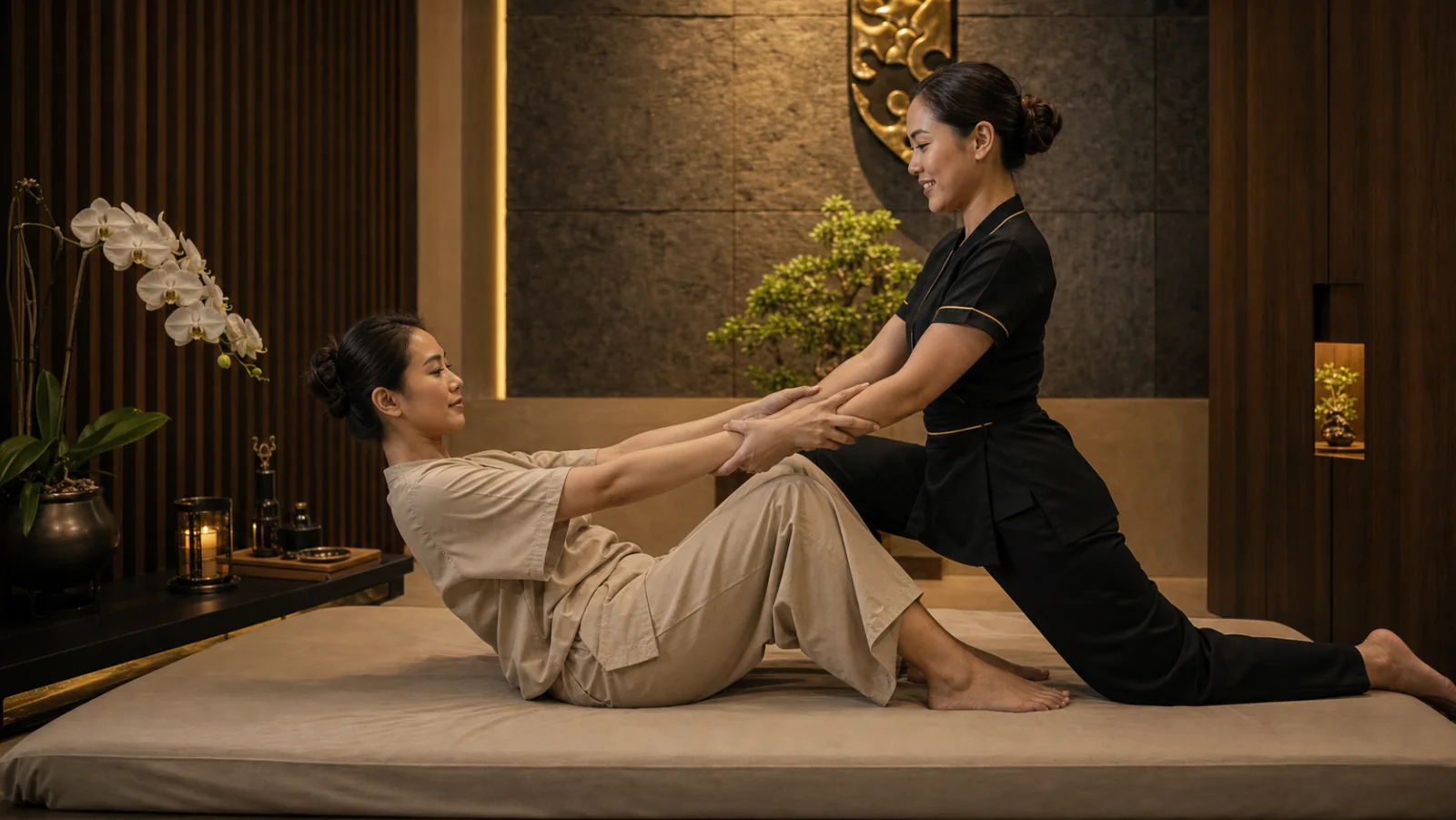
Among the many defining characteristics of Thai massage, few techniques express its holistic philosophy as clearly as the assisted sit-up stretch with arm engagement. This movement, which guides the recipient from a supine position into a seated posture with the therapist’s assistance, reflects the essence of Thai massage as a form of applied movement therapy rather than passive manipulation. It is a technique that simultaneously mobilizes the spine, activates the core, stretches the upper body, and re-educates the nervous system through coordinated, functional motion.
At first glance, the assisted sit-up stretch appears simple: the therapist holds the recipient’s hands or forearms and gradually draws the upper body forward into a seated position. Yet beneath this apparent simplicity lies a complex orchestration of muscular engagement, joint articulation, neurological signaling, and biomechanical precision. When executed with skill, the movement becomes a full-body integration exercise that mirrors natural patterns of rising, reaching, and stabilizing—patterns that modern sedentary lifestyles have largely erased.
From an anatomical perspective, this technique involves a coordinated activation of the anterior and posterior chains of the body. As the torso lifts, the rectus abdominis and deeper core stabilizers such as the transverse abdominis engage to support spinal flexion and control intra-abdominal pressure. At the same time, the hip flexors and quadriceps activate to assist in stabilizing the pelvis and legs against the floor. This controlled activation is not strenuous but precise, awakening muscles that are often dormant from prolonged sitting and minimal movement variation.
The spine plays a central role in this technique. Moving from lying to sitting requires sequential flexion of the cervical, thoracic, and lumbar regions. In daily life, many people bypass this segmentation, either by using momentum or by collapsing into poor posture. In Thai massage, the assisted sit-up stretch restores awareness to this spinal articulation. The therapist guides the movement slowly, ensuring that each vertebral segment participates in a fluid, wave-like motion rather than a single abrupt hinge.

This controlled spinal flexion has important medical implications. Gentle, guided movement nourishes the intervertebral discs by promoting fluid exchange within the disc matrix. Unlike static stretching, which primarily affects muscle tissue, this dynamic mobilization supports spinal health by encouraging hydration and reducing stiffness in surrounding ligaments and fascia. For individuals experiencing postural fatigue, mild disc compression, or movement-related discomfort, this technique offers a safe and restorative way to reintroduce spinal motion.
The engagement of the quadriceps during the assisted sit-up is often overlooked but highly significant. Although the legs remain on the floor, the quadriceps contract isometrically to stabilize the knees and hips as the upper body rises. This activation integrates the lower body into what might otherwise appear to be an upper-body movement. By involving the legs, the technique reinforces the idea that efficient movement is always whole-body movement, not isolated effort.
Equally important is the role of the shoulders and arms. As the therapist holds the recipient’s hands and applies gentle traction, the shoulder girdle undergoes a subtle stretch and mobilization. The deltoids, biceps, triceps, and muscles of the forearm lengthen in response to traction, while deeper stabilizers such as the rotator cuff coordinate to maintain joint integrity. This creates space in the shoulder joints and counters the chronic forward rounding commonly associated with desk work and device use.
The clavicles and scapulae also benefit from this movement. As the arms extend forward and upward, the scapulae glide along the rib cage, promoting healthy scapulothoracic rhythm. This is essential for shoulder health, as restricted scapular movement often contributes to neck tension, shoulder pain, and reduced arm mobility. By restoring this rhythm, the assisted sit-up stretch indirectly supports cervical spine comfort and upper limb function.
From a neurological standpoint, the assisted sit-up stretch is profoundly integrative. The brain must coordinate timing between core engagement, spinal movement, and arm traction. This re-establishes communication between different muscle groups and enhances proprioception, the body’s internal sense of position and movement. In individuals who lead sedentary lives, this proprioceptive awareness is often dulled, leading to clumsy movement, poor posture, and increased injury risk. Thai massage uses techniques like this one to gently retrain the nervous system without conscious effort from the recipient.
Breath plays a subtle but critical role in this technique. As the therapist initiates the pull, encouraging the recipient to exhale naturally allows the rib cage to soften and the abdominal wall to engage more efficiently. This synchrony between breath and movement shifts the nervous system toward a parasympathetic state, reducing protective muscle tension and fostering a sense of ease and trust. The result is a movement that feels supportive rather than demanding, even though it activates multiple muscle groups simultaneously.
One of the most notable benefits of the assisted sit-up stretch is its effect on posture. Modern postural dysfunction is characterized by a collapsed chest, rounded shoulders, forward head position, and weakened core musculature. By guiding the body from horizontal to vertical alignment, this technique reinforces the natural stacking of the head over the spine and the spine over the pelvis. The gentle traction through the arms encourages length through the torso, counteracting habitual compression and slouching.
This postural recalibration extends beyond the massage session. Clients often report feeling taller, more upright, and more energized afterward. This is not merely a subjective sensation but a reflection of improved neuromuscular organization. When the body remembers how to move efficiently, maintaining good posture requires less effort and less conscious correction.
The assisted sit-up stretch also carries an energizing quality that distinguishes it from purely relaxing techniques. While many Thai massage stretches calm the nervous system, this movement introduces a controlled activation that stimulates circulation and awakens the body. Blood flow increases through the muscles of the trunk and limbs, oxygen delivery improves, and metabolic waste products are cleared more efficiently. This makes the technique particularly suitable toward the middle or end of a session, when the body is warm and receptive to integrated movement.

From a functional movement perspective, this technique closely mimics daily actions such as rising from bed, sitting up, or reaching forward to stand. These are fundamental movements that humans perform countless times over a lifetime, yet rarely practice with awareness. When performed poorly, they contribute to strain, imbalance, and cumulative stress on the spine. By reintroducing these movements in a supported, mindful context, Thai massage helps preserve functional independence and movement confidence.
For therapists, technical precision is essential. The pull through the arms must be gradual and evenly distributed, avoiding sudden jerks or excessive force. The therapist’s posture remains grounded, using body weight and alignment rather than arm strength to guide the movement. This ensures safety for both parties and maintains the smooth, flowing quality that defines Thai massage.
The therapeutic value of the assisted sit-up stretch extends to a wide range of individuals, from office workers experiencing postural fatigue to athletes seeking better coordination between upper and lower body. It is particularly beneficial for those who feel disconnected from their bodies or experience stiffness from inactivity. By engaging multiple systems at once, the technique delivers a sense of wholeness that few isolated stretches can achieve.
In the broader philosophy of Thai massage, this technique embodies the principle that health is movement performed with awareness and balance. The assisted sit-up stretch with arm engagement does not impose change on the body; it invites participation, even in a passive recipient. Through guided motion, the body remembers its innate capacity to organize, stabilize, and rise with ease.
In a world where movement has been reduced to sitting, scrolling, and isolated exercise, such techniques serve as a reminder of how the body was designed to function. The assisted sit-up stretch is not just a transition between positions in a Thai massage session. It is a therapeutic dialogue between gravity, muscle, breath, and intention—one that restores vitality, coordination, and a sense of embodied presence that modern life too often erodes.
UPDATED LOFT THAI GUIDE
Additional guidance and current information
The following editorial update expands on the original Loft Thai article with practical context, current treatment guidance and further reading.
A Transition, Not a Standalone Treatment
The movement begins with the guest lying on the back and ends in a supported seated position. The therapist offers a stable contact point while the guest contributes as much or as little movement as feels comfortable.
Some Thai massage sequences use this transition before seated shoulder, neck or upper-back work. It can also simply help the guest change position near the end of a session.
Calling it an “assisted sit-up stretch” can be misleading. The purpose is not to strengthen the core, correct posture or prove flexibility. It is a coordinated change of position within a wellness treatment.
How Much Should the Guest Participate?
The safest version is usually active-assisted: the guest gently nods, engages the trunk and rises while the therapist provides a steady counterbalance. The therapist does not lift the entire body by the arms.
Participation should be agreed before movement begins. A guest may prefer to roll to one side and push up with an elbow, especially after a long treatment, during pregnancy or when lying-to-sitting causes dizziness.
A person who wants no active movement can still be helped with cushions and a side-lying route. There is no need to preserve a traditional-looking transition when another method is clearer.
- Explain the destination before moving
- Let the guest lead the speed
- Share load through a broad forearm grip
- Pause at a reclined angle if needed
- Offer a side-rolling alternative without judgement
The Grip: Protecting Wrists and Shoulders
Pulling the hands or fingers can concentrate force at the wrist and elbow. A forearm-to-forearm hold, with neutral wrists and relaxed shoulders, distributes contact more clearly and gives both people a secure way to release.
The arms should remain below a painful shoulder range. Guests with a history of dislocation, rotator-cuff injury, recent surgery, hypermobility or numbness into the hand may need a different transition.
The therapist’s stance matters too. A stable kneeling or split-kneeling base allows the therapist to shift weight smoothly instead of jerking with the arms or leaning backward suddenly.
A Five-Stage Supine-to-Seated Sequence
The therapist first bends the guest’s knees or supports the legs if that reduces effort. The head should begin on the mattress rather than hanging beyond a pillow.
After agreeing on the grip, the guest initiates the movement. The therapist follows with a gradual backward weight shift, pauses around halfway and checks for neck, shoulder, abdominal or lower-back discomfort.
At sitting, the therapist allows time for balance and orientation. The guest does not need to move directly into another stretch.
-
01
Explain
Describe the move and offer rolling to the side as an equal alternative.
-
02
Position
Set a neutral forearm grip and a stable therapist stance.
-
03
Initiate
Invite the guest to begin rather than pulling a relaxed body upward.
-
04
Pause
Check comfort at a reclined angle and reduce load if the shoulders rise or the neck strains.
-
05
Settle
Support seated balance and wait before adding any further technique.
Claims This Transition Cannot Support
The previous article described disc hydration, spinal re-education, core strengthening, posture recalibration, improved oxygen delivery, waste removal and a parasympathetic shift. Those mechanisms cannot be inferred from one assisted movement in a spa session.
A person may feel more awake after changing position or may enjoy the sense of moving together with the therapist. Those are valid subjective experiences without being evidence of neurological retraining or lasting postural change.
NCCIH notes that massage research is mixed and often supports only short-term outcomes for some conditions. A specific transition should therefore be described by what happens, not by a chain of unmeasured physiological promises.
What the Transition Should Feel Like
A good transition feels predictable. The guest knows when movement will begin, can keep breathing and feels supported rather than pulled. The head, arms and trunk move at a pace the person can follow.
Stop for sharp neck or back pain, shoulder strain, hand tingling, abdominal pain, breathlessness, nausea, visual disturbance or dizziness. The guest should be returned to a comfortable position and allowed time to settle.
Light-headedness can appear after lying down for a long period. Moving in stages—reclined, seated, then standing—can be more comfortable than one continuous lift.
When to Modify or Skip It
Recent abdominal, spinal or shoulder surgery; acute back or neck pain; rib injury; significant osteoporosis; uncontrolled vertigo; severe weakness or instructions to avoid trunk effort are reasons to choose another route.
During pregnancy, the guest’s comfort, stage of pregnancy and clinical guidance matter. Side-lying is often more practical than a direct sit-up, but the appropriate position is individual.
A spa therapist should not use this movement to assess a suspected disc condition, abdominal separation, neurological deficit or cardiovascular symptom. New or concerning symptoms need appropriate clinical evaluation.
Alternatives That Preserve Dignity and Control
Rolling to the side and pressing up through the forearm mirrors a familiar way of getting out of bed and avoids loading the shoulders through a bilateral pull. The therapist can support the upper back without lifting the person.
A wedge or stacked cushions can raise the torso in stages. The guest can pause, place the hands behind the body and continue only when ready.
For a guest who remains comfortable supine, the treatment can end there. The therapist can adjust the room and help the person sit only when the session is complete.
Thai Massage Choreography with Modern Consent
UNESCO recognises Nuad Thai as a living practice transmitted through generations and using varied forms of bodily manipulation. Living traditions also depend on judgement, adaptation and the ability to respond to the person in front of the practitioner.
The visual rhythm of Thai massage can make assisted transitions look effortless. Behind that fluency are simple professional standards: explain, agree, support, observe and stop.
At Loft Thai, the transition earns its place only when it improves the guest’s comfort and orientation. Omitting it is not a lesser treatment.
“An assisted transition should help the guest move—not turn the guest into a passive load.”
Loft Thai Editorial Team
Continue your research
REFERENCES
Sources & further reading
PRACTICAL GUIDANCE
Frequently Asked Questions
Should the therapist pull me up by my hands?
No. A broad forearm grip and active participation are safer than pulling fingers or wrists. You can also roll to your side.
Does an assisted sit-up strengthen the core?
It may involve some trunk effort, but one spa transition should not be marketed as strength training or rehabilitation.
What if I feel dizzy when I sit up?
Tell the therapist immediately. Return to a comfortable position, move in stages and do not stand until the dizziness has settled.
Can I decline the assisted transition?
Yes. It is optional, and side-rolling or a cushion-supported rise can be used instead.
Is the move suitable after shoulder surgery?
Not without following your clinician’s restrictions. Avoid an arm-assisted pull when the shoulder has not been cleared for that load.
CONTINUE READING
Related stories
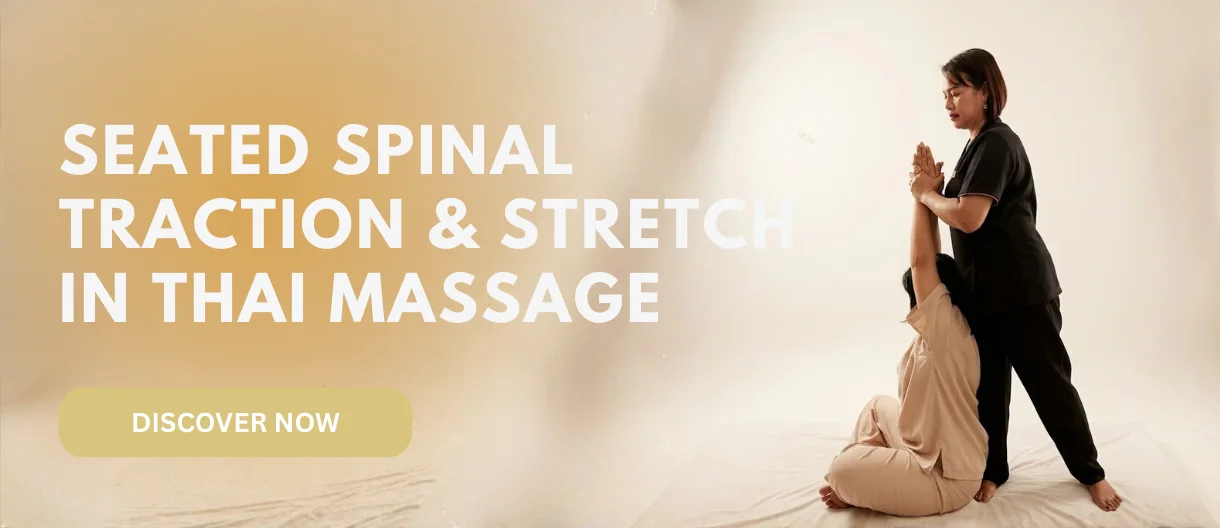
The Final Awakening: Deconstructing the Seated Spinal Stretch in Traditional Thai Massage
Traditional Thai Massage , or Nuad Thai, is often described poetically as "lazy man’s yoga." It is a complex, holistic therapy that blends rhythmic acupressure, assisted stretching, and deep compression to harmonize the body’s physical structure and energy…
Read the guide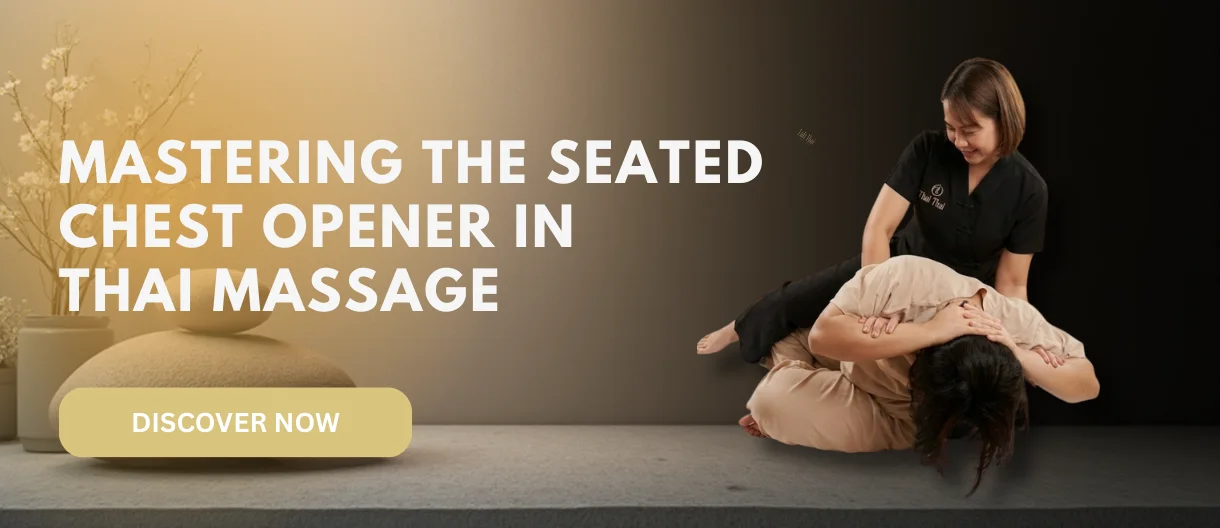
The Art of Dat Lang: Mastering the Seated Chest Opener in Traditional Thai Massage
In the intricate choreography of Traditional Thai Massage —often described as "lazy man's yoga"—there is a rhythm to the session. It begins at the feet, working through the energy lines (Sen lines) of the legs, moving up the back, and often culminates in a…
Read the guide
Bangkok Spa Etiquette: Tipping, What to Wear, What to Say to Get the Pressure You Want in 2026
Booking a spa in Bangkok should feel exciting—not confusing. But if it’s your first time Thai massage or oil massage, it’s normal to wonder about the unspoken rules. Do you tip? How much? What do you wear? Do you keep underwear on? And how do you ask for the…
Read the guide
Tok Sen Massage for Deep Tension: Why Vibration Can Reach Where Hands Cannot
Deep muscle tension is often misunderstood. Many people imagine that a tight shoulder, a stiff lower back, or a heavy neck can only be solved by stronger pressure, deeper elbows, or longer massage sessions. While deep pressure can be useful when applied…
Read the guide