
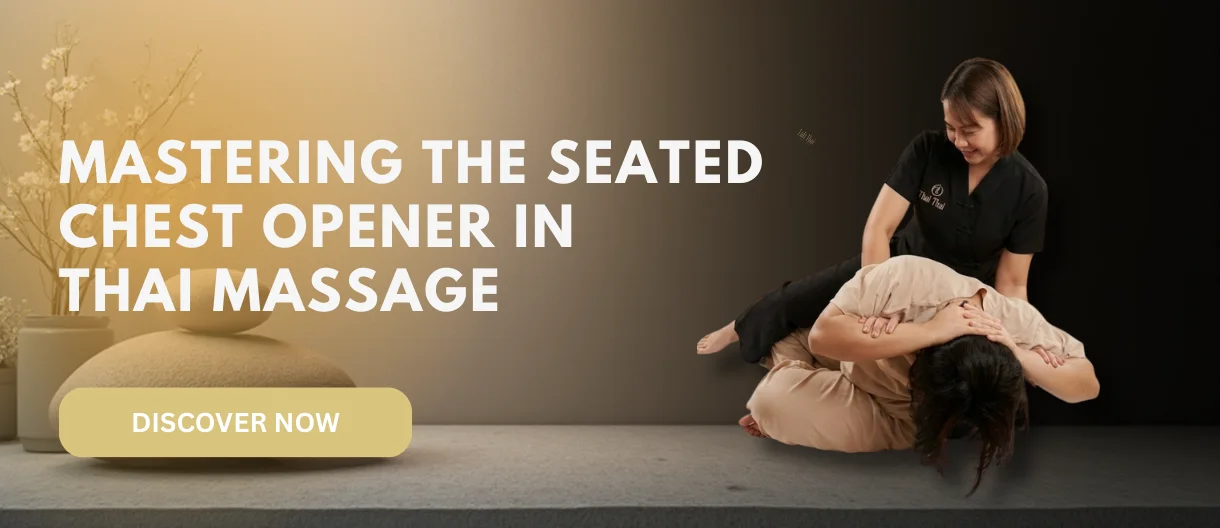
In the intricate choreography of Traditional Thai Massage—often described as "lazy man's yoga"—there is a rhythm to the session. It begins at the feet, working through the energy lines (Sen lines) of the legs, moving up the back, and often culminates in a series of seated stretches that leave the receiver feeling taller, lighter, and revitalized. Among these finale movements, one pose stands out for its elegance and profound relief: the Seated Chest Opener.
While Western anatomy might label it an "Assisted Seated Cobra" or a "Thoracic Extension," within the lineage of Thai healing, it falls under the category of "Dat" (ดัด). Specifically, this is Dat Lang (ดัดหลัง)—the art of bending and adjusting the back.
This article explores the anatomy, cultural roots, benefits, and precise execution of this powerful technique, dissecting why this single movement is the perfect antidote to the modern lifestyle.
The Cultural Roots: Reusi Dat Ton and the Concept of "Dat"
To understand this pose, one must understand the word the user provided: Dat. In the Thai language, Dat translates to "bending," "stretching," or "adjusting." It implies a structural correction, a way of returning the body to its intended alignment.
This concept draws directly from Reusi Dat Ton (Hermit’s Self-Stretching), the ancient foundation of Thai physical therapy. Legend holds that the Reusi (ascetic hermits/yogis) lived in the forests and mountains of ancient Thailand (Siam). After long hours of meditation in curled, seated positions, their bodies would ache and stiffen. To restore their flow of energy and physical comfort, they developed a system of dynamic exercises and self-massage.
The pose shown in the image is a practitioner-assisted evolution of those solitary stretches. Where the hermit would use their own muscles to arch their back and open their chest to the sky, the Thai massage therapist acts as an external force, allowing the receiver to surrender completely into the stretch without muscular effort. This is the essence of Thai Massage: the receiver remains passive, while the therapist facilitates the "Dat," guiding the skeleton back into harmony.
Anatomy of the Move: Extension, Not Rotation
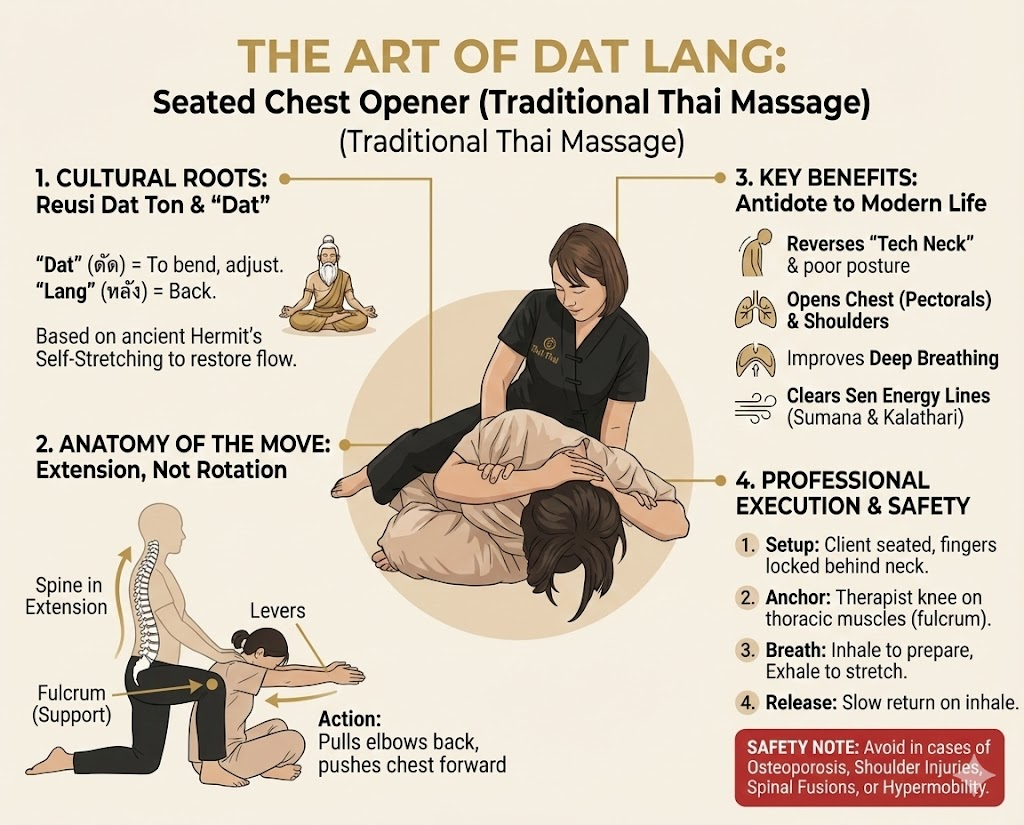
There is often confusion regarding the mechanics of this pose, with some labeling it "Spinal Rotation." It is crucial to correct this. Rotation implies a twisting of the spine along the transverse plane (looking left or right).
Dat Lang is a pure Spinal Extension in the sagittal plane.
Here is what is happening anatomically during this pose:
- The Fulcrum: The therapist places a knee (or sometimes a soft thigh/cushion) vertically along the client’s thoracic spine (the upper and middle back). This acts as a pivot point.
- The Levers: The client’s arms, with fingers interlocked behind the head, act as levers.
- The Action: By pulling the elbows backward while simultaneously pushing the thoracic spine forward with the knee, the therapist opens the anterior (front) chain of the body.
This movement specifically targets:
- Pectoralis Major and Minor: The chest muscles, which are chronically tight in most people.
- Anterior Deltoids: The front of the shoulders.
- Thoracic Vertebrae: It reverses the kyphotic curve (the natural outward curve of the upper back), encouraging extension.
- Intercostal Muscles: The muscles between the ribs are stretched, allowing for deeper lung expansion.
The Antidote to "Tech Neck"
Why is Dat Lang so popular in modern spas and clinics? Because it directly counteracts the "21st-century posture."
Most of modern life involves flexion—bending forward. We hunch over steering wheels, we curl forward to type on laptops, and we look down at smartphones. This constant flexion leads to a condition often called "Upper Crossed Syndrome," characterized by:
- Rounded shoulders.
- A collapsed chest.
- A forward head posture.
- Shallow breathing.
When a therapist performs the Seated Chest Opener, they are physically reversing this pattern. They are prying open the caved-in chest cavity. For a client who spends 40 hours a week at a desk, this moment in the massage often elicits a deep, involuntary groan of relief. It is the physical sensation of "un-hunching" years of bad posture.
Energetic Benefits: Clearing the Sen Lines
Beyond muscles and bones, Thai Massage is a manipulation of Lom (Wind/Energy) traveling through Sen (pathways).
This specific pose works on opening the chest to clear blockages in Sen Sumana and Sen Kalathari.
- Sen Sumana: Runs through the core of the body. By opening the chest, we free the pathway for the heart and lungs.
- Sen Kalathari: Runs from the navel out to the extremities (arms and legs). Stretching the arm lines and shoulders stimulates energy flow to the fingers.
When these lines are cleared, the client often experiences a "rush" of alertness. This is why this pose is usually done at the end of the session—it wakes the client up, transitioning them from the deep relaxation of the mat back to the reality of the world, feeling taller and more vibrant.
Step-by-Step Execution: The Professional Standard

For the therapist (like the one pictured in professional black attire), executing this move requires leverage, not brute strength. Here is the technical breakdown:
1. The Setup The client sits cross-legged (Sukhasana). The therapist kneels behind them. The therapist asks the client to interlace their fingers behind their neck (not the top of the head, to protect the cervical spine).
2. The Anchor The therapist places one knee gently but firmly against the client’s spine. Crucial Note: The knee must be placed on the muscles alongside the spine (erector spinae) or centrally on the thoracic vertebrae, but never on the kidney area (too low) or directly on the neck (too high).
3. The Grip The therapist threads their hands through the client’s arms to grasp the client’s wrists or forearms. Alternatively, they may hold the elbows directly, depending on the flexibility of the client.
4. The Breath and "Dat" The therapist instructs the client to inhale. On the exhale, the therapist leans their own body weight backward. They do not pull with their biceps; they lean back, using the knee as the fulcrum. This pulls the client’s elbows back and arches their spine over the therapist's knee.
5. The Release The stretch is held for 3 to 5 seconds, then slowly released as the client inhales. This may be repeated 2 or 3 times, moving the knee slightly up or down the thoracic spine to target different segments.
Safety and Contraindications
While Dat Lang is beneficial for most, it is not for everyone. A professional therapist must assess the client before attempting this deep extension.
Contraindications (When to avoid):
- Osteoporosis: In elderly clients or those with brittle bones, the pressure of the knee against the ribs or spine can cause fractures.
- Shoulder Injuries: If a client has a frozen shoulder or torn rotator cuff, the leverage on the arms is too aggressive.
- Spinal Fusions or Herniated Discs: Any history of spinal surgery in the thoracic or lumbar region requires extreme caution or avoidance of this move.
- Hypermobility: Clients who are "double-jointed" need stability, not more stretching. The therapist must not over-extend them.
Conclusion
The image of the therapist in black performing the Dat Lang on the white mat captures the essence of Thai Massage: a blend of clinical precision and compassionate touch. It is a moment of trust. The client exposes their most vulnerable area—the heart and chest—allowing the therapist to support them physically and structurally.
In a world that forces us to curl inward, to protect ourselves, and to hunch over our work, this "Seated Chest Opener" is a radical act of opening up. It reminds the body of what it feels like to stand tall, breathe deep, and face the world with an open heart. It is the perfect closing note to the ancient symphony that is Thai Massage.
UPDATED LOFT THAI GUIDE
Additional guidance and current information
The following editorial update expands on the original Loft Thai article with practical context, current treatment guidance and further reading.
What “Dat Lang” Means in Practice
Dat can refer to bending, stretching or adjusting, while lang refers to the back. Terminology is not perfectly standardised across schools, and the same name may describe more than one assisted back or chest-opening movement.
In the seated variation discussed here, the receiver sits while the elbows are bent and the hands rest behind or near the head. The practitioner stands or kneels behind, supports the upper arms and encourages a small extension through the upper torso.
This differs from the overhead-arm stretch in which the arms travel upward and the emphasis is a lengthening direction. Clear naming prevents teachers and students from treating two distinct leverage patterns as interchangeable.
Teach the Shape Without Forcing It
The visible pose can tempt students to reproduce the final photograph. Good teaching starts earlier: the receiver must sit comfortably, the practitioner must establish stable stance and the arms must reach the setup position without pain.
The movement does not need a dramatic arch. The practitioner’s support creates a boundary and a direction; it should not act as a hard pivot driven into the spine. Broad contact beside the upper back, or a padded thigh where appropriate to the school’s method, is easier to control than a sharp knee point.
If the receiver cannot place the hands comfortably behind the head, the technique should change. Pulling the elbows backward does not fix restricted shoulder range.
- Comfortable seated base before any leverage
- Bent elbows positioned without neck strain
- Broad thoracic support rather than a sharp pressure point
- Small initial range and clear verbal check
- Slow return with no rebound or sudden release
A Six-Part Teaching Sequence
Demonstration should show hand placement and the exit as clearly as the main movement. Students then practise at low range while the instructor observes the receiver’s position, the practitioner’s base and the quality of communication.
The first goal is repeatable control, not greater extension. Only when a student can begin, pause and return smoothly should range be considered.
-
01
Screen
Ask about neck, shoulder and spine history, pain with arm position, dizziness, osteoporosis and recent procedures.
-
02
Set the seat
Use a comfortable leg position and support the receiver so the pelvis does not slide as the torso moves.
-
03
Place the arms
Let the receiver move actively into a bent-elbow position; do not push hands or neck into place.
-
04
Build broad support
Contact the upper back with a stable, padded surface and keep pressure away from the neck and lower ribs.
-
05
Invite a small extension
Use body weight gradually while asking about the shoulders, chest and back.
-
06
Return and reassess
Release slowly, help the arms lower and ask how the receiver feels before another movement.

Thoracic Extension Is Not Posture Correction
The seated chest opener may encourage temporary extension through the upper torso and place the chest and front of the shoulders in a lengthened position. It does not permanently reverse kyphosis, correct upper-crossed syndrome or undo years of desk posture.
Posture changes across tasks, fatigue, habit and individual anatomy. A short assisted movement can feel refreshing without becoming a corrective medical intervention.
Teachers should remove promises about increasing lung volume, restoring spinal alignment or treating a disc condition. These statements go beyond what a spa technique can establish.
Hand Placement, Leverage and the Exit
Supporting the upper arms gives the practitioner influence over the movement without pulling directly on the neck. Contact at the elbows can be appropriate for some receivers, but the practitioner must avoid compressing sensitive joints or forcing the shoulders behind their available range.
The practitioner’s own spine remains long and the backward weight shift stays small. If balance depends on a large lean, the setup is unstable. A teacher should be able to interrupt the movement at any point and ask the student to return the receiver safely.
The exit often reveals more than the pose. Arms should lower gradually, the upper back should leave the support without a drop and the receiver should remain seated until balance is clear.
A Communication Script Students Can Practise
Technique instruction improves when consent language is rehearsed as carefully as hand placement. Before setup: “I would like to try a small seated chest-opening stretch. Would you like to continue?”
During arm placement: “Tell me if this position pinches the shoulder or strains the neck.” During movement: “I will move only a little. Is this range comfortable?” At the exit: “Any sharp pain, tingling, dizziness or discomfort?”
These questions are short and specific. They make it easier for the receiver to answer than a general “Okay?” delivered after the stretch is already at full range.
Modifications Before Omission
A smaller version can keep the elbows lower and use only a gentle upper-back support. One side can be explored at a time when shoulder range differs, provided the receiver remains stable and the practitioner avoids twisting the neck.
If sitting cross-legged is uncomfortable, the receiver can sit with legs supported or on a stable cushion. When seated balance is poor, a side-lying shoulder-opening technique may preserve the intention with less demand.
Omission is also a valid modification. A complete Thai massage does not depend on Dat Lang, and no student should be assessed by how far they can move another person.
Contraindications and Referral
Avoid or seek appropriate guidance with recent shoulder or spine surgery, acute injury, fracture, marked osteoporosis, instability, neurological symptoms or pain in the setup position. Significant hypermobility may call for stability rather than greater range.
The therapist should not diagnose frozen shoulder, disc herniation or postural syndrome. When a receiver reports persistent pain, weakness, numbness or trauma, refer for appropriate assessment rather than testing a stronger version.
NCCIH notes that serious adverse events from massage are rare but have occurred, particularly with vigorous methods or people at increased risk. Conservative screening and range are part of professional technique.
Cultural Language and Training Honesty
Dat Lang is sometimes linked in teaching narratives to Ruesi Dat Ton, Thai self-stretching traditions. Schools may explain that relationship as part of their lineage, but a visual resemblance alone does not prove that one modern partner technique descends directly from one ancient exercise.
UNESCO’s Nuad Thai inscription supports the importance of Thai knowledge transmission. It does not standardise every technique name or confirm every anatomical explanation used by a school.
Honest teaching distinguishes tradition, school-specific terminology and contemporary safety practice. That clarity strengthens the technique rather than diminishing its heritage.

“The teacher’s first responsibility is not a beautiful pose. It is a movement the practitioner can control and the receiver can leave at any moment.”
Loft Thai Editorial Team
Continue your research
REFERENCES
Sources & further reading
PRACTICAL GUIDANCE
Frequently Asked Questions
What does Dat Lang mean?
Dat can refer to bending, stretching or adjusting, and lang refers to the back. Usage varies between schools, so the exact movement should always be described.
Is Dat Lang the same as an overhead seated spinal stretch?
Not necessarily. The variation in this guide uses bent elbows and supported chest opening, while the overhead stretch places the arms in a different leverage pattern.
Should the practitioner press a knee directly into the spine?
Training should favour broad, controllable support and avoid sharp pressure on the neck, vertebrae or lower ribs.
Does Dat Lang correct rounded shoulders?
It may create a temporary sense of upper-body opening, but it should not be marketed as permanent posture correction or treatment for a postural condition.
Can Dat Lang be omitted from a Thai massage?
Yes. It should be modified or omitted whenever the setup, shoulder range, seated balance or health history makes it unsuitable.
CONTINUE READING
Related stories
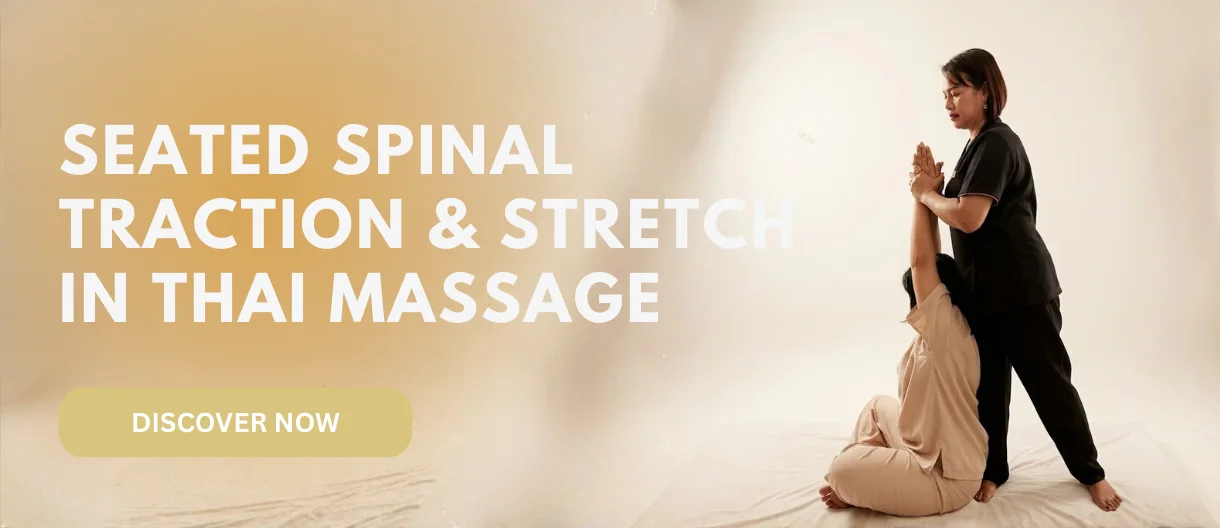
The Final Awakening: Deconstructing the Seated Spinal Stretch in Traditional Thai Massage
Traditional Thai Massage , or Nuad Thai, is often described poetically as "lazy man’s yoga." It is a complex, holistic therapy that blends rhythmic acupressure, assisted stretching, and deep compression to harmonize the body’s physical structure and energy…
Read the guide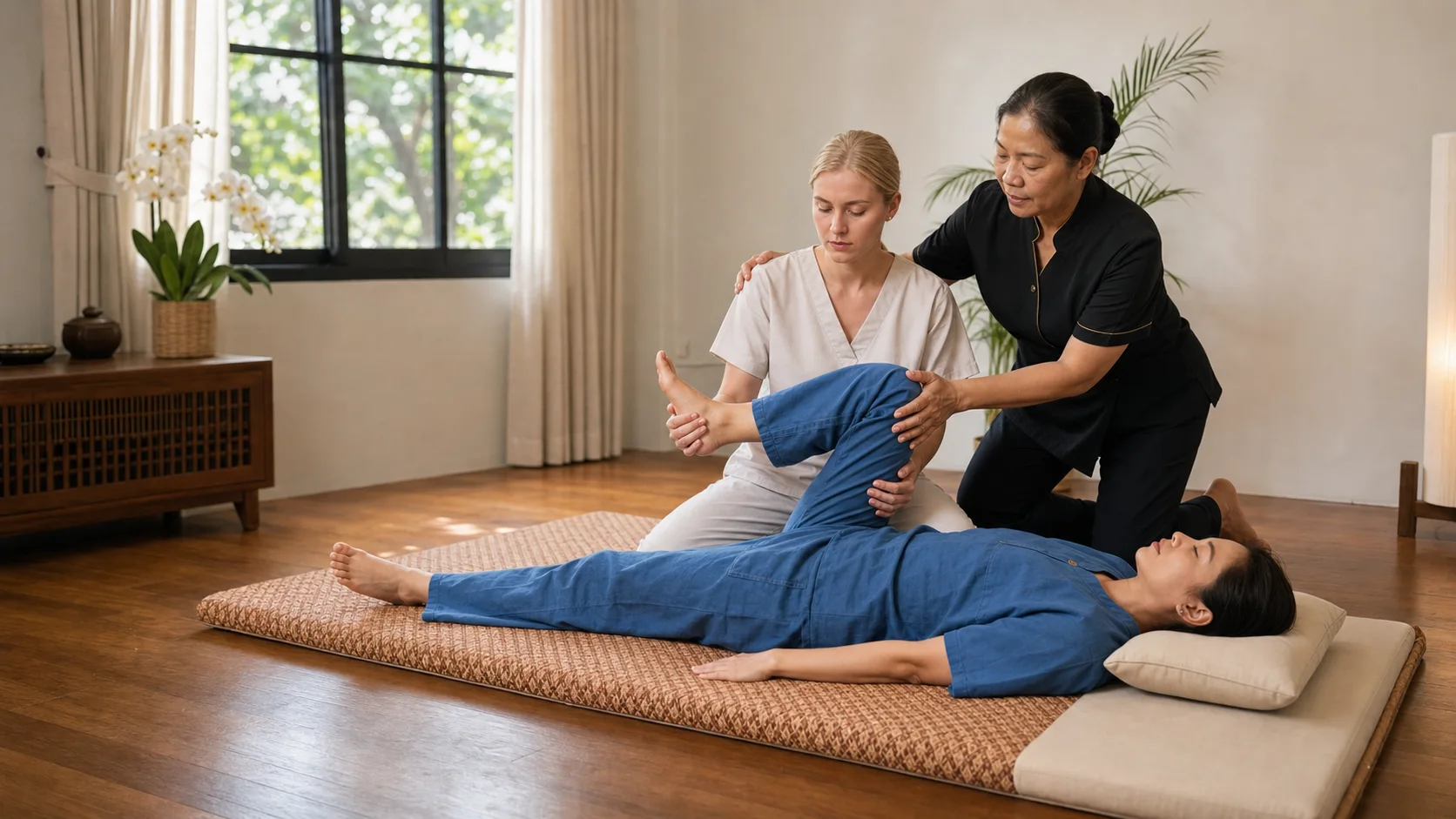
Nuad Thai School: One of the Best Thai Massage Schools and Spa Training Centers in Bangkok, Operated by Loft Thai Spa
Bangkok has long been recognized as one of the world capitals of massage, spa therapy, traditional healing, and wellness culture. For many international students, professional therapists, spa owners, and wellness entrepreneurs, Thailand is not simply a…
Read the guide
How Education and Heritage Power the World of Loft Thai Spa
In the competitive landscape of luxury wellness, where every establishment promises tranquility and rejuvenation, true distinction is rarely a matter of chance. It is easy to construct a beautiful room, to light scented candles, and to play soft music that…
Read the guide
A Beautiful Moment of Thai Massage Learning at Nuad Thai School by Loft Thai Spa
When someone travels across the world to learn Thai massage in Bangkok, they are not simply booking a class. They are choosing to enter a culture, a tradition, and a way of understanding the body that has been passed from generation to generation. At Loft Thai…
Read the guide