
Thai massage has always stood apart from other bodywork traditions because it does not merely treat muscles in isolation. It works with the entire kinetic chain, integrating joints, fascia, breath, posture, and neurological regulation. Among the most refined expressions of this philosophy is what can be described as controlled hip and quadriceps mobilization—an advanced Thai massage stretch technique that targets one of the most overloaded and dysfunctional regions of the modern body: the hip complex.
This technique focuses primarily on the hip flexors and the quadriceps, two muscle groups that play a decisive role in posture, gait, spinal health, and movement efficiency. Performed with the recipient lying either on the side or in a prone position, the therapist carefully bends one leg behind the body while stabilizing the pelvis and guiding the thigh into a precise, controlled stretch. Although the movement appears simple, the therapeutic depth lies in how the stretch is applied, how the joints are protected, and how the body is encouraged to release rather than resist.
To understand why this technique is considered advanced, it is essential to explore the anatomy involved, the biomechanics of the movement, and the neurological responses that make this stretch far more than a passive elongation of muscle tissue.
At the center of this technique is the hip joint, one of the largest and most powerful joints in the human body. Structurally, it is a ball-and-socket joint formed by the femoral head and the acetabulum of the pelvis. This design allows for a wide range of motion—flexion, extension, abduction, adduction, and rotation—while also bearing significant load during standing, walking, and running. However, this mobility comes at a cost. When movement patterns are limited or repetitive, the hip joint easily becomes restricted, leading to compensations elsewhere in the body.
The quadriceps femoris muscle group consists of four muscles: rectus femoris, vastus lateralis, vastus medialis, and vastus intermedius. Of these, the rectus femoris is particularly significant in Thai massage stretching because it crosses both the hip and knee joints. This dual-joint function makes it especially prone to tightness, particularly in individuals who sit for long periods, cycle frequently, or engage in repetitive lower-body activities without adequate stretching. When the rectus femoris shortens, it pulls the pelvis into anterior tilt, increases lumbar lordosis, and contributes directly to lower back strain.

The iliopsoas complex, often grouped with the hip flexors, plays an equally critical role. This deep muscle group connects the lumbar spine to the femur and is heavily involved in hip flexion, spinal stabilization, and postural balance. Chronic shortening of the iliopsoas is one of the most common yet overlooked contributors to persistent lower back discomfort and inefficient gait mechanics.
In controlled hip and quadriceps mobilization, the therapist’s goal is not forceful stretching but intelligent joint positioning. By stabilizing the pelvis—often using the therapist’s body weight, forearm, or knee—the movement is isolated to the hip joint rather than allowing excessive lumbar extension. This distinction is crucial. When the pelvis is not properly stabilized, the apparent stretch occurs in the lower back instead of the hip, which not only reduces effectiveness but increases the risk of discomfort or injury.
The bending of the leg behind the body creates a combined movement of hip extension and knee flexion. This simultaneously lengthens the quadriceps while mobilizing the anterior hip capsule. The therapist applies gradual pressure, working within the recipient’s natural breathing rhythm. On exhalation, the nervous system shifts toward parasympathetic dominance, allowing deeper release without triggering protective muscle guarding.
From a medical and neurological perspective, this technique engages more than just muscle fibers. Stretching in this controlled manner stimulates mechanoreceptors within the muscles, tendons, and joint capsules. These receptors send signals to the central nervous system, informing it that the movement is safe. When performed skillfully, the stretch reduces hypertonicity not by force, but by recalibrating neuromuscular tone.
This is particularly relevant for individuals suffering from chronic hip tightness or lower back strain. In many cases, pain in the lumbar spine is not caused by spinal pathology itself but by restricted hip mobility. When the hips cannot extend properly during walking or standing, the lumbar spine compensates by increasing movement beyond its optimal range. Over time, this leads to compression, irritation, and fatigue in spinal structures. By restoring hip extension through targeted Thai massage stretching, the load is redistributed more evenly across the body.
Another often underestimated benefit of this technique lies in its effect on posture. Modern lifestyles dominated by prolonged sitting place the hips in constant flexion. Over time, the body adapts by shortening the hip flexors and weakening the opposing muscles, particularly the gluteus maximus. This muscular imbalance results in a forward-shifted pelvis, rounded lower back mechanics, and reduced shock absorption during movement. Controlled hip and quadriceps mobilization helps reverse this pattern by reopening the front of the body and reminding the nervous system of its natural alignment.
The influence on gait is equally significant. Efficient walking requires coordinated hip extension at the end of each step. When this motion is restricted, stride length shortens, energy expenditure increases, and compensatory movements appear in the knees, ankles, or lower back. Regular application of this Thai massage technique can gradually restore a more fluid, symmetrical walking pattern, reducing strain across the entire kinetic chain.
From a therapeutic standpoint, this stretch is especially valuable for office workers, drivers, athletes, and anyone experiencing asymmetrical movement patterns. Runners and cyclists, for example, often develop dominant quadriceps and tight hip flexors, which predispose them to knee pain, hip impingement, or lumbar discomfort. When integrated into a broader Thai massage session, controlled hip mobilization acts as a reset mechanism, allowing subsequent stretches and compressions to work more effectively.
Technically, the therapist must maintain constant body awareness throughout the movement. The pressure is not linear but adaptive, responding to tissue resistance and subtle changes in breathing. The therapist’s spine remains neutral, their center of gravity low, ensuring that the stretch is delivered through body weight rather than muscular effort. This not only protects the therapist from injury but ensures a smooth, uninterrupted transmission of force.

One of the defining characteristics of advanced Thai massage is its emphasis on connection rather than manipulation. In this technique, the therapist does not impose movement onto the body but invites it. Small oscillations, micro-adjustments, and pauses allow the tissue to soften gradually. This approach respects the body’s protective mechanisms and avoids triggering stretch reflexes that would otherwise limit effectiveness.
Over time, consistent application of this technique produces cumulative benefits. Muscle length increases, joint mobility improves, and proprioceptive awareness deepens. Clients often report not only reduced pain but a feeling of lightness in the hips and legs, improved balance, and greater ease in everyday movements such as standing up, walking, or climbing stairs.
Importantly, this technique also has a preventive dimension. By maintaining healthy hip extension and quadriceps flexibility, the risk of degenerative joint changes, repetitive strain injuries, and postural dysfunction is reduced. In this sense, controlled hip and quadriceps mobilization is not merely corrective but foundational, supporting long-term musculoskeletal health.
In the broader context of Thai massage, this stretch reflects the art’s deeper philosophy. Thai massage is not about chasing symptoms but restoring harmony within the body’s structure and energy flow. The hips are a central hub of movement, stability, and power. When they are free, the rest of the body moves with greater efficiency and grace.
Controlled hip and quadriceps mobilization exemplifies how traditional Thai techniques align seamlessly with modern anatomical and medical understanding. By integrating joint stabilization, muscle elongation, neurological regulation, and breath awareness, this advanced stretch demonstrates why Thai massage remains one of the most sophisticated bodywork systems in the world.
In a time when sedentary habits dominate daily life, techniques that reopen the hips and restore natural movement patterns are no longer optional luxuries. They are essential tools for maintaining posture, preventing pain, and preserving the body’s innate capacity for fluid, efficient motion.
UPDATED LOFT THAI GUIDE
Additional guidance and current information
The following editorial update expands on the original Loft Thai article with practical context, current treatment guidance and further reading.
What “Hip Mobilization” Means in a Spa Setting
In this article, mobilization means a therapist-guided movement within a comfortable range. It may include bending or straightening the knee, moving the thigh slightly forward or back, or supporting the leg in a side-lying position.
It does not mean a clinical joint-mobilisation grade, a manipulation or a diagnosis. Loft Thai provides wellness massage; a spa therapist should not claim to reposition the femoral head, correct the pelvis or treat a structural hip condition.
The practical objective is to make the leg feel supported while the guest explores a modest movement or stretch. The route can be changed as soon as the knee, hip or lower back stops feeling easy.
The Anatomy, Without the Posture Story
The hip is a ball-and-socket joint built for both mobility and stability. NCBI’s hip anatomy overview notes its importance in standing, gait and rising from a chair, while also explaining that bone, capsule and neuromuscular structures define individual limits.
The quadriceps group extends the knee. Rectus femoris also crosses the hip and contributes to hip flexion, so combining knee bend with movement of the thigh can create a stronger front-of-thigh sensation.
Those facts do not prove that sitting has shortened a specific muscle or that one assisted stretch will change posture, gait or spinal load. A guest’s movement is influenced by many factors that cannot be reduced to one “tight hip flexor” explanation.
- The hip has individual anatomical limits
- Rectus femoris crosses the hip and knee
- Knee and hip positions influence one another
- A spa session cannot diagnose the source of pain or altered gait
Side-Lying, Prone or Supine?
Side-lying allows cushions beneath the head, waist and upper leg. It makes communication easy and can reduce pressure on the abdomen, chest and kneecaps. The therapist can support the entire leg rather than holding only the ankle.
Prone position gives direct access to knee flexion but may be uncomfortable for the neck, abdomen or lower back. The therapist should use a modest range and avoid pressing the spine while pulling the leg.
Supine movement is often the least demanding. A supported bend of the hip and knee, gentle outward or inward travel within comfort, or a heel slide can provide a useful alternative without turning the guest over.
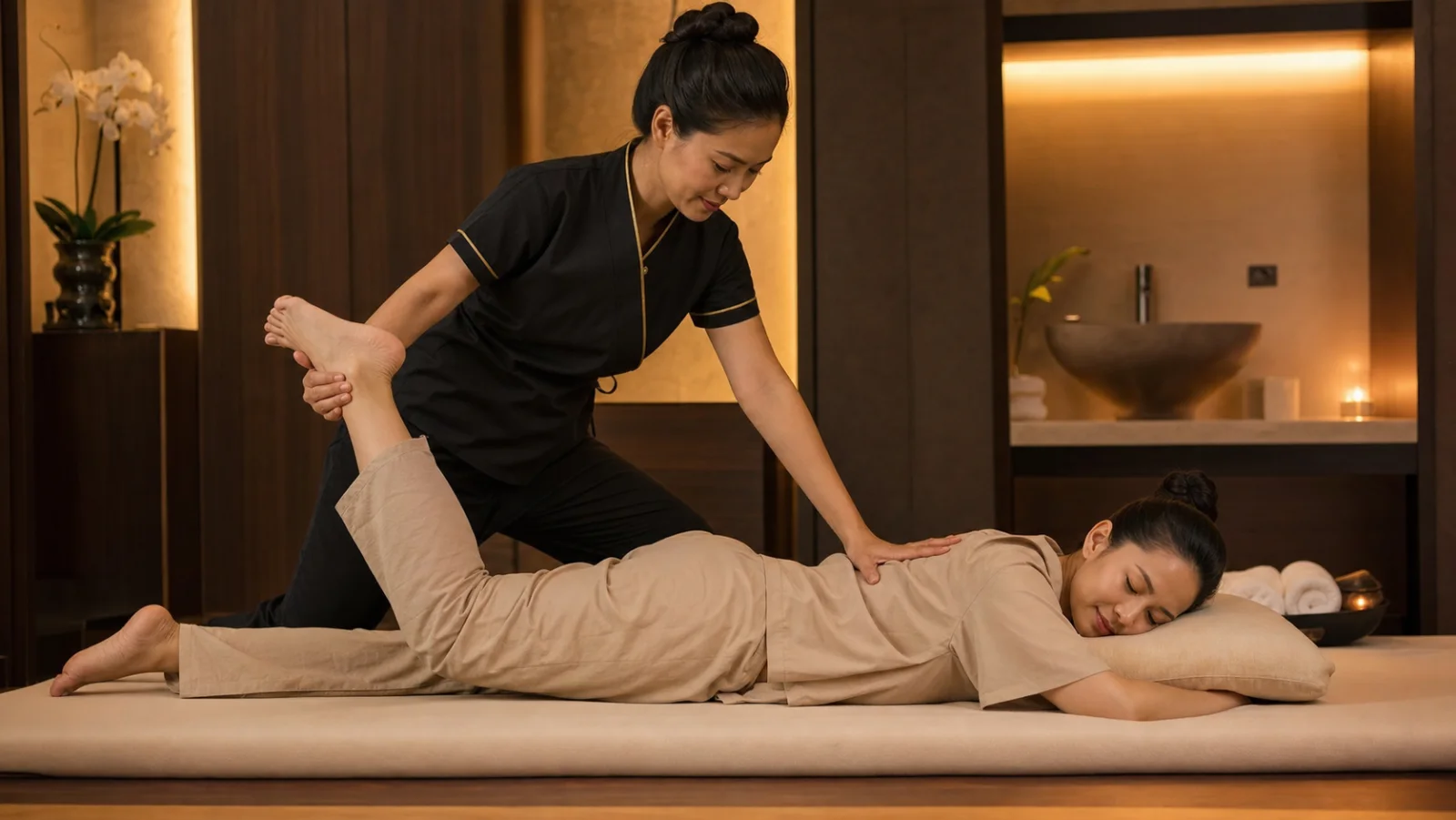
A Supported Side-Lying Sequence
The guest lies on one side with the lower leg stable and the upper leg supported by the therapist or a cushion. The pelvis is allowed to remain neutral rather than being forcibly stacked.
The therapist contacts above and below the knee so the joint is not used as a lever. A small knee bend may be combined with a slight movement of the thigh behind the body, but only while the pelvis, knee and lower back remain comfortable.
The leg returns to the cushion before the therapist changes hand position. Each new direction is explained rather than blended into a continuous, unpredictable stretch.
-
01
Cushion
Support the head, waist and upper leg so the guest is not holding the position.
-
02
Agree
Name the intended knee and hip movement and confirm a stop signal.
-
03
Support
Hold the thigh and lower leg broadly without twisting the knee or ankle.
-
04
Explore
Move through a small range and ask where the guest feels it.
-
05
Return
Bring the leg back to neutral slowly and let it rest before another direction.
Range Is Not a Performance Metric
An advanced-looking pose can hide poor control. The guest may rotate the pelvis, brace the abdomen, hold the breath or feel pressure at the knee long before the leg reaches the angle shown in a photograph.
Small oscillations can be comfortable when they remain within an agreed range, but they are not proof of fascial release or neurological recalibration. The therapist should stop if movement becomes springy, painful or difficult to reverse.
Both sides do not need to match. Differences can reflect anatomy, prior injury, habitual movement or simple day-to-day variation. A massage session is not a symmetry test.
Claims to Retire: Posture Reset, Gait Correction and Prevention
The former article promised postural correction, lumbar decompression, improved gait, pain prevention, greater proprioception and reduced degenerative change. Those are medical or long-term claims that a single spa technique cannot establish.
Massage research may support short-term comfort for some conditions, but NCCIH describes the evidence as mixed and often low in strength. It also notes that rare serious adverse events have been reported, particularly with vigorous techniques or vulnerable clients.
A careful article therefore separates plausible experience from guaranteed outcome: the guest may enjoy supported movement or temporary ease, while persistent pain, weakness or altered gait belongs in a clinical assessment.
Useful Sensations and Clear Stop Signals
A comfortable movement may produce a mild or moderate stretch across the front of the thigh or hip. Pressure should remain broad, and the guest should be able to breathe and speak normally.
Stop for groin pinching, knee pain, pressure beneath the kneecap, sharp lower-back discomfort, cramping, numbness, tingling, electric sensation or a feeling that the joint is catching or giving way.
The therapist should ask location as well as intensity. “Where do you feel this?” often produces more useful information than asking only whether the stretch is strong enough.
When to Modify, Postpone or Refer
Disclose recent hip, knee or lumbar injury; surgery; replacement precautions; fracture; dislocation; significant osteoporosis; inflammatory flare; unexplained swelling or a history of the joint giving way. A smaller range or a different position may be necessary.
Avoid direct work over acute bruising, inflamed skin, infection, open wound, painful varicose vein or a new injection site. Sudden leg swelling, warmth, redness or severe unexplained pain requires medical assessment rather than massage.
Pregnancy, neurological symptoms and chronic conditions are not handled by one universal rule. Follow the person’s healthcare guidance and choose positions that do not create abdominal pressure, dizziness or instability.
Integrating Hip Work into a Thai Massage
Hip and quadriceps work can follow gentle leg compression and precede a quiet return to neutral. It does not need to culminate in a deeper posture or dramatic bilateral stretch.
UNESCO describes Nuad Thai as a living tradition involving varied body tools and transmitted knowledge. Modern professional practice adds explicit consultation, informed consent, careful draping and appropriate referral.
At Loft Thai, the therapist can combine Thai massage rhythm with present-day safety: support the full limb, explain each position and let the guest’s response—not a predetermined sequence—set the range.
“A hip movement is controlled when the guest can remain supported, breathe normally and change the range at any moment.”
Loft Thai Editorial Team
Continue your research
REFERENCES
Sources & further reading
PRACTICAL GUIDANCE
Frequently Asked Questions
Is hip mobilization the same as a clinical joint manipulation?
No. In a spa context it describes gentle therapist-guided movement within comfort, not diagnosis, high-velocity manipulation or graded physiotherapy treatment.
Which position is best for hip and quadriceps work?
There is no universal best position. Side-lying offers support and easy communication, prone can suit modest knee flexion, and supine is often easiest to control.
Should both hips move through the same range?
No. Natural asymmetry is common, and each side should be adapted independently.
Can this technique correct my gait or posture?
It should not be sold as gait or posture correction. Temporary comfort is possible, but persistent movement concerns need appropriate clinical assessment.
What symptoms mean hip work should stop?
Groin pinching, joint pain, sharp back pain, catching, numbness, tingling, sudden swelling or a feeling of instability are reasons to stop and reassess.
CONTINUE READING
Related stories
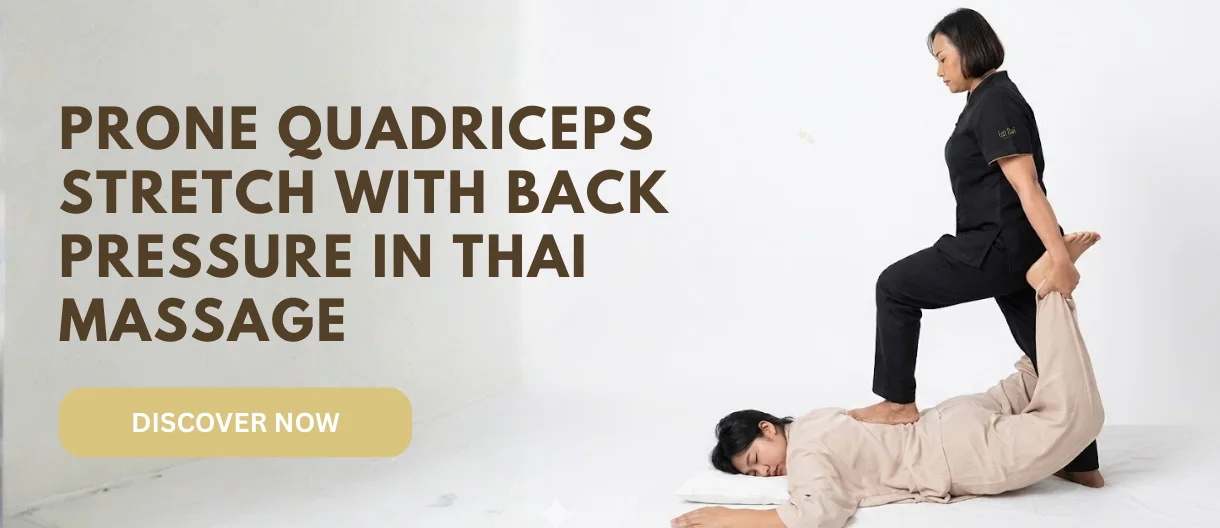
The Biomechanics of Deep Release: Prone Quadriceps Stretch with Back Pressure
In the realm of advanced bodywork—particularly within Traditional Thai Massage (Nuad Boran) and Ashiatsu—the therapist often utilizes body weight to achieve leverage that hands alone cannot provide. One of the most effective, yet mechanically complex…
Read the guide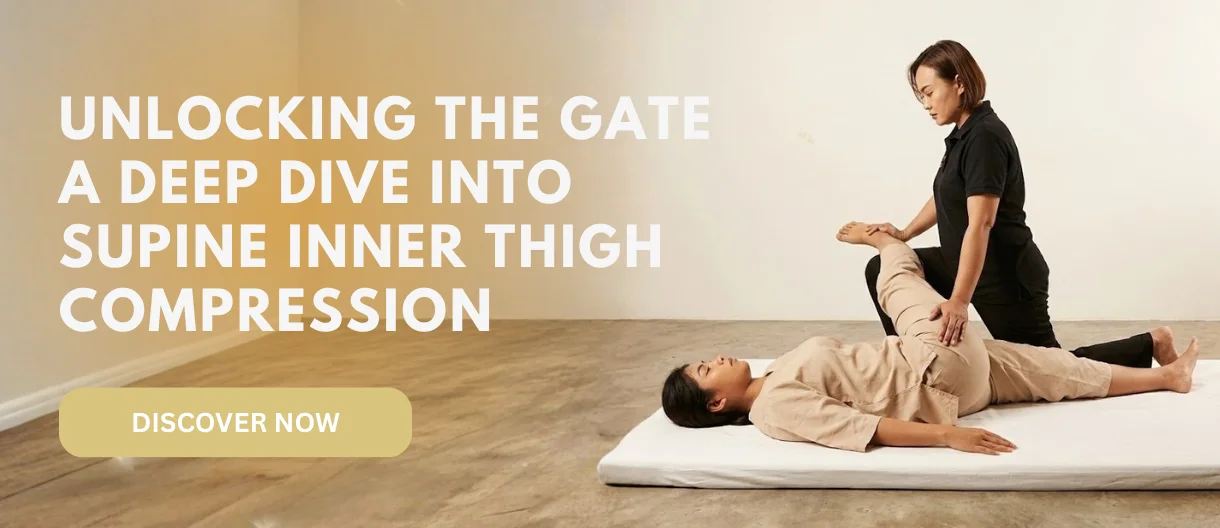
Unlocking the Gate: A Deep Dive into Supine Inner Thigh Compression
In the vast and intricate landscape of Traditional Thai Massage (Nuad Boran), few areas of the body are as crucial to overall structural integrity—and yet as frequently neglected—as the inner thighs. The adductor muscles act as the stabilizers of the pelvis…
Read the guide
How Education and Heritage Power the World of Loft Thai Spa
In the competitive landscape of luxury wellness, where every establishment promises tranquility and rejuvenation, true distinction is rarely a matter of chance. It is easy to construct a beautiful room, to light scented candles, and to play soft music that…
Read the guide
Tok Sen Massage for Deep Tension: Why Vibration Can Reach Where Hands Cannot
Deep muscle tension is often misunderstood. Many people imagine that a tight shoulder, a stiff lower back, or a heavy neck can only be solved by stronger pressure, deeper elbows, or longer massage sessions. While deep pressure can be useful when applied…
Read the guide