
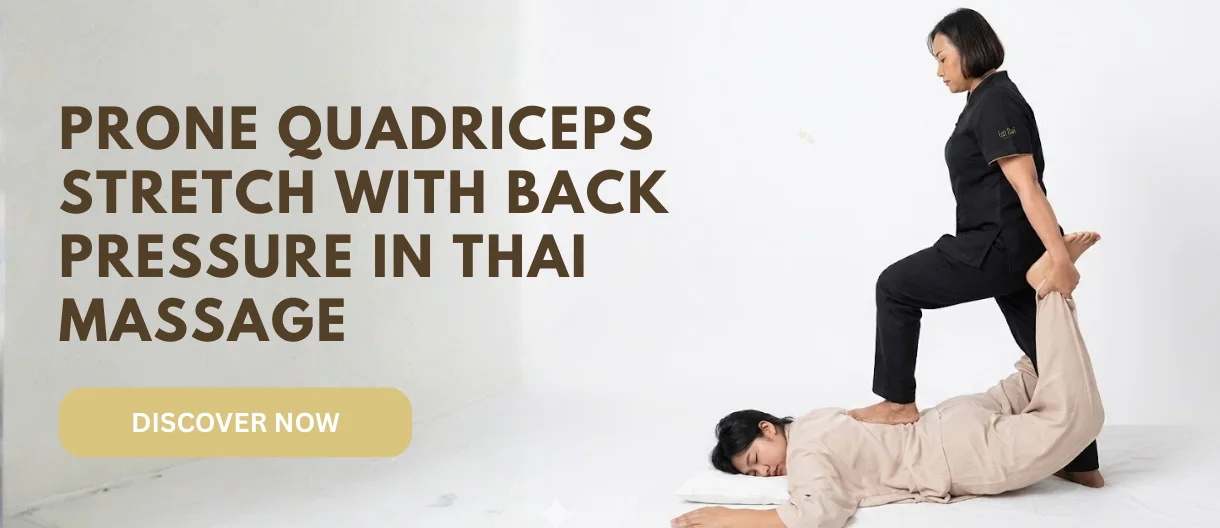
In the realm of advanced bodywork—particularly within Traditional Thai Massage (Nuad Boran) and Ashiatsu—the therapist often utilizes body weight to achieve leverage that hands alone cannot provide. One of the most effective, yet mechanically complex techniques, is the Prone Quadriceps Stretch with Back Pressure.
This technique involves the therapist using their foot to apply downward pressure to the client’s posterior pelvic region (sacrum or lower lumbar) while simultaneously pulling the client’s foot toward the gluteals. While it may appear dramatic, this maneuver solves a fundamental kinesiological problem: pelvic escape during deep quadriceps stretching.
Anatomy and Kinesiology: The Two-Joint Dilemma
To understand why back pressure is necessary, we must first look at the anatomy of the anterior thigh. The Quadriceps Femoris group consists of four muscles, but only one is the primary target of this advanced stretch: the Rectus Femoris.
The Rectus Femoris Mechanism
Three of the quadriceps muscles (Vastus Lateralis, Vastus Medialis, Vastus Intermedius) originate on the femur and insert into the tibial tuberosity. They cross only one joint, the knee. Simply bending the knee stretches them effectively.
The Rectus Femoris is bi-articular, crossing both the hip and knee joints. It originates from the Anterior Inferior Iliac Spine (AIIS) of the pelvis.
- Action: It extends the knee and flexes the hip.
- The Stretch Problem: To fully lengthen the Rectus Femoris, the knee must flex while the hip extends.
When a therapist bends a client’s knee in the prone position, tension in a tight Rectus Femoris pulls on the pelvis, creating an anterior pelvic tilt. The pelvis rotates forward and the lumbar spine increases its arch.
The result is pelvic escape. The muscle shortens instead of lengthening, while excessive force is transferred into the lumbar spine, potentially causing compression or discomfort.
The Technique: Execution and Mechanics

Back pressure acts as a mechanical anchor. By applying controlled pressure onto the sacrum or lower lumbar fascia, the therapist prevents anterior pelvic tilt and forces true lengthening of the Rectus Femoris.
Step-by-Step Technical Execution
- Pre-requisites: The client must be thoroughly warmed up. This technique belongs in the middle or end of a treatment sequence.
- Positioning: The client lies prone. The therapist stands beside the client or approaches from the feet, facing the head.
The Anchor (Downward Pressure)
- The therapist places one foot firmly on the sacrum, the flat triangular bone at the base of the spine.
- In some variations, the foot may be placed slightly higher on the lumbar erectors, but the sacrum remains the safest anchor.
- Pressure is vertical, controlled, and grounded, pinning the pelvis to the mat.
The Lever (Quadriceps Stretch)
- With the pelvis anchored, the therapist grasps the client’s ankle or dorsum of the foot.
- The heel is drawn toward the gluteals to flex the knee.
- The knee may lift slightly off the mat to increase hip extension.
The Dual Force Principle
- Force A: Downward pressure prevents pelvic tilt.
- Force B: Upward and backward pull lengthens the quadriceps.
Physiological and Therapeutic Benefits
True Myofascial Release
By preventing pelvic compensation, the stretch isolates the Rectus Femoris and deep hip flexors such as the iliopsoas. This creates high tensile loading on the anterior thigh fascia, helping release adhesions and restore tissue glide.
Lumbar Decompression
Tight hip flexors pull the lumbar spine into excessive lordosis. Lengthening these muscles reduces resting tension on the lumbar vertebrae, often relieving chronic lower-back discomfort.
Therapist Longevity
This is a body-saving technique. Using body weight instead of arm strength reduces shoulder strain and grip fatigue while allowing the therapist to work efficiently with gravity.
Safety Protocols and Contraindications
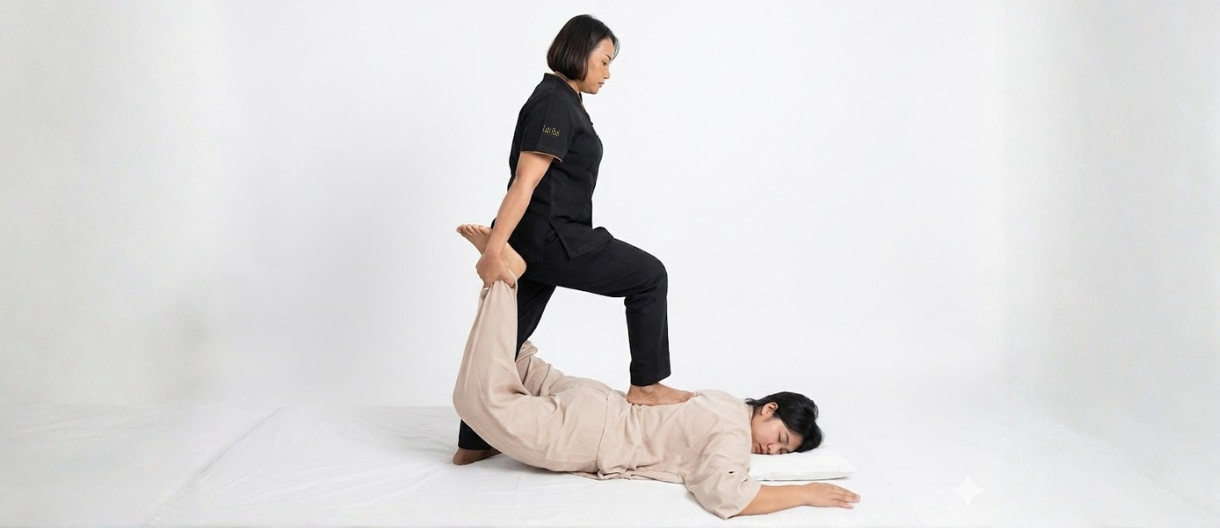
The Red Zone: Where Not to Step
Full standing pressure must never be applied directly onto floating ribs or lumbar vertebrae. The sacrum remains the safest and most stable contact point.
Contraindications
- Herniated or bulging lumbar discs, especially L4-L5 and L5-S1
- Spondylolisthesis
- Knee injuries such as meniscus tears or ligament damage
- Osteoporosis
- Pregnancy
Client Communication
A traffic-light communication system is essential due to the use of body weight.
- Green: Pressure is comfortable
- Yellow: Near the limit
- Red: Stop immediately
Summary
The Prone Quadriceps Stretch with Back Pressure is a masterful application of biomechanics. By eliminating pelvic compensation, it ensures the stretch targets the intended muscle rather than stressing the lower back.
For the client, it provides access to deep anterior tension rarely reached through conventional methods. For the therapist, it exemplifies intelligent leverage—maximum effectiveness with minimal effort.
UPDATED LOFT THAI GUIDE
Additional guidance and current information
The following editorial update expands on the original Loft Thai article with practical context, current treatment guidance and further reading.
What the Prone Quadriceps Stretch Is
The guest lies face down while the therapist bends one knee, bringing the heel toward the back of the thigh. At a modest angle, the movement mainly explores knee flexion. If the thigh is lifted from the mat, hip extension is added and the experience can become much stronger.
Some Thai massage schools include a second contact at the back of the pelvis. That contact should be understood as light orientation or support, not permission to stand on the lumbar spine, force the sacrum down or pull the leg beyond its easy range.
A professional version can be almost visually uneventful. The therapist supports the ankle, watches the pelvis, asks about the knee and lower back, then stops at the first clear limit.
The Two-Joint Detail That Matters
The quadriceps group extends the knee. The rectus femoris is distinctive because it also crosses the hip and assists hip flexion. NCBI’s anatomy reference describes this dual role, which helps explain why combining knee flexion with hip extension can feel different from bending the knee alone.
That does not mean a therapist can isolate one muscle by touch or diagnose a “short” rectus femoris during a spa session. The front of the thigh contains overlapping tissues, and a guest’s range is shaped by joint anatomy, nervous-system response, prior injury and comfort as well as muscle length.
Anatomy is most useful here as a reason to be conservative. Two joints are involved, so a change at the knee can be felt at the hip or lower back, and a smaller movement may be the more precise choice.
- Knee flexion changes the front-of-thigh sensation
- Lifting the thigh adds hip extension and intensity
- Pelvic movement is information, not a defect to overpower
- A spa therapist observes comfort rather than diagnosing tissue length
Why the Pelvis or Lower Back May Move
As the knee bends, some guests naturally tip the pelvis or increase the curve of the lower back. This can be a normal strategy for finding more range. It becomes a reason to reduce the movement when the guest feels compression, pinching or a strong pull away from the thigh.
The old article called this “pelvic escape” and proposed fixing it with downward body weight. That language turns normal adaptation into a problem and risks shifting force into the lumbar area. The therapist does not need a perfectly motionless pelvis to deliver useful, comfortable work.
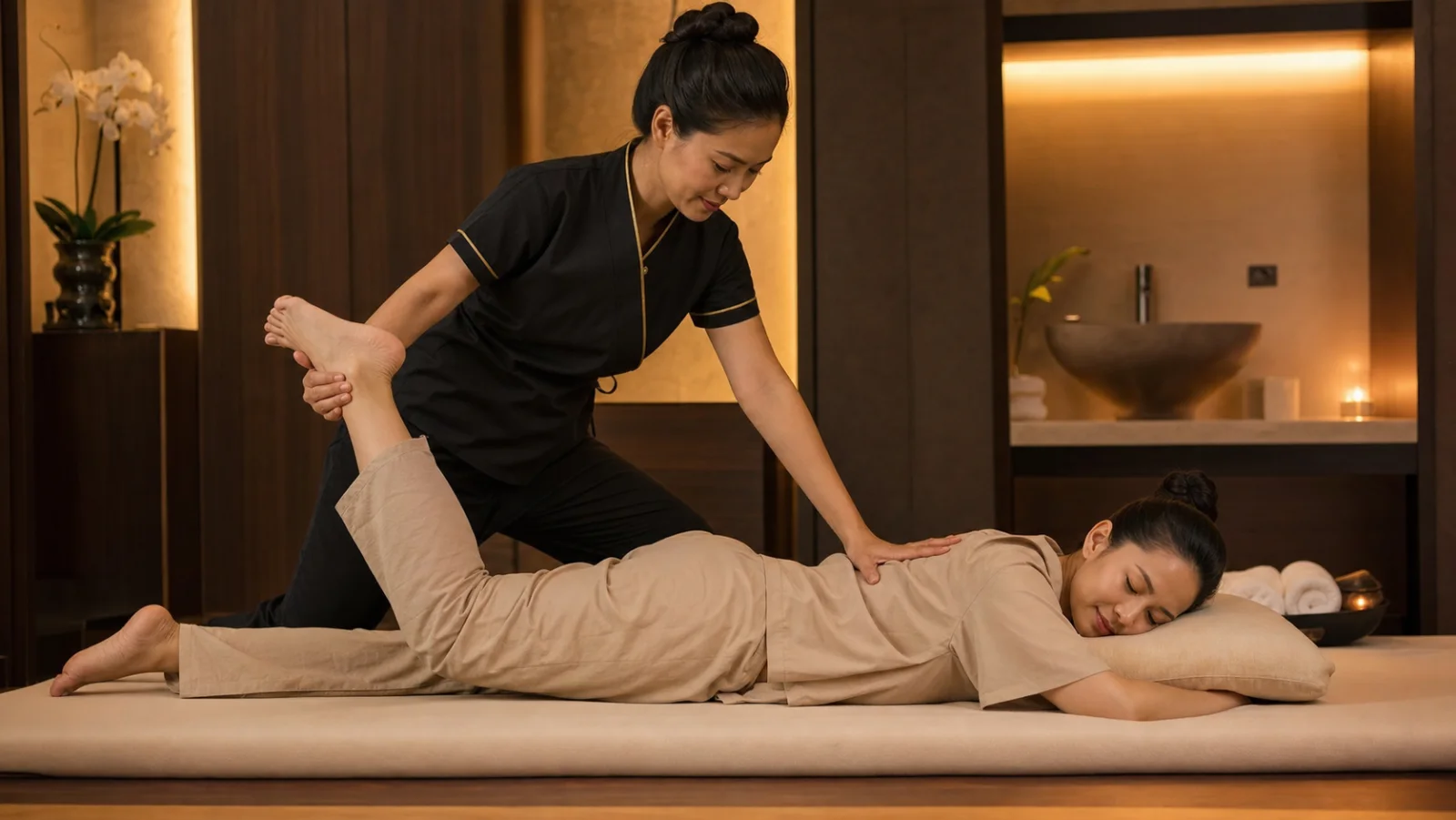
A folded towel beneath the lower abdomen, a smaller knee bend or a side-lying position can reduce lumbar effort without heavy pressure. The best modification is often to make the movement simpler.
A Safer Setup, Step by Step
The guest’s head should be supported without excessive neck rotation, and both front hip bones should feel comfortable against the mattress. Before lifting the foot, the therapist asks about knee, hip and lower-back history and explains the intended range.
The ankle is supported without twisting the foot. The therapist bends the knee slowly, pauses, and checks whether the sensation remains in the front of the thigh rather than inside the knee or across the lower back.
If pelvic contact is used, it should be a broad, light hand through clothing and away from the spine. The contact provides a reference point; it should not prevent the guest from moving or make the person feel pinned.
-
01
Prepare
Support the head and abdomen, then agree on the area, range and stop signal.
-
02
Bend
Flex the knee slowly while supporting the ankle and keeping the foot neutral.
-
03
Observe
Watch the pelvis and ask where the guest feels the movement.
-
04
Limit
Stop before knee pressure, lumbar compression or a sharp front-of-hip sensation.
-
05
Return
Lower the leg gradually and reassess before considering the other side.
Why “Back Pressure” Is Not the Goal
Standing or placing a knee on a guest’s back while pulling the ankle creates several simultaneous forces that are difficult to grade. It also reduces the guest’s ability to shift away from discomfort. This should not be presented as a necessary route to a deeper result.
The original text promised “true myofascial release,” lumbar decompression and adhesion breakdown. A spa stretch cannot verify those mechanisms, and massage evidence does not support assigning them to this single manoeuvre.
The useful outcome is more modest: a guest may experience a temporary feeling of ease or a comfortable stretch. More range is not automatically more therapeutic, and an impressive photograph is not evidence of better technique.
What It Should—and Should Not—Feel Like
A suitable version often feels like a broad, gradually increasing sensation along the front of the thigh. The guest should be able to breathe normally, keep the jaw and hands relaxed and answer questions without bracing.
Stop for pain inside or around the knee, pinching at the front of the hip, pressure in the kneecap, sharp lower-back discomfort, cramping, numbness, tingling or an electric sensation. A forceful stretch should never be used to “break through” guarding.
The guest can request less range at any point. A therapist should not use breath-holding, laughter or silence as evidence that the intensity is acceptable.
When to Modify or Avoid the Position
Recent knee, hip or lumbar injury; surgery; joint replacement precautions; fracture; significant osteoporosis; unexplained swelling; acute inflammation or severe pain all warrant modification or postponement. Follow advice from the relevant clinician when restrictions have been given.
Prone lying may be unsuitable during pregnancy, after some abdominal procedures or when breathing, reflux or facial pressure makes the position uncomfortable. Side-lying can offer more space and control.
Massage should not delay assessment of new weakness, loss of sensation, inability to bear weight, marked swelling, fever or pain after trauma. NCCIH advises discussing massage with a healthcare provider when there is uncertainty about whether it is appropriate.
Three Useful Alternatives
In side-lying, the pelvis and head can be cushioned while the therapist supports the upper leg. The position allows easy eye contact and can reduce pressure on the abdomen and kneecap.
In supine position, a supported heel slide or gentle hip-and-knee bend explores movement without loading the front of the body. A bolster can keep the leg within a comfortable path.
The guest can also perform an active quadriceps stretch independently after the session if it is already familiar and comfortable. A spa therapist need not turn a passive stretch into an exercise prescription.
Traditional Context and Professional Judgement
UNESCO describes Nuad Thai as a living traditional practice that uses hands, elbows, knees and feet within a wider system of transmitted knowledge. Recognition of the tradition does not make every possible body-weight variation suitable for every guest.
Technique names and sequences vary by school. Training should therefore emphasize supervised practice, body mechanics, contraindications, consent and the ability to abandon a planned technique when the guest’s response changes.
At Loft Thai, the strongest interpretation of an advanced technique is not maximal leverage. It is the judgement to choose a smaller, clearer and more comfortable version.
“The goal is not to pin the pelvis. It is to choose a range the knee, hip and lower back can share comfortably.”
Loft Thai Editorial Team
Continue your research
REFERENCES
Sources & further reading
PRACTICAL GUIDANCE
Frequently Asked Questions
Should a therapist step on my back during a quadriceps stretch?
Heavy foot or knee pressure on the lumbar spine is not required. A conservative version uses supported ankle movement and, if needed, light broad hand contact away from the spine.
Does the heel need to touch the buttock?
No. Range differs between people, and the useful endpoint is comfort—not a visual target.
Where should I feel a prone quadriceps stretch?
Usually across the front of the thigh. Knee pain, hip pinching or lower-back compression means the position or range should change.
Can this stretch fix anterior pelvic tilt or lower-back pain?
It should not be marketed as a corrective treatment. A guest may feel temporary ease, but posture and pain have many possible contributors.
What is the gentlest alternative?
A smaller knee bend in prone, a supported side-lying version or simple supine leg movement may all be easier to control.
CONTINUE READING
Related stories
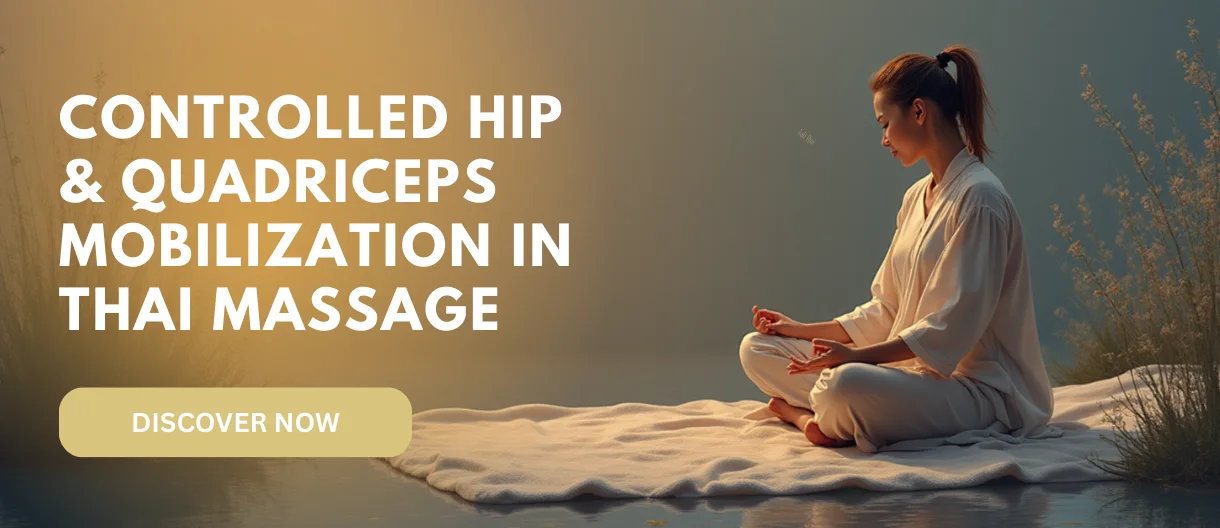
Controlled Hip & Quadriceps Mobilization in Thai Massage: The Advanced Technique That Restores Posture and Mobility
Thai massage has always stood apart from other bodywork traditions because it does not merely treat muscles in isolation. It works with the entire kinetic chain, integrating joints, fascia, breath, posture, and neurological regulation. Among the most refined…
Read the guide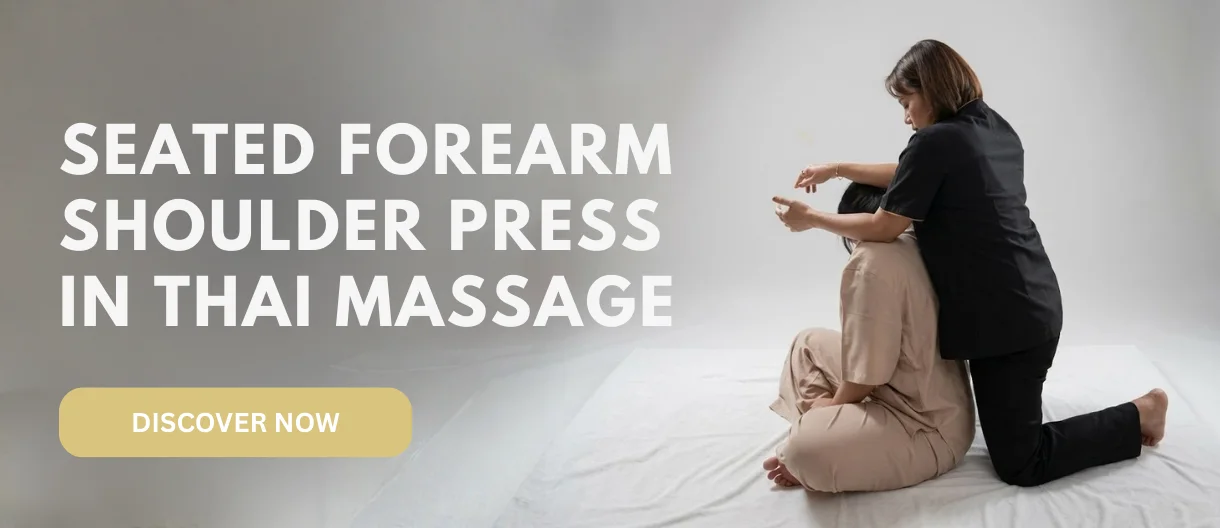
The Weight of the World Lifted: Deconstructing the Seated Forearm Shoulder Press in Traditional Thai Massage
In the landscape of modern living, the human body bears the brunt of our technological conveniences. We are a culture of sitters, hunched over keyboards and peering down at smartphones. This pervasive posture manifests physically, most notably in the shoulder…
Read the guide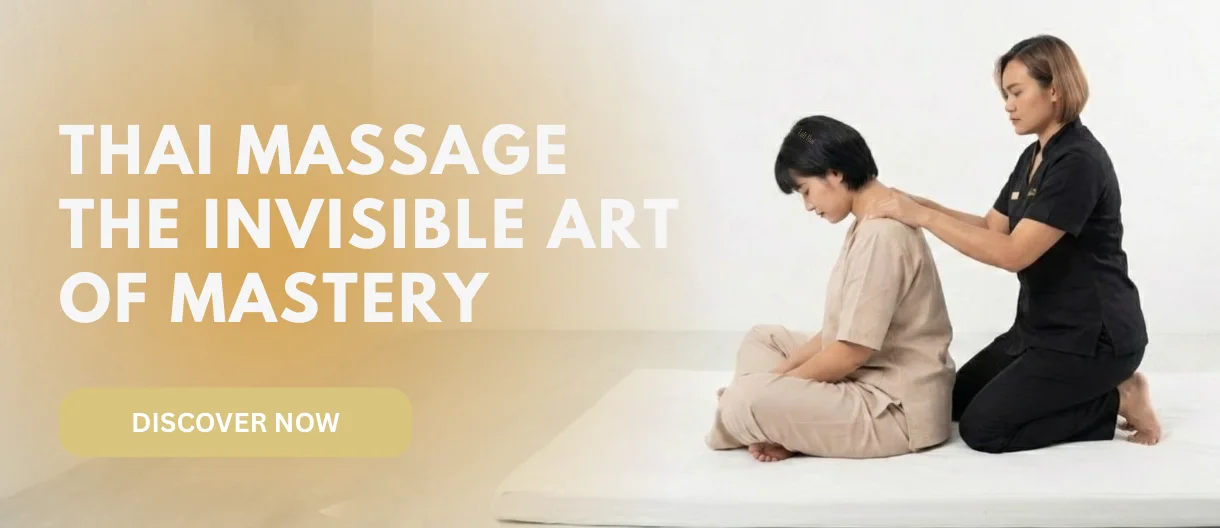
How Education and Heritage Power the World of Loft Thai Spa
In the competitive landscape of luxury wellness, where every establishment promises tranquility and rejuvenation, true distinction is rarely a matter of chance. It is easy to construct a beautiful room, to light scented candles, and to play soft music that…
Read the guide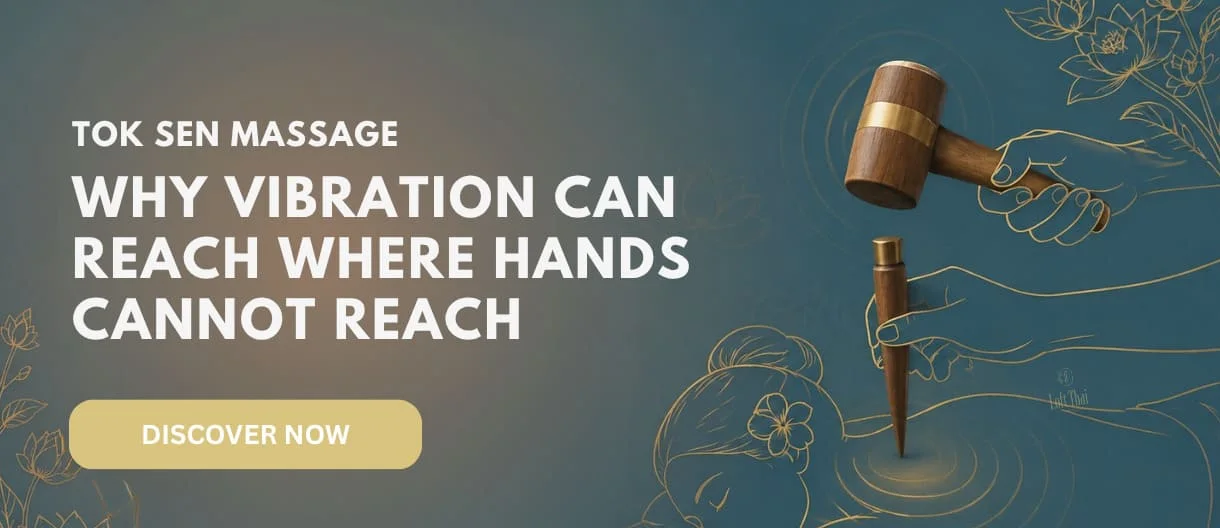
Tok Sen Massage for Deep Tension: Why Vibration Can Reach Where Hands Cannot
Deep muscle tension is often misunderstood. Many people imagine that a tight shoulder, a stiff lower back, or a heavy neck can only be solved by stronger pressure, deeper elbows, or longer massage sessions. While deep pressure can be useful when applied…
Read the guide