
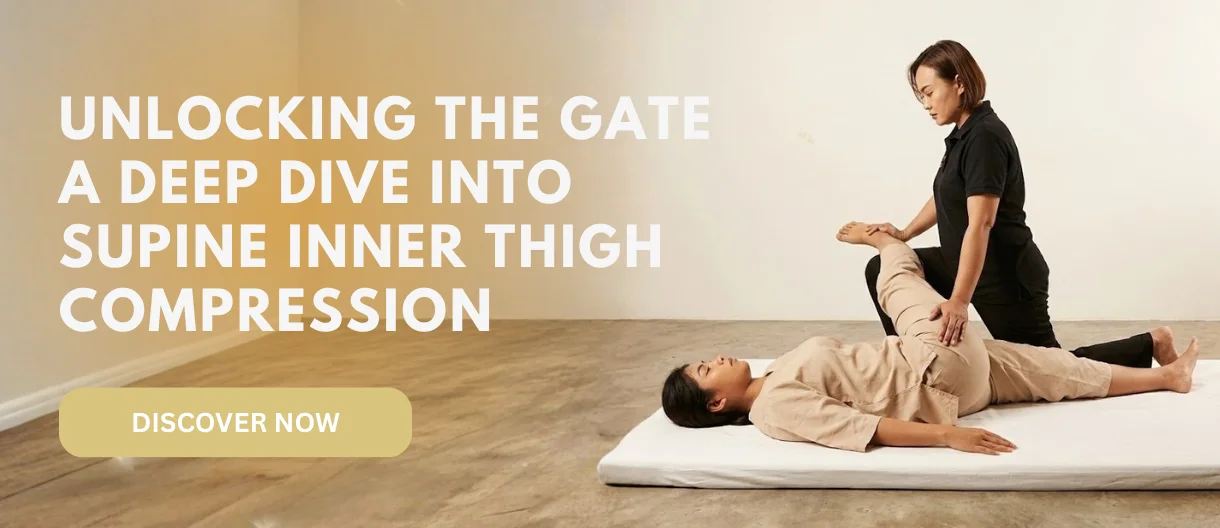
In the vast and intricate landscape of Traditional Thai Massage (Nuad Boran), few areas of the body are as crucial to overall structural integrity—and yet as frequently neglected—as the inner thighs. The adductor muscles act as the stabilizers of the pelvis and the guardians of the hips. When tight, they pull the skeletal structure out of alignment, contributing to lower back pain, knee instability, and restricted gait.
One of the most effective, accessible, and profound techniques for addressing this tension is the Supine Inner Thigh Compression, also descriptively known as the Single-Leg Hip Opener with Adductor Press.
This article explores the mechanics, anatomy, energetic theory, and safety protocols of this essential technique, providing a complete roadmap for therapists wishing to master the art of the "opened hip."
The Anatomy of the Inner Thigh: The Adductor Group
To understand the value of this technique, one must first understand the landscape being traversed. The inner thigh is not a singular muscle but a complex group of muscles collectively known as the Adductors.
The primary muscles addressed in this technique include:
- Adductor Magnus: The largest and deepest of the group, acting as a powerful stabilizer.
- Adductor Longus & Brevis: Frequently the source of "groin pull" pain.
- Gracilis: A long, strap-like muscle that crosses both the hip and the knee, often responsible for medial knee pain.
- Pectineus: Situated high in the groin, often tight in those with sedentary lifestyles.
The Modern Problem
In modern society, these muscles are chronically shortened. Prolonged sitting causes the adductors to remain in a semi-contracted state. Conversely, athletes like runners and soccer players often develop rigid adductors to stabilize their stride.
When the therapist performs the Single-Leg Hip Opener with Adductor Press, they are not merely "rubbing a leg." They are mechanically lengthening these fibers, signaling the nervous system to drop the protective tension that locks the hips in place.
The Energetic Pathway: Sen Kalathari
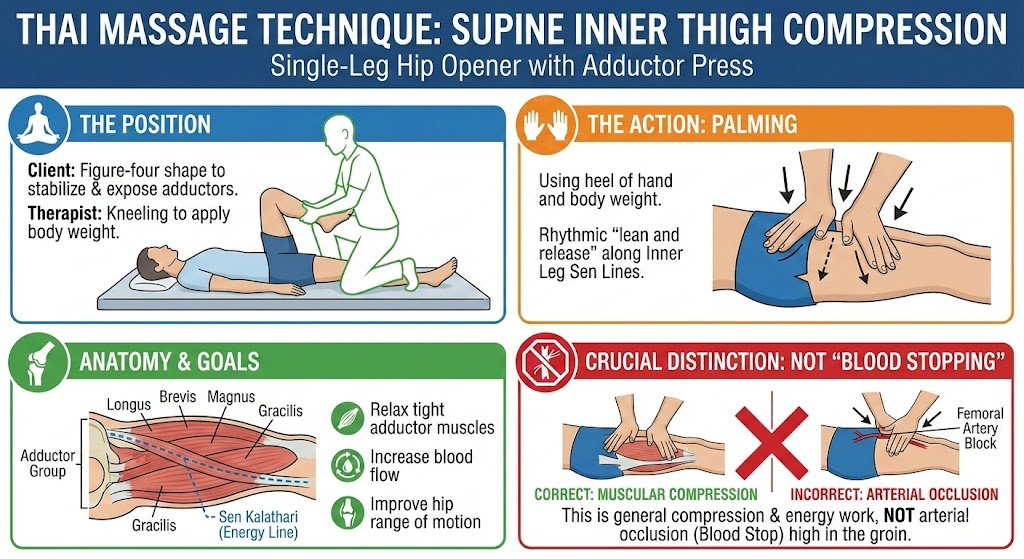
Thai Massage is never purely physical; it is an interplay of mechanical manipulation and energy work. The theoretical framework of Thai Massage relies on the Sen Sib (The Ten Lines).
This specific technique focuses primarily on the Inner Leg Sen Lines, most notably Sen Kalathari.
Understanding Sen Kalathari
Sen Kalathari is known as the "psychic" or "emotional" line. It creates an X-shape across the torso, running from the navel, through the deep adductors, down to the extremities.
- Physical Associations: It governs the movement of the limbs, joint lubrication, and digestive organs.
-
Emotional Associations: This line is intimately connected to the release of emotional stagnation. The hips are often referred to as the "junk drawer" of the body, where humans store unexpressed emotions like fear, frustration, and control.
By Palming (applying compression) down these lines, the therapist is not just flushing blood through the tissue; they are clearing energy blockages (stagnation) in Sen Kalathari, promoting a sense of emotional lightness alongside physical relief.
The Setup: The "Figure-Four" Position
The effectiveness of this technique relies entirely on the correct positioning of the client. This is often described as a supine "Tree Pose" (Vrksasana in Yoga).
Client Positioning
- Supine Alignment: The client lies face up.
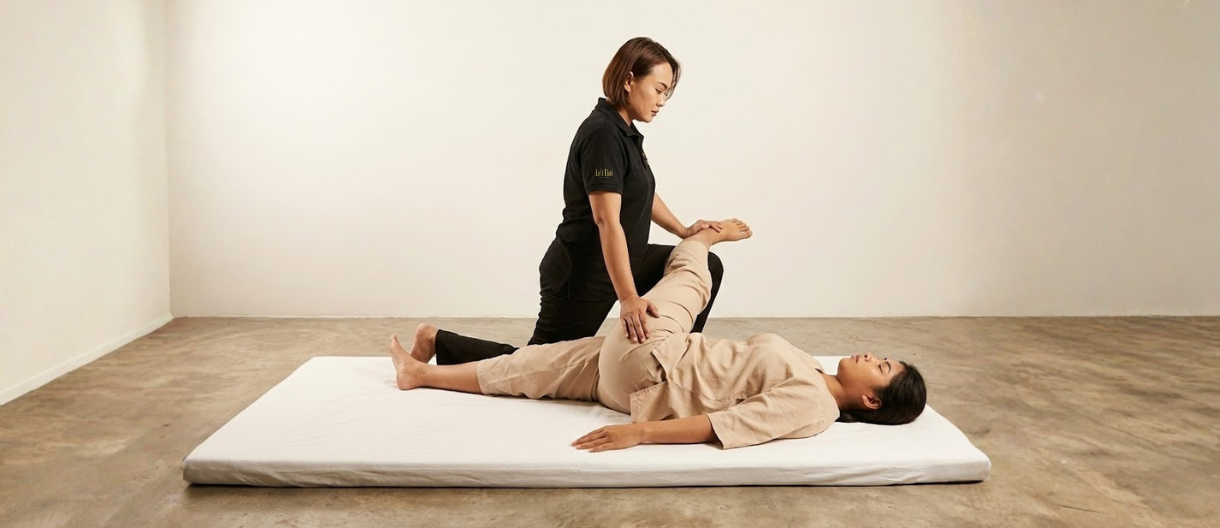
- The Fold: The therapist bends the client's knee and allows the leg to fall open to the side.
- The Anchor: The sole of the client's foot is placed against the inner thigh or knee of the opposite (straight) leg.
Why this shape matters: This "figure-four" shape pre-stretches the adductors. If the leg were straight, the adductors would be bunched together, making it difficult to differentiate the muscle fibers. By placing the leg in this open position, the muscles are taut and exposed, providing a flat, stable surface for the therapist to apply pressure.
Technique Breakdown: The Art of Palming
The core action here is Palming. In Thai Massage, we rarely use muscle strength to push. Instead, we use body weight to sink.
Step-by-Step Execution
- Stance: The therapist kneels beside the client’s bent leg, facing toward the client's head or perpendicular to the thigh, depending on their height and reach.
- Contact Point: The therapist uses the heels of their hands (the thenar and hypothenar eminences) or broad palms. Fingers should remain relaxed to avoid poking.
- The Sink: Keeping the arms straight (elbows locked but not hyperextended), the therapist leans their body weight forward. The pressure should be vertical, directed straight down into the meat of the muscle.
- The Rhythm: The compression follows a rhythmic "lean and release" pattern. It mimics the heartbeat—slow, heavy, and grounding.
The Pathway:
- Pass 1 (Inner Line 1): Work the line closest to the surface/anterior side of the thigh.
- Pass 2 (Inner Line 2): Work slightly deeper/posterior, closer to the hamstrings.
Therapist Tip: Never press directly onto the knee bone or the pubic bone. Work only on the soft tissue between these two hard landmarks.
Crucial Distinction: This is NOT "Blood Stopping"
There is a frequent misunderstanding among novice therapists regarding inner thigh work in Thai Massage. It is vital to distinguish the Adductor Press from the famous "Blood Stop" technique.
The "Blood Stop" (Arterial Occlusion)
- Location: High in the femoral triangle, directly at the groin crease where the leg meets the torso.
- Target: The femoral artery.
- Goal: To temporarily occlude blood flow so that, upon release, a rush of heat and fresh blood (hyperemia) floods the lower limbs.
- Risk Profile: High. This requires advanced training and is contraindicated for clients with high blood pressure, heart conditions, or diabetes.
The Adductor Press (Muscular Compression)
- Location: The mid-thigh to lower-thigh (closer to the knee).
- Target: The myofascial belly of the adductor muscles and Sen lines.
- Goal: Muscular relaxation and energy flow.
- Risk Profile: Low. This is a general tension-relief technique.
In the technique discussed here, the therapist is working the "belly" of the muscle, generally starting a hand-width away from the groin and moving toward the knee. This distinction ensures safety and clarifies the intent: we are softening muscle, not stopping the heart's flow.
The Benefits: Why We Do It
When performed correctly, the Single-Leg Hip Opener with Adductor Press offers a cascade of benefits for the client.
1. Improved Hip Range of Motion (ROM)
Tight adductors pull the femur medially, limiting how wide the legs can open. By softening this tissue, the hip joint regains its natural rotation, improving performance in yoga, martial arts, and daily movements like squatting.
2. Enhanced Circulation
The inner thigh is a vascular highway. Compression pumps fresh, oxygenated blood into tissues that are often starved due to compression from sitting. This helps flush metabolic waste products (like lactic acid) from the muscles.
3. Lower Back Relief
The adductors anchor to the pelvis. When they are tight, they can tilt the pelvis anteriorly or laterally, causing strain in the lumbar spine. Releasing the inner thigh often provides surprising relief for lower back pain.
4. Grounding and Relaxation
Because this technique works on Sen Kalathari and involves heavy, rhythmic pressure, it is deeply grounding. It activates the parasympathetic nervous system (rest and digest), helping anxious clients settle into their bodies.
Contraindications and Safety Precautions
While this technique is generally safe, a professional therapist must always assess the client before proceeding.
- Knee Pathology: Since the leg is in a figure-four position, torque is applied to the knee. If a client has a torn meniscus or ligament issues, place a pillow under the bent knee to reduce the angle, or skip the position entirely.
- Hip Replacements: Clients with hip replacements often have strict limitations on degrees of rotation. Avoid forcing the leg open.
- Deep Vein Thrombosis (DVT): Never perform deep compression on the legs of a client with a history of blood clots or DVT, as this could dislodge a clot.
- Varicose Veins: Avoid direct heavy pressure on visible varicose veins.
- Pregnancy: While the position is safe, avoid deep pressure on the inner thigh near the ankle (reflexology points for the uterus) and be gentle with the adductors to avoid over-stretching the relaxin-softened ligaments.
Integration: When to Use This Technique
The Supine Inner Thigh Compression is best utilized in the first half of a Thai Massage sequence.
- Sequence Flow: It serves as a perfect transition after working on the feet and lower leg lines. It prepares the hip for deeper stretches that will come later, such as spinal twists or hamstrings stretches.
- Pairing: It pairs beautifully with gluteal compression. By releasing the inner thigh (adductors) and then the outer hip (abductors/glutes), you completely "free" the pelvic girdle.
Conclusion
The Single-Leg Hip Opener with Adductor Press is a cornerstone of effective Thai Massage therapy. It is deceptively simple: a bent leg and a rhythmic palm press. However, within that simplicity lies the potential to alleviate chronic back pain, restore fluid movement to the hips, and balance the body’s energy lines.
By respecting the anatomy, understanding the difference between muscular compression and arterial occlusion, and using body weight rather than force, the therapist transforms this technique from a simple massage move into a profound act of healing.
UPDATED LOFT THAI GUIDE
Additional guidance and current information
The following editorial update expands on the original Loft Thai article with practical context, current treatment guidance and further reading.
What Supine Inner-Thigh Compression Is
The guest lies face up with one knee bent and the leg supported in a comfortable outward position. The therapist uses broad palms on the muscular middle portion of the inner thigh, away from the groin and knee.
The position is sometimes described as a figure four, but the exact shape should follow hip and knee comfort rather than a photograph. The bent leg may need cushions so the guest does not hold it open with muscular effort.
This is optional inner-leg work, not a required gateway to deeper hip stretches. The guest can request another technique or avoid the area entirely.
The Adductor Region in Plain Language
The inner thigh contains several muscles that help bring the leg toward the midline and contribute to hip and knee movement. The region also contains important nerves and blood vessels, especially closer to the groin.
A therapist cannot reliably identify every deep structure through clothing or decide that one muscle is responsible for back, knee or walking problems. Broad contact should remain conservative and within professional spa scope.
The old article claimed that tight adductors pull the skeleton out of alignment and cause lower-back pain or knee instability. Those relationships are not established by a spa assessment and should not be used to diagnose a guest.
- Work on the broad muscular mid-thigh, not the groin crease
- Avoid direct pressure on the knee and pubic bone
- Treat symptoms as information, not proof of a specific muscle problem
- Refer persistent groin, hip or knee pain for appropriate assessment
Consent and Draping Come Before Pressure
The inner thigh is a sensitive and intimate area. The therapist should explain the proposed work before moving the leg, ask whether the guest wants it and describe how draping or loose Thai massage clothing will preserve coverage.
Consent to leg massage does not automatically include the inner thigh. The guest can define a boundary, request same-gender therapist preference where available or decline without explanation.
The therapist should keep contact clearly professional and visible to the guest. Hands do not travel under clothing or toward the groin. A towel or the clothing itself maintains a defined border.

Support the Leg Instead of Forcing the Hip Open
The foot can rest against the opposite leg, on a cushion or in the therapist’s supported hand. The bent knee should not hang unsupported when that creates strain in the hip, groin or knee.
Begin with the guest moving the leg actively into a comfortable range. Additional outward movement is not necessary for effective palm contact. If the knee lifts or the pelvis rolls, use more support or a smaller angle.
People with hip replacement precautions, recent injury, knee instability or pain in the position need modification or appropriate clinical guidance.
-
01
Explain the area
Ask permission for inner-thigh work and agree on the upper boundary.
-
02
Position actively
Let the guest bend and open the leg only as far as comfortable.
-
03
Support
Use cushions or a stable hand so the leg can rest without effort.
-
04
Contact broadly
Place relaxed palms on the muscular mid-thigh, well away from the groin.
-
05
Check and finish
Ask about hip, knee, skin and pressure comfort, then return the leg slowly.
Palming, Not Poking
Thai massage palming uses a broad hand surface and gradual body-weight transfer. Fingers remain relaxed rather than digging into the inner thigh. Pressure can follow a slow lean-and-release rhythm without trying to reach a maximum depth.
The therapist should avoid sudden compression on tender tissue or new exercise soreness. Sharp pain, burning, tingling, numbness or a pulsating sensation is a reason to stop.
Moving closer to the groin does not make the technique more advanced. Precision often means maintaining a larger safety margin.
This Should Never Become Vascular Occlusion
The old article contrasted muscular compression with a so-called blood stop near the femoral artery. That comparison can encourage unsafe experimentation. This guide does not teach deliberate arterial occlusion.
Do not press into the groin crease or seek a pulse to restrict it. Massage should not intentionally interrupt circulation, create a rush of heat or produce numbness.
A history or suspicion of blood clot, unexplained leg swelling, redness, warmth, severe calf or groin pain, chest symptoms or shortness of breath requires urgent medical attention, not massage.
Claims to Remove From Inner-Thigh Work
Compression should not be described as flushing lactic acid, restoring joint lubrication, treating digestion or releasing emotions stored in the hips. Traditional sen concepts may be presented as cultural beliefs, not measured anatomy.
A person may feel temporarily more comfortable after gentle work, but that does not prove increased hip range, corrected pelvic alignment or relief of lower-back pathology.
The purpose can remain modest and useful: comfortable, consented pressure within a broader Thai massage sequence.
When to Avoid or Modify the Technique
Avoid direct work over varicose veins that are painful or inflamed, bruising, rash, infection, recent injection, surgical site or unexplained swelling. Anticoagulant medication may increase bruising risk and should be disclosed.
Hip or knee surgery, replacement precautions, acute groin strain, fracture, pregnancy discomfort and significant osteoporosis can change both position and pressure. Follow the relevant clinician’s guidance.
NCCIH notes rare serious adverse events from massage, including reports involving blood clots and vigorous techniques. Conservative screening is especially important for leg work.
Integrating the Technique Professionally
Inner-thigh compression may appear after lower-leg work and before other supported hip movements, but sequences differ. It should not automatically lead into a deeper stretch.
The therapist returns the leg to neutral slowly, checks knee and hip comfort, then repeats on the other side only with renewed consent. Asymmetry is normal; both legs do not need the same angle or pressure.
A professional boundary is visible throughout: clear explanation, adequate clothing or draping, distance from the groin, broad contact and no pressure to accept a sensitive-area technique.

“In a sensitive body area, clear consent and precise boundaries are part of the technique itself.”
Loft Thai Editorial Team
Continue your research
REFERENCES
Sources & further reading
PRACTICAL GUIDANCE
Frequently Asked Questions
Is inner-thigh massage a normal part of Thai massage?
It can be part of some sequences, but it is optional. The therapist should ask specifically before working in this sensitive area.
How close to the groin should the therapist work?
Professional work stays on the muscular thigh with a clear safety and privacy margin. The groin crease is not a target.
Should inner-thigh compression hurt?
No. Broad pressure may feel strong, but sharp pain, burning, tingling, numbness or pulsation is a reason to stop.
Does this technique release emotions stored in the hips?
That is a wellness narrative, not an established anatomical mechanism. A therapist should not interpret the guest’s emotions or body position.
When should leg massage be postponed?
Unexplained swelling, redness, warmth, severe pain or suspected blood clot needs urgent medical assessment rather than massage.
CONTINUE READING
Related stories
How Education and Heritage Power the World of Loft Thai Spa
In the competitive landscape of luxury wellness, where every establishment promises tranquility and rejuvenation, true distinction is rarely a matter of chance. It is easy to construct a beautiful room, to light scented candles, and to play soft music that…
Read the guide
What Makes Authentic Thai Massage Different from Spa Massage?
People often say “I want a Thai massage,” but what they actually mean can be very different.
Read the guide
Bangkok Spa Etiquette: Tipping, What to Wear, What to Say to Get the Pressure You Want in 2026
Booking a spa in Bangkok should feel exciting—not confusing. But if it’s your first time Thai massage or oil massage, it’s normal to wonder about the unspoken rules. Do you tip? How much? What do you wear? Do you keep underwear on? And how do you ask for the…
Read the guide
Tok Sen Massage for Deep Tension: Why Vibration Can Reach Where Hands Cannot
Deep muscle tension is often misunderstood. Many people imagine that a tight shoulder, a stiff lower back, or a heavy neck can only be solved by stronger pressure, deeper elbows, or longer massage sessions. While deep pressure can be useful when applied…
Read the guide