Traditional Thai Massage, often poetically referred to as "assisted yoga," is a complex modality that weaves together rhythmic acupressure, mindful stretching, and energetic balancing. Unlike Western massage forms that primarily target musculature through kneading, Thai massage views the body as an interconnected matrix of energy lines, fascia, and bone. Within a typical two-hour sequence, the practitioner guides the recipient through a progression of movements designed to free blocked energy and restore structural integrity.
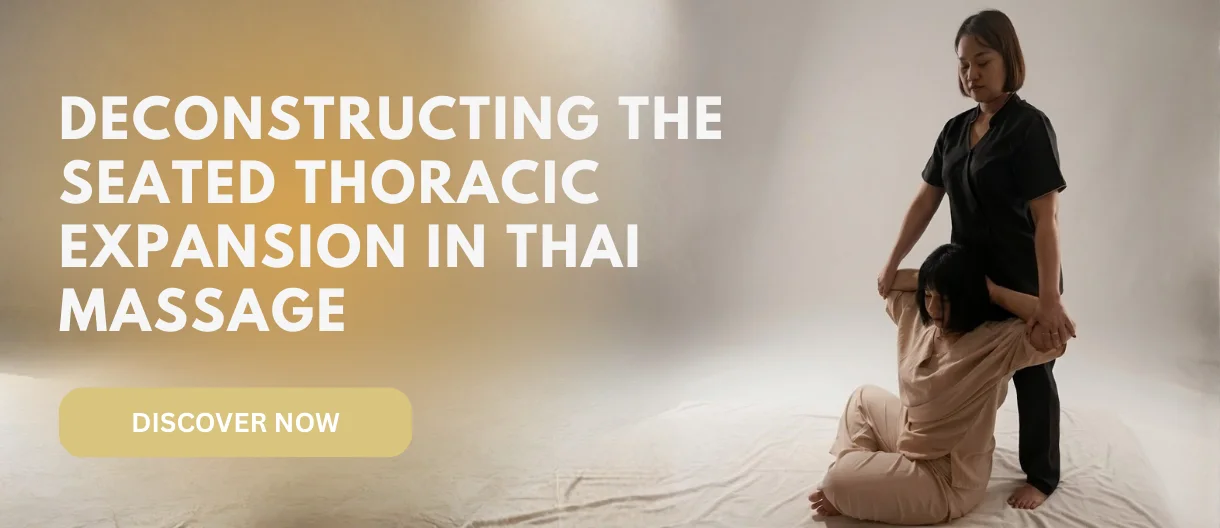
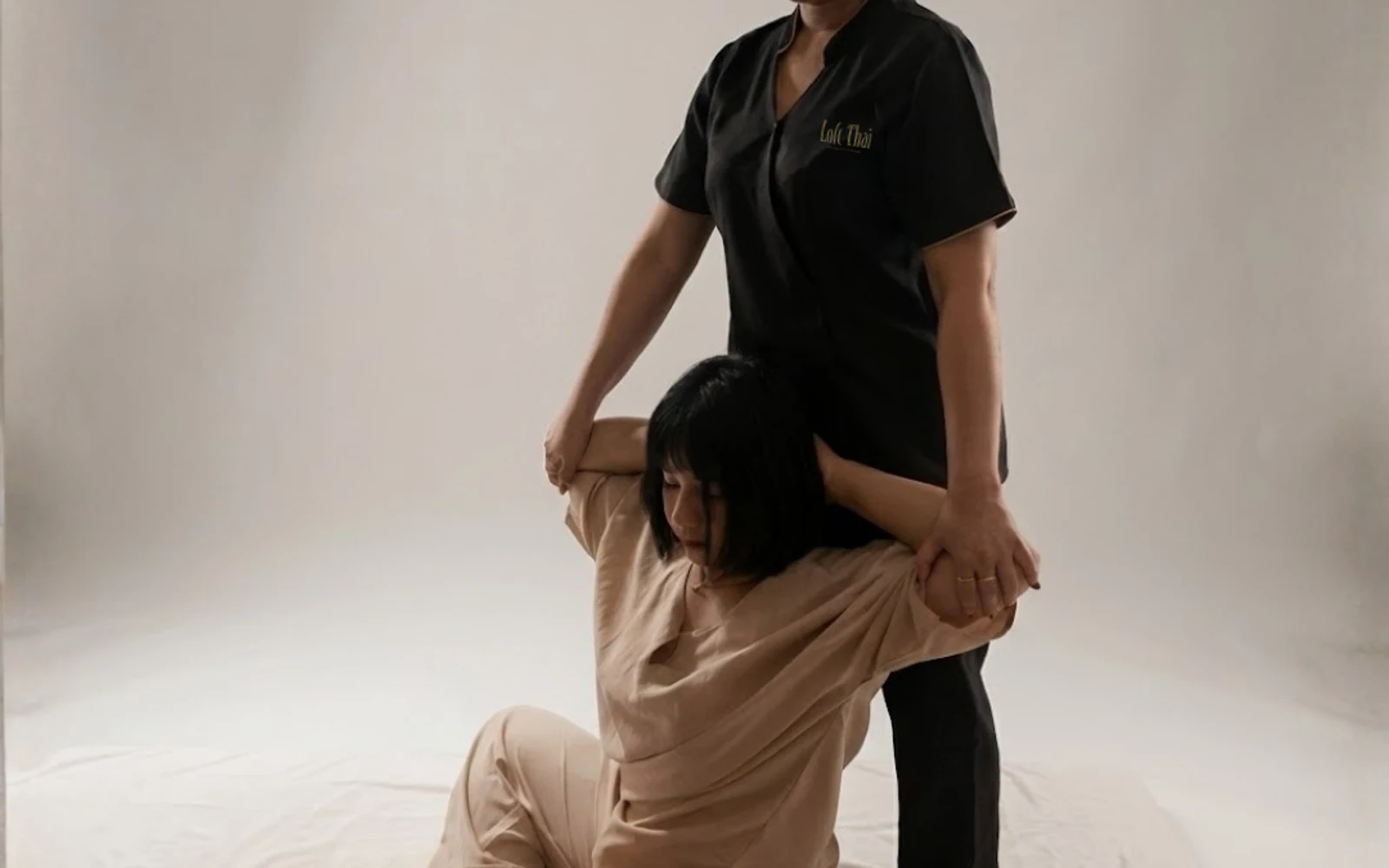
Among the most visually striking and physiologically profound techniques in the Thai repertoire is the seated thoracic expansion and extension, frequently dubbed the "Seated Cobra" or the "Butterfly Arch." This technique, usually performed toward the culmination of a session, is more than a mere stretch; it is an integrative maneuver that addresses the structural collapse inherent in modern, sedentary lifestyles. The image provided captures the essence of this technique: the recipient seated cross-legged, fingers interlocked behind the occiput, while the therapist, positioned behind, utilizes leverage to retract the elbows and extend the upper spine. This seemingly simple interplay of forces offers a deep dive into therapeutic anatomy, respiratory mechanics, and postural correction.
The Anatomical Landscape of the Anterior Thorax
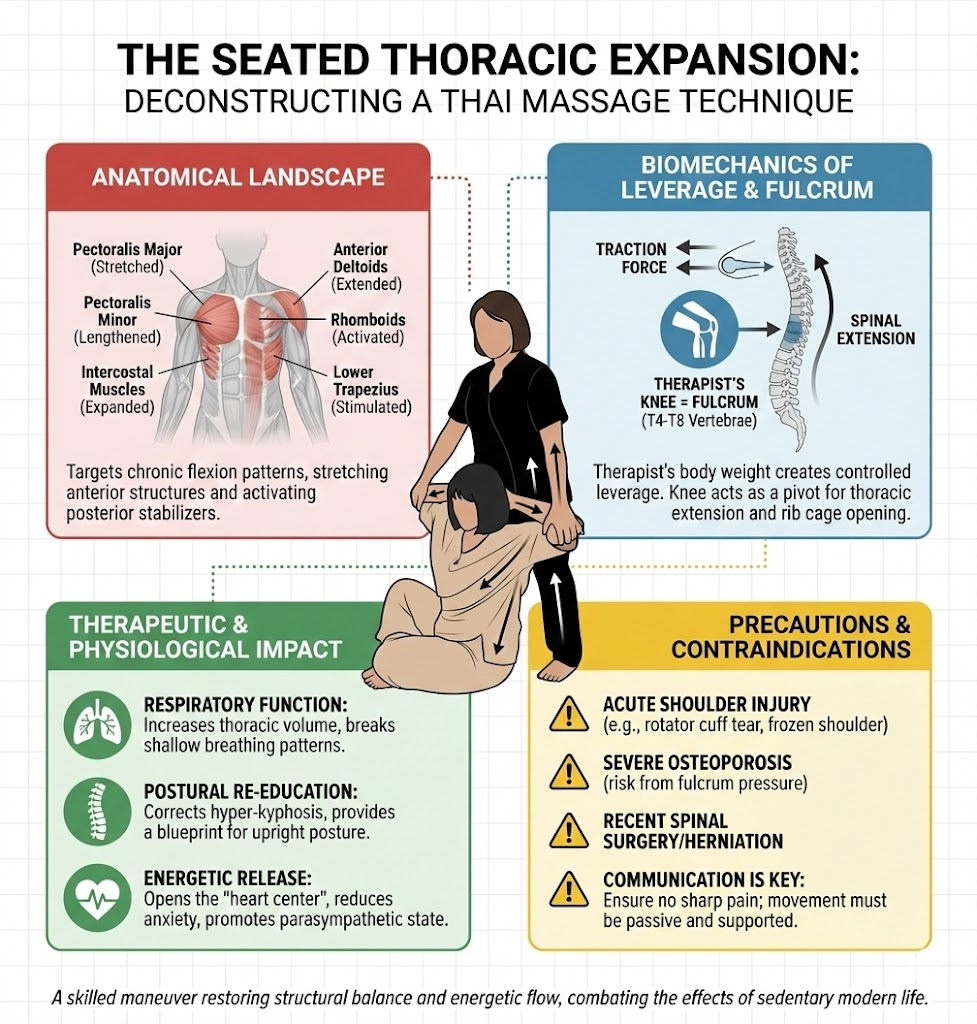
To understand the profundity of this maneuver, one must first appreciate the anatomical landscape it targets. Modern life, characterized by prolonged sitting, desk work, and smartphone usage, encourages a chronic flexion pattern. The head migrates forward, the shoulders roll inward (protraction), and the thoracic spine deepens its natural outward curve into hyper-kyphosis. This posture acts as a physical cage, locking down the anterior structures of the torso.
The Seated Thoracic Expansion directly confronts this anterior dominance. The primary muscular targets are the pectoralis major and, perhaps more crucially, the pectoralis minor. The pectoralis major, the large fan-shaped muscle of the chest, tends to shorten structurally with chronic slouching. Beneath it lies the pectoralis minor, a smaller triangular muscle that attaches to the upper ribs and the coracoid process of the scapula. A tight pec minor acts like a persistent anchor, pulling the shoulder blade forward and down, locking the shoulder girdle into a rounded position.
Simultaneously, the anterior deltoids at the front of the shoulder joint and the intricate web of intercostal muscles between the ribs become shortened and stiff. Deep to the musculature, the anterior fascial line—the connective tissue sheath running up the front of the body—becomes densified, further cementing poor posture. This technique seeks to remodel this entire anterior landscape by taking these tissues to their passive end-range of tension, encouraging lengthening and hydration of the fascial matrix.
Biomechanics of Leverage and Fulcrum
The efficacy of Thai massage lies in the efficient use of the therapist’s body mechanics to generate force without strain. In this seated expansion, the therapist does not rely on brute arm strength. Instead, they establish a stable base and utilize their own body weight as the primary engine of movement.
The critical element that transforms this from a simple arm-pull into a spinal mobilization is the fulcrum. The therapist places a knee or the broad surface of their anterior thigh against the recipient's thoracic spine, generally between the shoulder blades (T4-T8 vertebrae). This point of contact serves as a pivot. When the therapist firmly grips the recipient's distal humerus (just above the elbow) and leans back, the force is transmitted through the recipient's arms to their scapulae.
The leverage forces the scapulae to retract (move toward the spine) and depress down the back. Because the therapist’s knee is stabilizing the spine anteriorly, the backward pull on the shoulders forces the thoracic vertebrae to move into extension. This action essentially "cracks open" the anterior rib cage. It is a controlled, passive forcing of the body into the exact opposite configuration of the "fetal slump" we adopt during stress or fatigue. The placement of the recipient’s hands behind the neck is also strategically important, as it supports the heavy weight of the head and prevents cervical strain during the backward lean, ensuring the movement is isolated to the thoracic spine and shoulder girdle.
Therapeutic and Physiological Implications
The benefits of this maneuver extend far beyond merely feeling "stretched out." The most immediate physiological impact is on the respiratory system. The thoracic cage is designed to expand three-dimensionally during inhalation. However, chronic tension in the intercostals and pecs creates a rigid corset that restricts rib excursion. By forcibly lifting and expanding the anterior rib cage, this technique temporarily increases thoracic volume. It stretches the accessory muscles of respiration, signalling to the nervous system that a deeper breath is possible. Recipients often spontaneously take an enormous, liberating inhalation at the peak of this movement, flooding the body with oxygen and breaking shallow breathing patterns.
Furthermore, this technique serves as powerful neuromuscular re-education for posture. The strong retraction of the shoulder blades activates and stimulates the oft-dormant rhomboids and lower trapezius muscles in the back, which are responsible for maintaining an upright stance. The stretch provides a sensory blueprint to the brain of what "good posture" feels like.
On an energetic and emotional level, which is intrinsic to the Thai medical tradition, this area corresponds to the heart center. Many individuals somatically store anxiety, grief, and self-protection in a collapsed chest. By physically opening this region in a safe, supported environment, the technique can sometimes facilitate an emotional release, or simply a profound sense of lightness and vulnerability that is deeply therapeutic. It transitions the body from a sympathetic, protective, forward-curled state toward a parasympathetic state of openness and receptivity.
Medical Considerations and Precautions

While highly beneficial, the immense leverage inherent in this technique demands a skilled practitioner and careful client assessment. It is not a universal remedy. The primary medical contraindication involves pathology of the glenohumeral joint (the shoulder ball-and-socket). Clients with a history of shoulder dislocation, acute rotator cuff tears, or adhesive capsulitis (frozen shoulder) should not be subjected to this end-range forced extension, as the torque on the joint capsule is significant.
Furthermore, the health of the spine is paramount. While thoracic mobilization is generally good, practitioners must exercise extreme caution with clients who have known severe osteoporosis, as the pressure from the fulcrum knee against fragile vertebrae carries risk. Similarly, those with recent spinal fusions or acute disc herniations in the thoracic region are not suitable candidates for this specific maneuver.
The dialogue between therapist and recipient is crucial. The movement must be slow, progressive, and totally free of sharp pain. The recipient must be able to completely surrender the weight of their arms and head to the therapist; any guarding or tensing against the movement negates its benefits and increases injury risk.
Conclusion
The seated thoracic expansion is a microcosm of Thai massage philosophy: using disciplined mechanics and assisted stretching to restore the body's natural alignment and energetic flow. It is a corrective antidote to the gravitational pull of modern life, offering a moment of supported expansion that allows the recipient to breathe more fully, stand taller, and inhabit their body with a renewed sense of spaciousness. It is a powerful closing statement to a massage session, leaving the recipient open to the world both physically and energetically.
UPDATED LOFT THAI GUIDE
Additional guidance and current information
The following editorial update expands on the original Loft Thai article with practical context, current treatment guidance and further reading.
What the Position Is
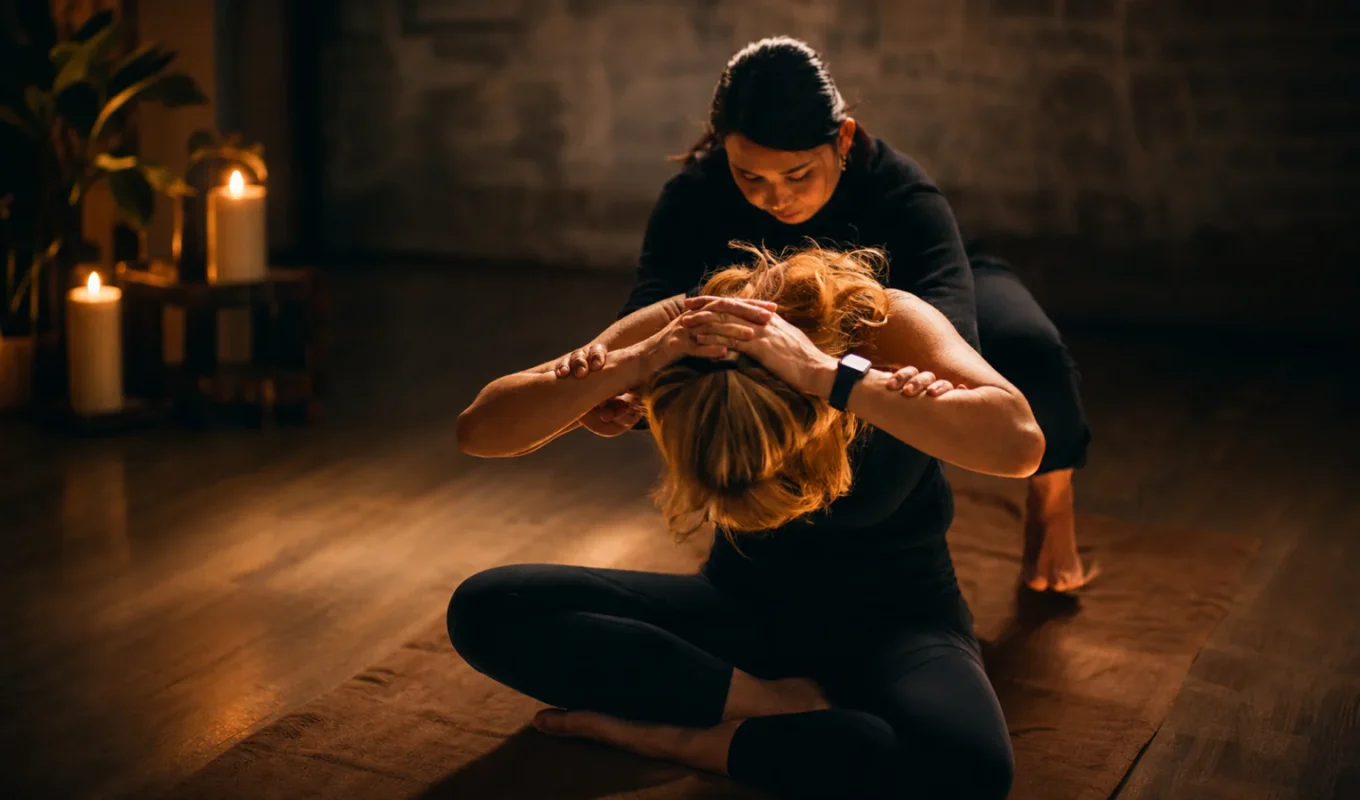
The guest sits while the hands rest behind or near the head and the elbows remain bent. The therapist supports the upper arms from behind and invites a small backward movement through the upper torso.
Some schools call related variations a seated cobra, butterfly arch or Dat Lang. These labels are not universal. The practitioner should describe the actual setup rather than assume the name tells the guest what will happen.
This article focuses on the guest-facing claims and limits of the movement. A separate Dat Lang training guide addresses teaching setup, hand placement and progression in more detail.
Upper-Back Movement Versus Lower-Back Compensation
The intended direction is usually extension through the upper or middle back, accompanied by movement at the shoulders and shoulder blades. If upper-back range is limited, the body may compensate by arching the lower back or tilting the head.
A larger visible arch does not prove that the thoracic spine moved more effectively. The therapist should reduce range when the guest feels compression in the lower back, pinching in the shoulders or strain in the neck.
Broad support can guide the region, but a knee or hard contact point should not be driven into vertebrae. The practitioner needs a surface and stance that allow pressure to be removed immediately.
- Target direction: small upper-torso extension
- Common compensation: excessive lower-back arch
- Range limiters: shoulder, neck and upper-back comfort
- Quality marker: easy breath and a controlled return
What the Movement Does Not Prove About Breathing
A guest may take a deeper breath during or after the stretch because the position feels different. That observation does not establish increased lung volume, improved oxygen delivery or correction of a breathing disorder.
The rib cage moves during breathing, but a brief external stretch cannot be assumed to remodel intercostal tissue or restore diaphragmatic function. People with respiratory symptoms need appropriate clinical evaluation rather than stronger chest-opening massage.
Therapists can use normal breathing as a pacing tool: if the guest holds breath, the range or pressure may be too much.
A Temporary Stretch Is Not Posture Correction
Posture changes from one activity to another and is influenced by comfort, habit, fatigue, vision, work setup and individual structure. Describing every desk worker as structurally collapsed oversimplifies the problem.
The seated expansion may offer a temporary contrast to forward-focused tasks. It does not permanently reverse kyphosis, activate dormant muscles or teach the brain a corrected alignment after one repetition.
If the goal is lasting change in movement or function, an appropriate exercise or rehabilitation plan may be more relevant than progressively forceful passive stretching.
Be Careful With Emotional-Release Language
Some wellness narratives describe the chest as a place where grief, anxiety or self-protection is stored. A person can experience emotion during touch, but the therapist cannot infer a psychological history from posture or muscle tension.
Never tell a guest that tears, laughter or discomfort prove a blocked emotion has been released. Offer privacy, slow the session and ask what the person needs without interpretation.
Trauma-informed care gives the guest control over position, touch and stopping. It does not use a vulnerable chest-opening shape to manufacture an emotional event.
Consent Before Leverage
Ask whether the guest is comfortable placing hands behind the head and having the elbows supported. That arm position alone may be unsuitable for shoulder pain, limited range or personal preference.
Begin with the guest moving actively into the shape. Add a small amount of assistance only when the setup is comfortable. Pause before increasing range and release slowly.
Consent continues throughout. A guest can decline the technique after trying the setup, and the therapist should have an alternative ready.
-
01
Describe
Explain the seated position, bent elbows and intended small upper-back movement.
-
02
Check active range
Let the guest place the arms and gently extend without external force.
-
03
Support broadly
Use a stable padded contact and avoid sharp pressure on bone.
-
04
Move a little
Invite a small range while asking about shoulders, neck and lower back.
-
05
Return slowly
Lower the arms and allow time for balance before the guest stands.
When to Avoid or Seek Guidance
Recent shoulder or spine surgery, fracture, dislocation, significant osteoporosis, acute injury, marked instability and neurological symptoms can make the technique inappropriate. Pain in the setup position is enough reason to stop.
A history of dizziness or difficulty sitting unsupported also changes the plan. Use side-lying or supine alternatives that demand less balance and shoulder range.
A spa therapist should not assess disc disease, adhesive capsulitis or spinal fusion safety. Relevant conditions require guidance from the clinician managing them.
Alternatives to the Full Seated Arch
A small scapular movement with the arms resting by the sides can create an upper-body transition without overhead or behind-head positioning. Side-lying shoulder work can also be adapted one side at a time.
A rolled towel along the upper back in a supported lying position may feel more stable for some guests, but it should remain comfortable and never force the neck.
The therapist can also omit extension entirely and finish with broad shoulder contact or quiet seated breathing. No single pose defines an authentic Thai massage.
Tradition Is Stronger With Honest Claims
UNESCO recognises Nuad Thai as a living cultural practice with formal knowledge transmission. That recognition supports respectful teaching; it does not validate every modern anatomical or emotional explanation attached to a pose.
Traditional sen or element frameworks may be shared as cultural context when they are identified clearly. They should not be presented as measured spinal, respiratory or psychological mechanisms.
A guest can appreciate the movement as part of Thai bodywork while understanding its limits. Accuracy makes the experience more credible, not less meaningful.
“A feeling of openness can be valuable without being turned into a diagnosis or permanent correction.”
Loft Thai Editorial Team
Continue your research
REFERENCES
Sources & further reading
PRACTICAL GUIDANCE
Frequently Asked Questions
Does seated thoracic expansion improve lung capacity?
A guest may take a deeper breath, but one assisted stretch does not establish improved lung capacity or treatment of a breathing condition.
Can the technique correct rounded posture?
It may create temporary upper-body opening, but it should not be marketed as permanent posture correction.
Where should I feel the movement?
A broad stretch may be felt across the chest, shoulders or upper back. Pinching, sharp pain, tingling, neck strain or lower-back compression means the range should be reduced or stopped.
Is emotional release a required part of the technique?
No. Therapists should not interpret posture or emotion. If feelings arise, the guest controls whether to pause, continue or stop.
Can seated thoracic expansion be omitted?
Yes. Thai massage offers many alternatives, and the technique is never required when shoulder range, balance, history or preference makes it unsuitable.
CONTINUE READING
Related stories
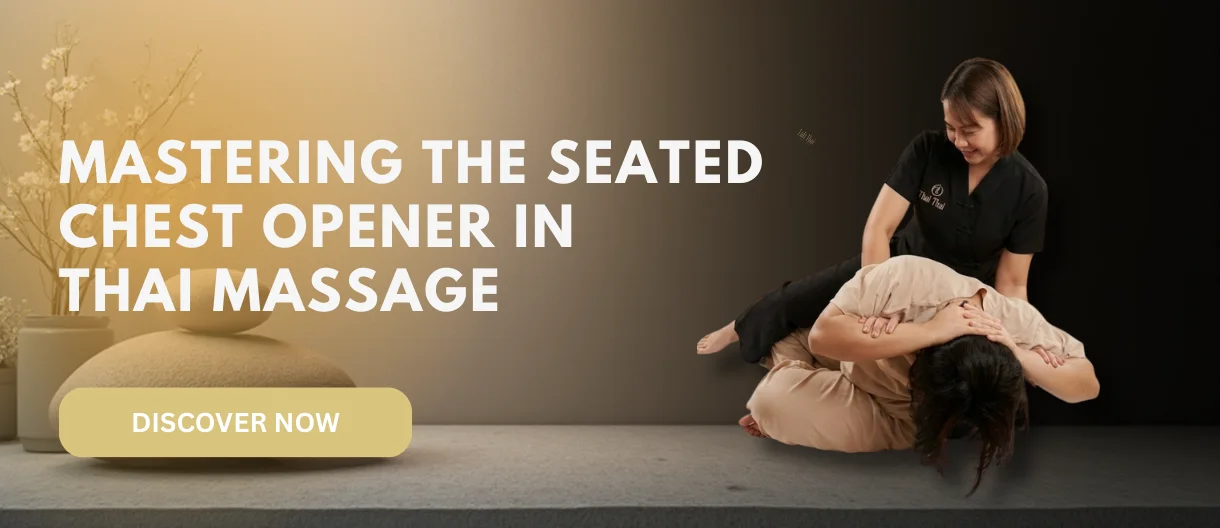
The Art of Dat Lang: Mastering the Seated Chest Opener in Traditional Thai Massage
In the intricate choreography of Traditional Thai Massage —often described as "lazy man's yoga"—there is a rhythm to the session. It begins at the feet, working through the energy lines (Sen lines) of the legs, moving up the back, and often culminates in a…
Read the guide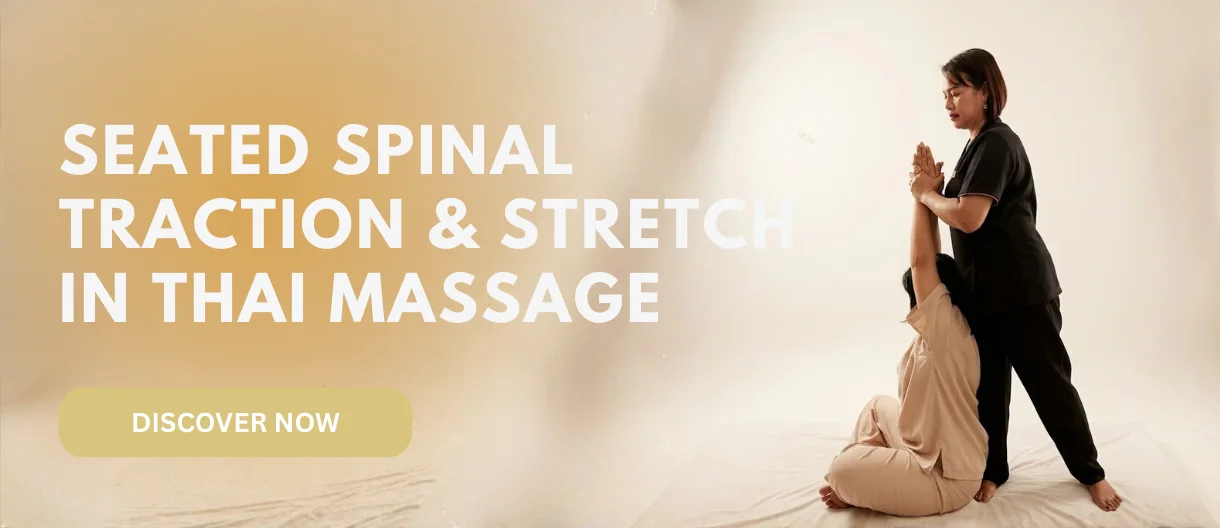
The Final Awakening: Deconstructing the Seated Spinal Stretch in Traditional Thai Massage
Traditional Thai Massage , or Nuad Thai, is often described poetically as "lazy man’s yoga." It is a complex, holistic therapy that blends rhythmic acupressure, assisted stretching, and deep compression to harmonize the body’s physical structure and energy…
Read the guide
How Education and Heritage Power the World of Loft Thai Spa
In the competitive landscape of luxury wellness, where every establishment promises tranquility and rejuvenation, true distinction is rarely a matter of chance. It is easy to construct a beautiful room, to light scented candles, and to play soft music that…
Read the guide
Tok Sen Massage for Deep Tension: Why Vibration Can Reach Where Hands Cannot
Deep muscle tension is often misunderstood. Many people imagine that a tight shoulder, a stiff lower back, or a heavy neck can only be solved by stronger pressure, deeper elbows, or longer massage sessions. While deep pressure can be useful when applied…
Read the guide