
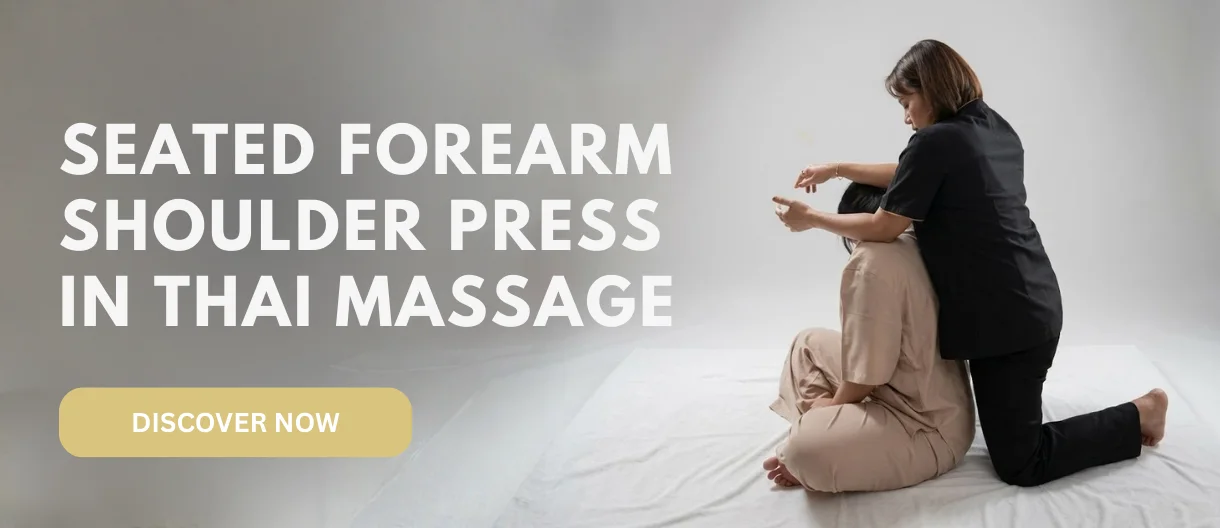
In the landscape of modern living, the human body bears the brunt of our technological conveniences. We are a culture of sitters, hunched over keyboards and peering down at smartphones. This pervasive posture manifests physically, most notably in the shoulder girdle and neck. The shoulders migrate upward toward the ears in a perpetual state of semi-shrug, a physical manifestation of stress and ergonomic failure. Traditional Thai Massage, an ancient modality with roots in Ayurvedic and Chinese medicine, offers a profound antidote to this contemporary affliction.
Among the vast repertoire of Thai massage techniques—which includes rhythmic acupressure, assisted stretching, and joint mobilization—the Seated Forearm Shoulder Press stands out for its deceptive simplicity and immense effectiveness. Often performed toward the end of a two-hour session, this technique is a grounding finale that addresses the epicenter of tension for most clients. It is a maneuver where structural anatomy meets energetic healing, utilizing the broad tool of the therapist’s forearm to sink deep into the hypertonic muscles of the upper back.
To fully appreciate this technique, one must move beyond seeing it as merely “squeezing the shoulders” and understand the intricate anatomical landscape, the physiological mechanisms of release, and its purposeful integration into the Thai healing system.
The Thai Massage Context: The Art of Sinking
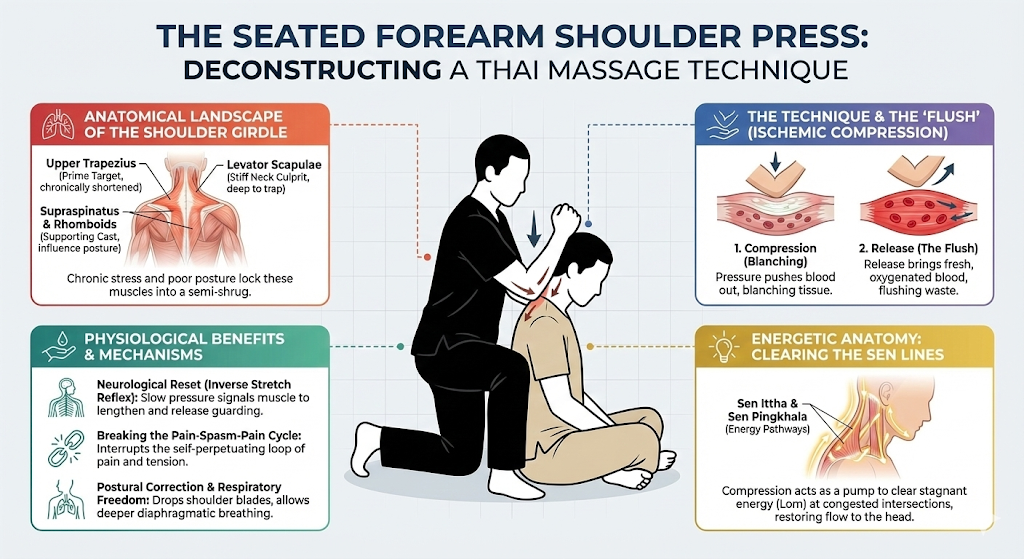
To understand the Seated Forearm Shoulder Press, one must first understand the fundamental principles of Thai Massage. Unlike Western modalities that often rely on muscular effort from the therapist to push into tissue, Thai massage is a dance of leverage and weight transfer. The therapist uses their body weight—leaning, sinking, and rocking—to generate pressure.
This technique is traditionally performed with the client seated cross-legged on a mat on the floor, while the therapist kneels behind them. The upright position is crucial; after a long session lying prone, supine, and side-lying, bringing the client to a seated position begins the process of re-orienting them to gravity and gently waking the body.
The choice of tool—the forearm, specifically the ulnar border near the elbow—is intentional. While thumbs are ideal for precision work on specific acupoints, they can be too sharp or invasive for highly inflamed shoulder muscles. The forearm offers a broad, diffused surface area, allowing deep pressure without triggering sharp pain or protective muscle guarding. The sensation is deep, melting, and encompassing rather than piercing.
The therapist’s free hand gently supports the client’s forehead or the side of the head. This support allows the client to fully surrender the weight of the head, deactivating the neck muscles and enabling the shoulder tissues to soften and receive the pressure more effectively.
Anatomical Deconstruction of the Shoulder Girdle
The Seated Forearm Shoulder Press targets a complex intersection of musculature responsible for stabilizing the head, neck, and scapulae.
The Prime Target: Upper Trapezius
The primary focus of this technique is the upper trapezius, a large diamond-shaped muscle spanning the upper back and neck. The upper fibers originate at the base of the skull and cervical vertebrae and insert onto the outer third of the clavicle. Their main function is scapular elevation. Under chronic stress and poor ergonomic conditions, this muscle becomes shortened, dense, and fibrotic, often described by clients as “rock-hard” shoulders.
The Stiff Neck Culprit: Levator Scapulae
Deep to the trapezius lies the levator scapulae, a muscle connecting the upper cervical vertebrae to the inner upper corner of the shoulder blade. Tightness here commonly causes restricted neck rotation and persistent stiffness. The broad forearm pressure penetrates through the trapezius to influence this deeper structure.
The Supporting Cast: Supraspinatus and Rhomboids
The compression also affects the supraspinatus, part of the rotator cuff, and the upper fibers of the rhomboids located between the shoulder blades. These muscles are essential for postural integrity and shoulder mechanics, yet they suffer significantly from forward-head and rounded-shoulder postures.
This technique also addresses the fascia, the connective tissue network surrounding these muscles. Chronic tension dehydrates fascia and causes layers to adhere together. Slow, sustained forearm pressure rehydrates the tissue and restores healthy glide between muscle layers.
Energetic Anatomy: Clearing the Sen Lines
Traditional Thai Massage views the body through a network of energy pathways known as Sen lines. The neck and shoulders are a major junction for several important lines, including Sen Ittha and Sen Pingkhala, which run alongside the spine and ascend into the head.
According to Thai medical theory, pain and stiffness arise from blocked energy, or Lom. The rhythmic compression of the forearm press acts as a pump, clearing stagnation and restoring energetic flow toward the head and arms. This explains why clients often experience mental clarity, improved vision, and a sense of lightness following this work.
Physiological and Therapeutic Benefits
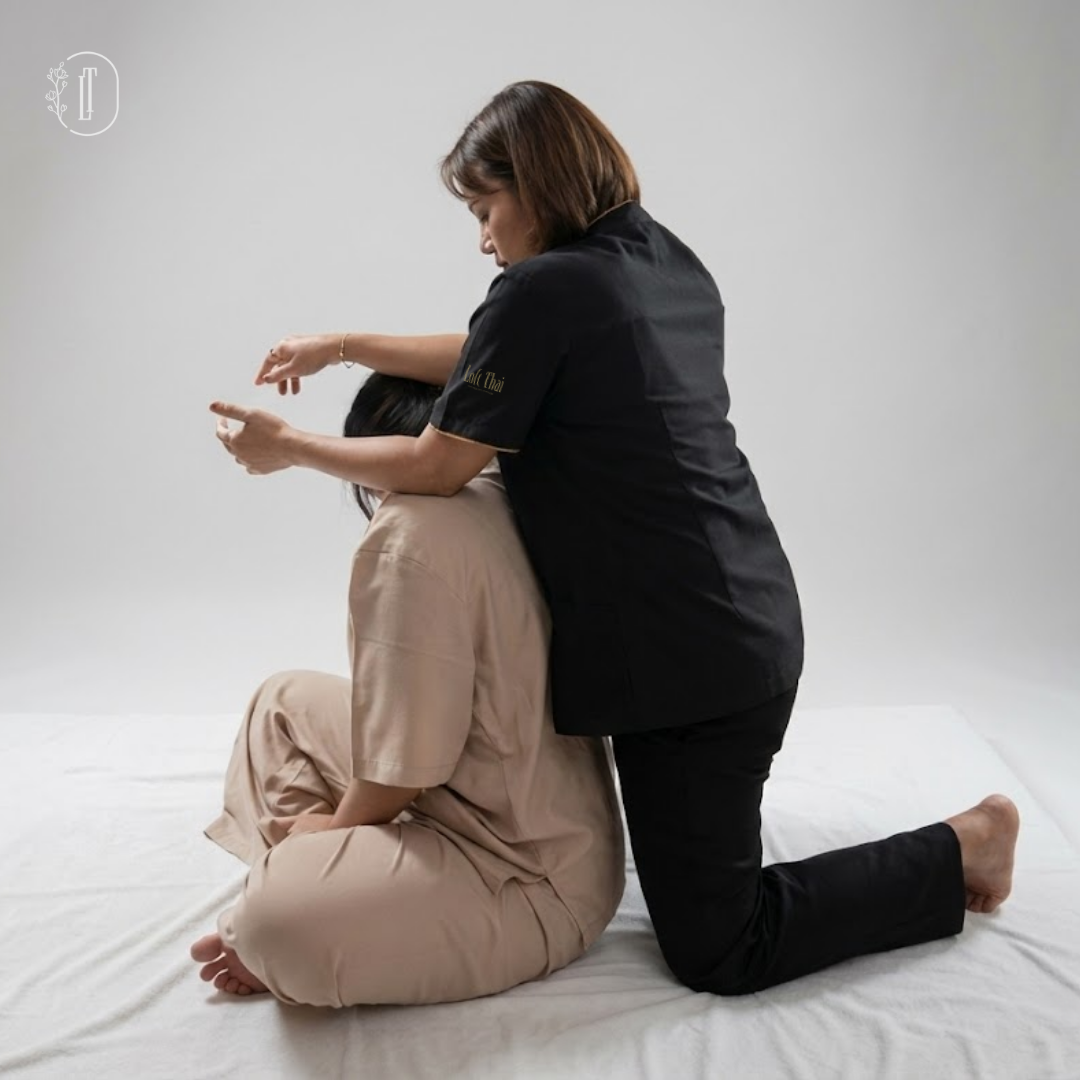
- Ischemic Compression and Circulatory Flush – Sustained forearm pressure temporarily restricts blood flow to hypertonic tissue. Upon release, fresh oxygenated blood floods the area, flushing out metabolic waste such as lactic acid and supporting tissue recovery.
- Neurological Reset via the Inverse Stretch Reflex – Slow, heavy pressure overwhelms tension receptors in chronically tight muscles. The nervous system responds by triggering relaxation and muscle lengthening, allowing true release rather than superficial softening.
- Interrupting the Pain–Spasm–Pain Cycle – By manually inducing relaxation and introducing varied sensory input, this technique breaks the self-perpetuating loop where pain causes tension and tension reinforces pain.
- Postural Correction and Improved Breathing – As the shoulders release downward and backward, posture improves and the accessory breathing muscles relax. This allows deeper, diaphragmatic breathing, reinforcing the relaxation response.
Conclusion
The Seated Forearm Shoulder Press is a microcosm of the brilliance of Traditional Thai Massage. It is intuitive yet anatomically precise, physically powerful yet energetically refined. It addresses modern muscular tension while honoring the body’s subtle energetic systems.
For many recipients, this technique marks the moment when the weight of daily stress is not only felt, but consciously released. In the skilled hands of a Thai therapist, even the simplest-looking movement becomes a sophisticated therapeutic intervention designed to restore balance, ease, and clarity to the human form.
UPDATED LOFT THAI GUIDE
Additional guidance and current information
The following editorial update expands on the original Loft Thai article with practical context, current treatment guidance and further reading.
What the Seated Forearm Shoulder Press Is
The guest sits upright while the therapist works from behind. A forearm or the broad area near the elbow rests across the muscular upper shoulder, and the therapist transfers weight gradually rather than pushing with arm strength.
A free hand may support the forehead, side of the head or opposite shoulder, depending on the variation. That support should reduce effort and keep the neck neutral; it should never push the head into a forced angle.
The technique may appear late in a Thai massage sequence because sitting helps the guest transition after time on the mat. It is not required, and it should not be used as a dramatic final test of pressure.
Why Use a Forearm Instead of a Thumb?
The forearm spreads contact over a larger surface than a thumb. That can make pressure feel less sharp and reduce strain on the therapist’s small joints. It also creates a slower, heavier sensation that some guests prefer across the upper trapezius region.
Broad does not mean imprecise. The therapist still needs to remain on soft tissue and away from the neck vertebrae, collarbone, top of the shoulder joint and other bony landmarks. More body weight increases risk when placement is wrong.
The old article described the forearm as automatically reaching deep structures and rehydrating fascia. Touch cannot confirm a specific muscle or restore tissue hydration in the way that claim implied. The useful description is simpler: broad external pressure is applied to a selected muscular area.
- Broader contact than a thumb or knuckle
- Gradual weight transfer instead of muscular pushing
- Placement on soft tissue, not bone or the side of the neck
- Pressure adapted to the guest rather than a fixed depth
Setup: A Stable Seat and a Quiet Neck
The guest should be able to sit without strain. Cross-legged is only one option; legs can be supported, extended or positioned differently. A cushion can help when the hips or lower back make floor sitting uncomfortable.
Before pressure begins, the therapist explains where the forearm will contact and asks whether head support is welcome. Some guests dislike touch near the face or prefer to keep the head upright.
The therapist’s own kneeling or standing base must be stable enough to increase and release pressure smoothly. If balance depends on leaning against the guest, the setup is not ready.
-
01
Position
Find a seated posture the guest can maintain without hip, knee or lower-back strain.
-
02
Explain
Name the shoulder area and agree on whether the therapist will support the head.
-
03
Contact
Place a broad forearm surface on soft tissue and begin with almost no weight.
-
04
Sink
Transfer weight gradually while the guest breathes normally and reports comfort.
-
05
Release
Remove pressure slowly before changing location or side.

What It Should—and Should Not—Feel Like
A well-placed press usually feels broad and local. The guest may notice pressure spreading across the top or back of the shoulder without a sharp point. Normal breathing and a relaxed hand are useful comfort signals.
The technique should stop for sharp pain, electric sensation, tingling into the arm, numbness, headache, dizziness, nausea or pressure that feels as if it is on bone. Pain travelling below the elbow deserves particular attention rather than more force.
A guest can ask for lighter contact before the press becomes uncomfortable. The therapist should not equate silence, closed eyes or deep breathing with consent to increase pressure.
Pressure Without Circulation Myths
The original article described a deliberate restriction of blood followed by a flush that removes lactic acid and metabolic waste. This is not an appropriate explanation for routine shoulder work. A therapist should not aim to occlude circulation.
It also claimed a neurological reset, automatic postural correction and deeper breathing. Massage research does not justify attributing those outcomes to one press. A guest may experience temporary comfort or relaxation without those effects being measurable or permanent.
Conservative language protects both tradition and the client. The therapist is providing external pressure within a wellness session, not performing vascular treatment or correcting a clinical syndrome.
Head and Neck Support Requires Separate Consent
Supporting the head can help some guests relax, but it adds another sensitive contact area. Ask before touching the forehead, face, jaw or scalp. Makeup, hair styling, head coverings and personal boundaries may affect the choice.
The neck should remain comfortable rather than being pulled sideways to expose more shoulder. If support creates strain, keep the head neutral or work with the guest lying down.
The therapist should not hold the head so firmly that the guest feels trapped. The person receiving the treatment must be able to change position or ask to stop immediately.
When to Modify or Avoid Seated Pressure
Disclose recent neck or shoulder injury, surgery, fracture, dislocation, severe osteoporosis, unexplained arm symptoms or pain that worsens with pressure. A lighter or different position may be needed, and clinical guidance may be more appropriate.
Avoid direct pressure over a new bruise, inflamed skin, open wound, swelling, prominent painful vein or a recent injection site. Dizziness or difficulty sitting unsupported is another reason to stay side-lying or supine.
Massage should not be used to diagnose a rotator-cuff tear, nerve problem or cervical condition. Concerning symptoms require assessment by an appropriate health professional.
Alternatives to the Forearm Press
Broad palm contact can offer a gentler seated option. In side-lying, the shoulder can be supported against the mat while the therapist works with less demand on posture. In prone position, a pillow can reduce neck rotation.
Some guests prefer an oil-based shoulder massage with gliding contact, while others enjoy clothed acupressure. The service label matters less than choosing a position and pressure that the guest can comfortably receive.
A complete Thai massage can finish with quiet head support, gentle shoulder contact or no seated work at all.
Traditional Context and a Professional Finish
UNESCO describes Nuad Thai as a living traditional practice using a range of body tools and transmitted knowledge. The seated shoulder press fits within that broader culture of leverage and rhythmic contact, but technique names and sequences vary.
Traditional sen-line explanations may be discussed as cultural frameworks. They should not be converted into claims of improved vision, emotional cleansing or treatment of blocked circulation.
After the press, the therapist should help the guest orient before standing and ask whether any symptoms remain. The strongest finish is informed, stable and unhurried.

“Broad pressure becomes skilled touch only when placement, pace and feedback remain precise.”
Loft Thai Editorial Team
Continue your research
REFERENCES
Sources & further reading
PRACTICAL GUIDANCE
Frequently Asked Questions
Is forearm pressure always deeper than thumb pressure?
Not necessarily. A forearm distributes contact over a larger area. Depth depends on weight, placement, pace and the guest’s tissue and comfort.
Should the therapist push my head to the side?
No forced neck position is necessary. Head support should be separately explained, welcomed and easy to stop.
Can the shoulder press improve posture permanently?
A session may create temporary comfort, but one press should not be marketed as permanent posture correction.
What symptoms mean the press should stop?
Sharp pain, tingling, numbness, electric sensation, dizziness, headache or pain spreading down the arm are reasons to stop and reassess.
Is seated shoulder work required in Thai massage?
No. It can be modified, moved to another position or omitted without making the session incomplete.
CONTINUE READING
Related stories
The Final Awakening: Deconstructing the Seated Spinal Stretch in Traditional Thai Massage
Traditional Thai Massage , or Nuad Thai, is often described poetically as "lazy man’s yoga." It is a complex, holistic therapy that blends rhythmic acupressure, assisted stretching, and deep compression to harmonize the body’s physical structure and energy…
Read the guide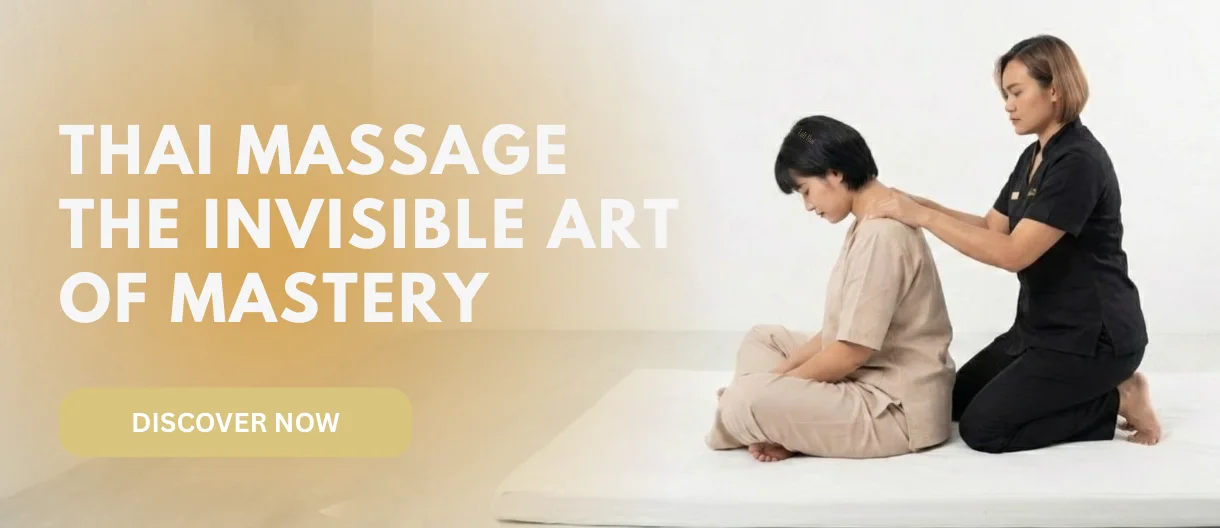
How Education and Heritage Power the World of Loft Thai Spa
In the competitive landscape of luxury wellness, where every establishment promises tranquility and rejuvenation, true distinction is rarely a matter of chance. It is easy to construct a beautiful room, to light scented candles, and to play soft music that…
Read the guide
Bangkok Spa Etiquette: Tipping, What to Wear, What to Say to Get the Pressure You Want in 2026
Booking a spa in Bangkok should feel exciting—not confusing. But if it’s your first time Thai massage or oil massage, it’s normal to wonder about the unspoken rules. Do you tip? How much? What do you wear? Do you keep underwear on? And how do you ask for the…
Read the guide
Tok Sen Massage for Deep Tension: Why Vibration Can Reach Where Hands Cannot
Deep muscle tension is often misunderstood. Many people imagine that a tight shoulder, a stiff lower back, or a heavy neck can only be solved by stronger pressure, deeper elbows, or longer massage sessions. While deep pressure can be useful when applied…
Read the guide